
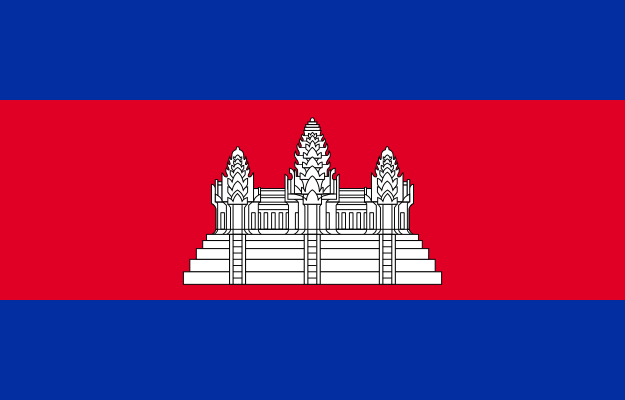
Cambodia is a country in mainland Southeast Asia, bordered by Thailand, Laos, Vietnam, and the Gulf of Thailand. It is best known internationally for the temple complex of Angkor, the violent upheaval of the Khmer Rouge era, and a contemporary visual culture that moves between Buddhist tradition, French colonial traces, and fast-changing urban life.
- Its capital is Phnom Penh, and its largest religious and architectural landmark is Angkor, near Siem Reap.
- Khmer culture shapes much of the country’s art, language, architecture, and craft.
- The twentieth century left deep scars, especially the genocide and forced labor regime under the Khmer Rouge from 1975 to 1979.
- Contemporary Cambodian image-making often balances memory, survival, tourism, and redevelopment.
- Stone carving, lacquerware, textiles, and Buddhist sculpture remain important material traditions.
What makes Cambodia visually distinctive?
Cambodia’s visual identity is strongly tied to the Khmer Empire, which ruled much of mainland Southeast Asia between the 9th and 15th centuries. The stone temples at Angkor, especially Angkor Wat and Bayon, combine monumental scale with intricate relief carving, sacred geometry, and a precise command of sandstone. These structures still shape how Cambodia is seen: as a place where architecture, religion, and state power were once fused into highly refined built form.
That older legacy sits beside everyday scenes of markets, river life, motorbikes, pagodas, and densely packed cities. In photography and design, Cambodia often appears through strong contrasts: ancient stone against tropical vegetation, ritual against commerce, and tourism against the lived reality of contemporary Khmer society. Those contrasts give the country a recognisable visual charge, but they can also flatten it if treated only as a backdrop for ruins.
How did modern Cambodia take shape?
Modern Cambodia was shaped by colonial rule, war, and the collapse of social structures in the late twentieth century. French colonial administration altered cities, institutions, and building styles, while the Vietnam War era and the Khmer Rouge period devastated the population and destroyed cultural institutions. Between 1975 and 1979, the Khmer Rouge attempted to remake society through forced labour, starvation, and mass violence, leaving a traumatic historical legacy that continues to inform Cambodian art and public memory.
Because of that history, many Cambodian artists and photographers work with absence as much as presence. Family archives, emptied landscapes, damaged buildings, and testimonial images often carry the emotional weight of the subject. In practical terms, this can mean careful portraiture, documentary work, or mixed-media pieces that combine photography, text, and found material to address what was lost and what remains.
What does Cambodian craft and architecture look like?
Traditional Cambodian craft includes silk weaving, silverwork, basketry, lacquer, and wood or stone carving. The materials are often local and tactile: sandstone for temples, silk and cotton for textiles, palm leaf for books and shelters, and lacquered wood for ceremonial objects. Buddhist monasteries and rural homes also show a strong material logic, with raised structures, shaded verandas, carved ornament, and practical responses to heat and seasonal flooding.
In design terms, Cambodian motifs frequently draw from Angkor-era iconography: apsaras, naga serpents, lotus forms, and vegetal arabesques. These appear in temple decoration, contemporary furniture, and decorative objects alike, sometimes as direct quotation and sometimes as loose reference. Olivier Dollé’s Angkor Table Collection, for instance, translates the angular, sculptural rhythms of temple architecture into furniture form, showing how Cambodia’s historical language can be reworked without becoming literal reproduction.
Why does Cambodia matter in contemporary visual culture?
Cambodia matters because it is not only a site of heritage but also a place where memory, tourism, development, and artistic repair meet. International image-makers have long been drawn to the country for its temples and scenic landscapes, but stronger work treats Cambodian people and histories as central rather than decorative. That shift matters in photography, street art, and editorial illustration, where the risk of exoticism is always present.
Contemporary Cambodian and Cambodia-focused artists often use the country’s visual inheritance in pointed ways. Seth Globepainter’s wall paintings, for example, bring large-scale figurative imagery into public space, linking local presence to global street art languages. Other artists, especially those working with archive material or documentary methods, revisit the Khmer Rouge period to challenge silence and to show how history survives in photographs, scars, and ordinary spaces.
Frequently Asked Questions
Is Cambodia defined mostly by Angkor?
No. Angkor is the country’s most famous visual landmark, but Cambodia also has a living urban culture, active craft traditions, and a contemporary art scene shaped by recent history. Treating the country only as an ancient temple landscape ignores the political, social, and material realities that define it now.
Why do so many art projects about Cambodia focus on memory?
Because the Khmer Rouge period caused such profound destruction, memory is not just a theme but a necessary subject. Artists often work with testimony, family photographs, and damaged landscapes because official records alone cannot carry the full weight of what happened. That makes Cambodian art frequently personal, archival, and ethically attentive.
What materials are most associated with Cambodian making?
Stone is central because of Angkor, especially sandstone carved into walls, towers, and reliefs. In everyday craft, silk, cotton, wood, lacquer, silver, and basket fibers are all important. These materials reflect both ritual use and practical life, which is why Cambodian making often moves between the sacred and the domestic.