
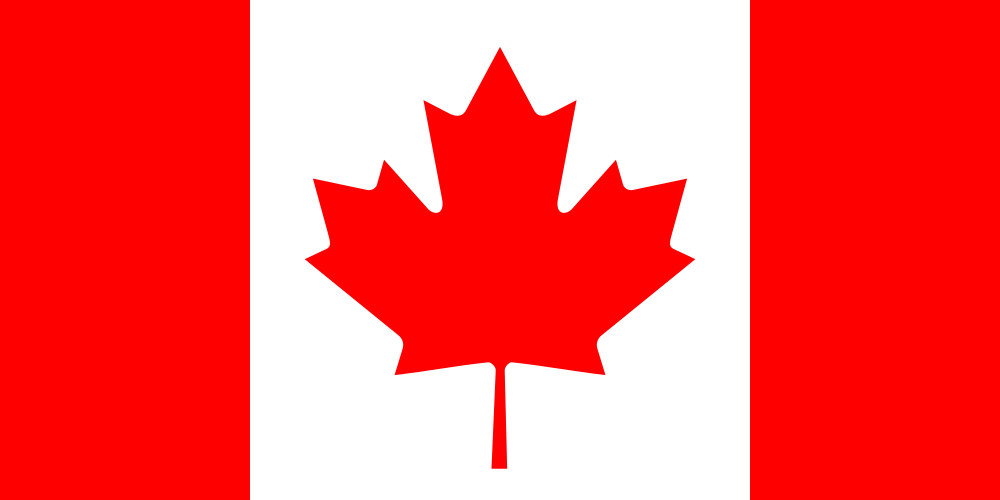
Canada is a country in North America, spanning ten provinces and three territories from the Atlantic Ocean to the Pacific and north into the Arctic. It is the world’s second-largest country by total area and shares the longest land border on Earth with the United States. Long before European colonisation, the land was home to many Indigenous nations, whose presence and systems of knowledge continue to shape the country.
| What it is | Sovereign state in North America |
|---|---|
| Capital | Ottawa |
| Largest city | Toronto |
| Official languages | English and French |
| Political structure | Federal parliamentary democracy and constitutional monarchy |
| Made of | 10 provinces and 3 territories |
What makes Canada distinct?
Canada is defined by scale. Its geography runs from temperate Pacific coasts through prairie plains and dense boreal forest to Arctic tundra and islands. That range shapes not only climate and settlement but also design, building, and material culture: cedar, spruce, stone, steel, concrete, wool, fur, and winter-ready synthetics all appear in the country’s visual and made environments.
The country is also defined by duality and plurality. English and French shape public life, especially in Québec and in federal institutions, while Indigenous languages and cultural traditions remain essential to the country’s identity. Canadian design history reflects this mix: British parliamentary order, French colonial urbanism, Indigenous making, immigrant craftsmanship, and modernist industrial production all sit side by side.
Where did Canada come from?
The modern state of Canada grew out of European colonisation, especially French and British settlement. French colonies developed along the St. Lawrence River in the 17th century, while British control expanded later through war, treaty, and settlement. Confederation in 1867 united four provinces into a self-governing dominion, and the country gradually gained full legislative autonomy over the 20th century.
That political history rests on older and ongoing Indigenous histories. First Nations, Inuit, and Métis peoples occupied, governed, traded across, and shaped these lands long before the arrival of Europeans, and their rights and sovereignty remain central and contested in the present. Any serious account of Canada has to include both the state and the Indigenous nations within and beyond it.
What does Canada look like in practice?
Canada appears in practice as a federal state with strong regional variation. Québec’s civil-law tradition and French-language culture differ sharply from the common-law provinces; Atlantic Canada has its own coastal economies and material traditions; the Prairie provinces are shaped by agriculture and extraction; and the North demands infrastructure built for extreme cold, remoteness, and seasonal light. This makes the country hard to reduce to one style or image.
In visual culture, Canada often shows up through landscape, weather, and infrastructure. Snowbound streets, timber frames, brick row houses, glass towers, rail lines, ports, and remote airports are part of the same national picture. In objects and products, Canadian identity is often carried less by ornament than by material choice, durability, and adaptation to climate.
Why does Canada matter in design and culture?
Canada matters because it sits at a crossroads of cultural influence and material practice. Its cities absorb American commercial culture, European institutions, and global migration, but local conditions still matter. Cold-weather construction, bilingual public signage, state-funded cultural institutions, and strong traditions of craft and photography all shape how things are made and seen.
It also matters as a place where national identity is constantly negotiated. Designers, architects, artists, and makers often work with questions of land, resource extraction, decolonisation, and regional belonging. That means Canadian work can look understated or pragmatic on the surface while carrying heavy political and historical weight underneath.
Frequently Asked Questions
Is Canada part of the United States?
No. Canada is an independent sovereign country, while the United States is a separate country to the south. The two share a long border and a close economic and cultural relationship, which sometimes leads to confusion.
Why is Canada often described as bilingual?
English and French are both official languages at the federal level. That reflects the country’s British and French colonial history and the continuing prominence of French-speaking communities, especially in Québec. Public life, signage, and institutions often reflect this bilingual structure.
What should be remembered first about Canada’s history?
The first thing to remember is that Canada is built on Indigenous homelands, not on empty land. The modern state emerged through colonisation, settlement, treaty-making, and displacement. Any accurate history has to hold Indigenous presence and sovereignty at the centre, not at the margins.
At a glance
- Address
- Canada
- Coordinates
- 45.4, -75.666664
Articles mentioning Canada


