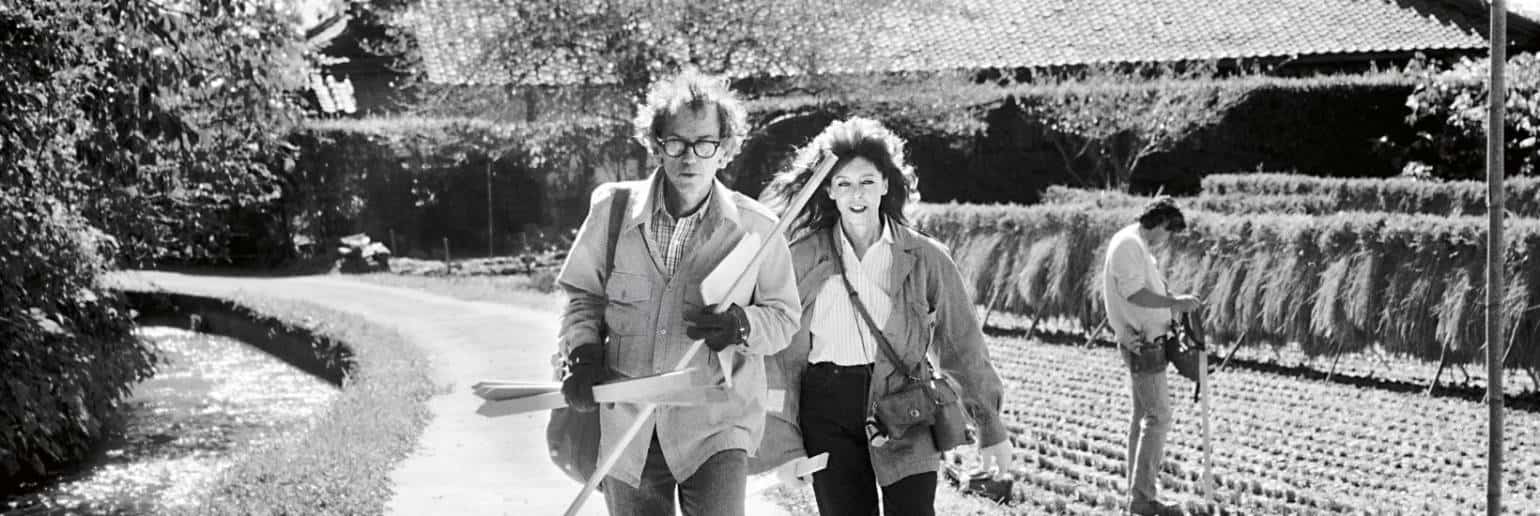
Christo and Jeanne-Claude were a husband-and-wife artist team known for large-scale environmental works that wrapped, fenced, floated, or temporarily altered buildings, bridges, landscapes, and coastlines. Their projects used industrial fabric, rope, steel frames, drums, and thousands of workers to turn familiar places into short-lived public events. Christo handled much of the drawing and planning; Jeanne-Claude drove the logistics, permissions, and public coordination that made the projects possible.
- They made temporary installations, not permanent monuments.
- The work depended on engineering, permits, and heavy material handling as much as on artistic concept.
- Wrapped architecture became their best-known strategy, but they also built curtains, barriers, paths, and floating forms.
- Each project was funded privately, usually through drawings, collages, and studies sold to collectors.
- The temporary nature was central: removal was part of the work, not an afterthought.
What did Christo and Jeanne-Claude actually make?
Their art often changed the surface of a place without hiding its form. A wrapped building still read as a building, but the fabric pressed its volume into view and erased ordinary detail. In other projects they stretched colored fabric across valleys, hung curtains between cliffs, or arranged thousands of barrels in fields and city spaces. The effect was rarely subtle; it relied on scale, repetition, and the sight of an ordinary site turned into something ceremonial.
Material choice mattered. They used woven polypropylene and other industrial fabrics, steel cables, scaffolding, flotation devices, and custom fasteners. These were not decorative materials in the usual sense. They were structural, weather-resistant, and designed for quick installation and complete removal.
Where did the work come from?
Christo was born in Bulgaria and left Eastern Europe in the 1950s, later settling in Paris and then the United States. Jeanne-Claude was born in Morocco and raised in France. They met in Paris in 1958 and soon began working together, though Christo often received public credit alone in the early years. Over time, they insisted on joint authorship and on the inseparability of their roles.
Their practice emerged from postwar avant-garde art, but it also drew on civil engineering, event production, and urban planning. That mix helped define their style. The projects were not studio objects scaled up to monumental size; they were negotiated interventions that involved landowners, city authorities, insurers, riggers, climbers, and fabricators.
Why does their work matter?
Christo and Jeanne-Claude helped expand what counts as sculpture. Their work treated space, access, duration, and public permission as artistic materials. A wrapped bridge or encircled island was not only an image; it was a chain of decisions about labor, law, cost, and site-specific assembly. That made the work unusually transparent about its own making.
They also changed how temporary art can function in public. Because each project lasted only days or weeks, it generated urgency and crowds without becoming permanent infrastructure. The works existed as events, but they were documented exhaustively through drawings, photographs, plans, films, and models, which became part of the afterlife of the project.
How were the projects produced?
Production was slow and exacting. Christo and Jeanne-Claude typically spent years obtaining permits, engineering approvals, environmental reviews, and local consent. They financed the work themselves by selling preparatory drawings, collages, and maquettes, which kept sponsors from controlling the final result. Jeanne-Claude in particular became known for relentless administration and public advocacy, while Christo developed the visual proposals and material studies.
The installation phase was often highly choreographed. Fabric panels were sewn to precise dimensions, then hoisted, tensioned, and secured against wind and wear. Crews had to work around weather, shipping, terrain, and public safety. The final object was less a fixed sculpture than a temporary system under strain.
Frequently Asked Questions
Were Christo and Jeanne-Claude always credited together?
Not at first. Early publicity often centered Christo, but the pair later insisted that every work be credited to both names. They said the projects were conceived as a single practice, with no separation between artistic idea and practical realization.
Why did they make the works temporary?
Temporary duration was part of their artistic logic. A short life made the work feel public, urgent, and unrepeatable, while also avoiding the problem of a permanent object taking over a site. Removal mattered as much as installation because it returned the place to ordinary use.
How were these projects paid for?
They did not usually rely on corporate sponsorship or public commission money. Instead, they sold preliminary works such as drawings, collages, and editions to finance each project independently. That approach protected the scale and timing of the work, but it also meant years of preparation before a project could happen.
} जरूरत to json error? Let’s ensure valid JSON with escaped quotes and no extra tags.Hmm final contained broken closing tag. Need correct json only.♀♀♀♀ to final correct. એવો։ </analysis to=final ाठमाडौं{
Articles mentioning Christo and Jeanne-Claude