
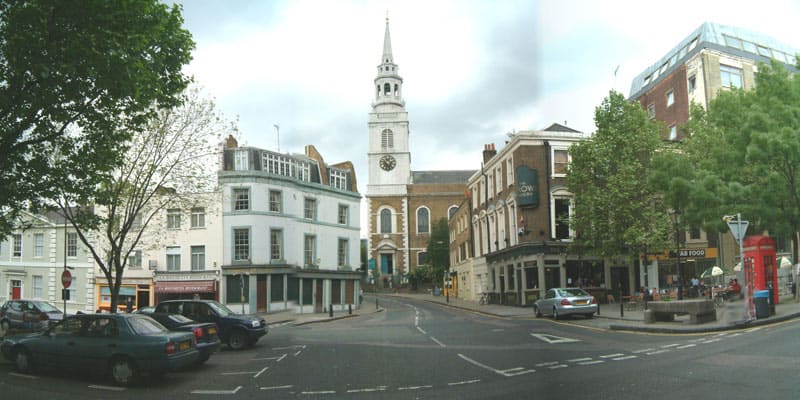
Clerkenwell is a district in central London, now within the London Borough of Islington, known for its long association with skilled trades, religious history, and design industries. It takes its name from a medieval well linked to a clerks’ religious community, and for centuries it developed as a dense working neighbourhood of workshops, foundries, printers, watchmakers, and makers’ yards. Today it is closely associated with design events, architecture practices, and adaptive reuse of industrial buildings.
- Clerkenwell sits in central London and is part of the London Borough of Islington.
- Its name comes from a clerks’ well, a medieval water source tied to nearby religious life.
- Watchmaking and watch repair were once major local trades.
- From the mid-19th century to the 1960s, it was known as London’s “Little Italy.”
- Its warehouses, churches, and workshops now support a strong design and creative sector.
Why Clerkenwell matters
Clerkenwell matters because it shows how a city district can be shaped by successive layers of making. The area has never been a single-purpose place: medieval religious institutions, craft production, immigrant communities, and modern design businesses all left visible traces. That continuity gives Clerkenwell a character that is both historic and practical, with old brick buildings, narrow streets, and repurposed industrial spaces still doing useful work.
Its reputation in design comes from this built fabric. Former warehouses and workshops now house studios, showrooms, galleries, and event spaces, especially around Clerkenwell Design Week. The district’s past as a place of precision trades, small-scale production, and independent businesses also fits the way many contemporary design firms work: close together, experimental, and rooted in physical materials.
Where did Clerkenwell get its name?
The name Clerkenwell comes from the “clerks’ well,” a medieval well associated with the clerks of St Mary’s Priory, a religious house that once stood in the area. The well was thought to have been rediscovered in 1924, a reminder that the district’s origins lie far beneath its later street life and commercial use. The name preserves a fragment of the area’s earliest identity, when water sources and church institutions shaped settlement patterns.
That medieval origin still matters because it explains why Clerkenwell became a focused urban place rather than a broad, open suburb. Religious houses drew workers, tenants, and services; later urban development crowded around that core. The area’s name therefore carries both a geographic clue and a record of how London grew through layered occupation.
What kinds of making have defined the area?
Clerkenwell became especially important for watchmaking and watch repair. Those trades depended on precision, small tools, and specialist knowledge, which suited the area’s dense network of workshops. In practice, that meant tiny parts handled by skilled makers, repairers, engravers, and finishers rather than large-scale factory production. The district’s economy long favoured close, hands-on labour.
Other making trades also clustered there over time, including printing and metalwork. The area’s buildings reflect this history: narrow frontages, yards, and converted workshops reveal how work was organised around limited space and shared access. Clerkenwell’s current design profile is partly a continuation of that pattern, even when the products are no longer watches but furniture, graphics, interiors, lighting, or architectural concepts.
How did Little Italy shape Clerkenwell?
From the 1850s until the 1960s, Clerkenwell was widely known as London’s “Little Italy.” Italian immigrants settled in the area in significant numbers, creating a community that shaped local shops, cafés, churches, and social life. This was not just a demographic label; it changed the everyday culture of the district and gave it a strong identity in the city.
The Italian presence also connects to the area’s making culture. Immigrant communities often found work in trades and small businesses, and Clerkenwell’s compact urban form supported that kind of economy. Although the “Little Italy” era has largely passed, traces remain in institutions, family names, and local memory, adding another layer to the district’s identity.
Why is Clerkenwell so important to design now?
Clerkenwell has become one of London’s key design districts because it combines location, architecture, and a concentration of creative businesses. Designers, architects, and manufacturers are drawn to the area’s restored industrial buildings, which provide characterful spaces for showrooms and offices. The district’s annual design events amplify that concentration and make the neighbourhood visible to a wider public.
What makes it distinctive is the fit between old and new uses. A former workshop can become a furniture showroom; a warehouse can host a material library or exhibition; a church building can serve as a temporary installation space. Clerkenwell’s history of specialised labour gives these conversions a local logic rather than a generic creative-brand feel.
Frequently Asked Questions
Is Clerkenwell a neighbourhood or an area of London?
Clerkenwell is generally described as an area or district in central London. Administratively, it lies within the London Borough of Islington. Its boundaries and identity have shifted over time, but the name remains in everyday use for the historic neighbourhood.
What was the “clerks’ well”?
The “clerks’ well” was the medieval well that gave Clerkenwell its name. It was associated with the clerks of St Mary’s Priory, a religious community in the area. The well was rediscovered in 1924, which helped reconnect the district with its medieval origins.
Why do design events happen in Clerkenwell?
Design events happen in Clerkenwell because the district already has the right physical and cultural infrastructure: converted workshops, showrooms, and a dense network of creative firms. Its history of skilled making also gives the area credibility in materials-led industries. That makes it a practical and symbolic base for exhibitions and trade events alike.
At a glance
- Address
- London Borough of Islington, United Kingdom
- Coordinates
- 51.526, -0.103475
Articles mentioning Clerkenwell


