
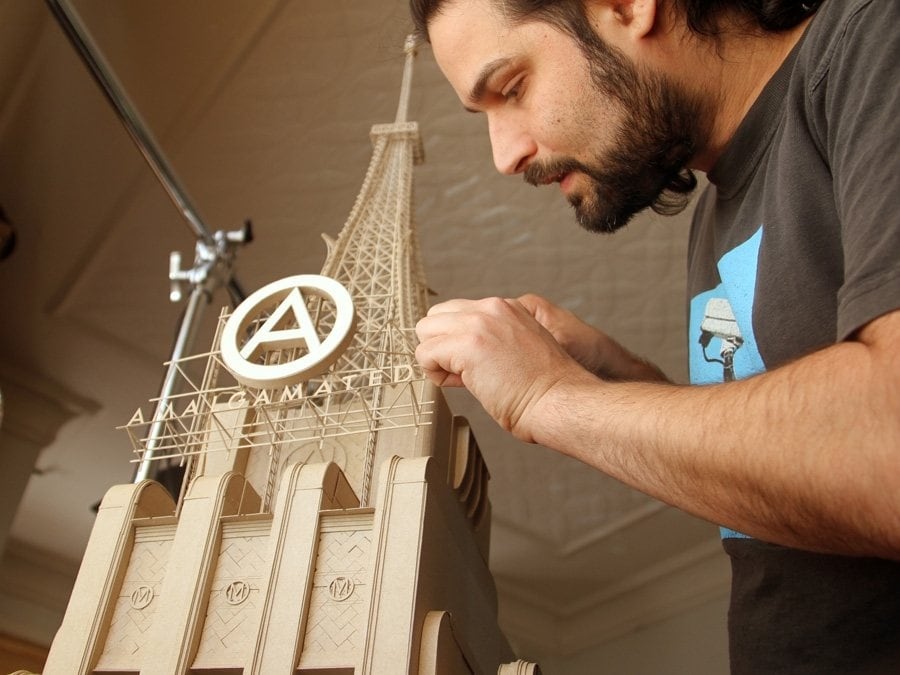
Daniel Agdag is an Australian sculptor and filmmaker known for building intricate imagined machines, vehicles, and buildings from cardboard. His work combines precise hand construction with a cinematic sense of scale, turning an everyday packing material into objects that feel engineered, theatrical, and slightly impossible.
| Field | Sculpture, stop-motion film |
|---|---|
| Known for | Complex cardboard constructions of machines, transport, and architecture |
| Material | Cardboard, paper, glue, and assembled found packaging |
| Style | Detailed, mechanical, whimsical, architectural |
| Significance | Shows how a humble material can support highly elaborate form and narrative |
What does Daniel Agdag make?
Agdag makes sculptural works that often look like prototypes, industrial models, or fantasy infrastructure. The forms can suggest cranes, trains, towers, engines, and obscure machines, but they are not usually functional objects. Their appeal lies in the tension between engineering logic and obvious fragility: the surfaces are cut, folded, layered, and braced so carefully that cardboard starts to read as a serious construction medium.
He also works in film, where those same qualities become animated through motion and framing. The camera can make a cardboard structure feel massive or miniature, and Agdag uses that ambiguity to build worlds that sit between model, set, and sculpture. His work depends on exactness of craft, but it also leaves room for dreamlike interpretation.
Why cardboard?
Cardboard gives Agdag a material with structural limits that are visible in the finished piece. Corrugation, seam lines, cut edges, tabs, and layers remain legible, so the viewer can often see how the object was built. That transparency matters: the material does not disguise labor, it records it.
Using cardboard also changes the meaning of the subject. A monumental building or machine made from packaging stock becomes a study in scale, value, and transformation. The material is cheap, common, and disposable, yet in Agdag’s hands it supports patient assembly and elaborate detail. That shift from waste material to engineered object is central to the work’s impact.
How is his work made?
Agdag’s practice depends on cutting, scoring, folding, laminating, and assembling cardboard with a near-architectural logic. Small parts are built into larger systems, so individual elements read like components of a machine or sections of a model railway. The work often depends on repetition: ribs, panels, vents, pipes, and brackets create rhythm and density.
The process is slow and exact. Because cardboard can warp or crush, the maker must anticipate how pieces will hold their shape over time. That attention to structure is one reason his work feels so convincing. It does not merely imitate machinery; it behaves as if it has been designed from the inside out.
Where does his work sit in contemporary art?
Agdag belongs to a line of artists and makers who treat commonplace materials as the basis for refined sculptural practice. His work is closely related to model-making, assemblage, paper engineering, and stop-motion production design, but it is not limited to any one category. It operates in the space between fine art, craft, and cinematic fabrication.
He matters because he expands what cardboard can do. Rather than serving as a temporary mock-up or a support material hidden beneath something else, cardboard becomes the finished surface and the main conceptual tool. In that sense, his work is not only about images of machines; it is about making, structure, and the dignity of an overlooked material.
Frequently Asked Questions
Is Daniel Agdag mainly a sculptor or a filmmaker?
He is both, and the two practices support each other. The sculptures carry a strong sense of narrative and scene-setting, while the films extend that world through movement and editing. Each medium helps the other explain scale, atmosphere, and construction.
What makes his cardboard sculptures different from simple craft projects?
The difference lies in ambition, precision, and structure. Agdag uses cardboard to build large, highly detailed forms that behave like engineered objects rather than decorative models. The work is controlled enough to feel designed, but handmade enough to keep its material vulnerability visible.
Why do his works often look like machines or buildings?
Machines and buildings let him explore systems, volume, and human-made order. They also give cardboard a convincing role, because the material can be cut and layered into panels, housings, ducts, and frames. Those subjects suit his interest in particulars, where logic and beauty have to coexist.
Articles mentioning Daniel Agdag
