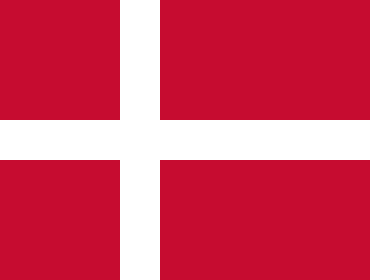
Denmark is a Nordic country in Northern Europe and a constitutional monarchy whose mainland sits on the Jutland peninsula and a chain of islands between the North Sea and the Baltic Sea. It also includes the Faroe Islands and Greenland within the Danish Realm. For design and visual culture, Denmark matters because it has shaped modern furniture, architecture, graphic design, ceramics, and exhibition culture far beyond its size.
- Capital: Copenhagen
- Government: constitutional monarchy and parliamentary democracy
- Region: Northern Europe, part of Scandinavia and the Nordic countries
- Mainland geography: Jutland plus more than 400 islands
- Associated territories: the Faroe Islands and Greenland
What makes Denmark distinct?
Denmark is defined by water, low-lying land, and a compact geography that has long encouraged trade, shipping, and concentrated urban life. Its capital, Copenhagen, sits on the island of Zealand and acts as the country’s main cultural and design centre. The built environment tends to favour human scale, daylight, durable materials, and efficient public space, qualities that recur across Danish architecture and product design.
The country’s identity also extends through the wider Danish Realm. Greenland and the Faroe Islands are self-governing communities with their own landscapes, materials, and design traditions, yet they remain tied to Denmark politically. That broader structure often appears in contemporary art, craft, and architecture as a tension between centre and periphery, mainland and North Atlantic territory.
Why does Denmark matter in design history?
Denmark helped define mid-century modern design through furniture, lighting, and domestic objects that paired craft with industrial production. Designers and makers such as Kaare Klint, Hans J. Wegner, Arne Jacobsen, Børge Mogensen, and Poul Henningsen turned wood, steel, leather, and glass into a vocabulary of clear forms and careful joinery. Their work spread globally because it looked restrained but felt practical, comfortable, and made to last.
That reputation did not stop in the 20th century. Danish architecture and design firms continue to build with timber, brick, copper, concrete, and glass in ways that stress climate response and social use. Museums, cultural centres, housing blocks, and public installations in Denmark often treat materials as part of the experience rather than decoration alone.
What does Danish design look like in practice?
In practice, Danish design often shows a bias toward honest construction and visible material logic. Chairs expose frames and joints instead of hiding them. Buildings use light to soften heavy materials. Textiles, ceramics, and tableware favour calm palettes and tactile finishes, even when the underlying form is experimental. This approach has made Denmark especially visible in current debates about sustainability, because the same restraint that shaped classic design also supports repair, reuse, and long product life.
That material-mindedness appears in recent projects tagged to Denmark: robotic timber construction, cork and concrete housing, light installations at ARoS in Aarhus, and watch and jewellery design that borrows architectural geometry. These examples show a country where design culture moves easily between industry, art, and daily use. Denmark is not only a setting for such work; it is one of the places that helped establish the standards it now extends.
How should Denmark be understood on a FreeYork page?
On FreeYork, Denmark is best read as a place where visual culture is inseparable from making. The country has a dense network of schools, studios, manufacturers, and exhibition venues, especially in Copenhagen and Aarhus, that support furniture, architecture, graphic identity, and contemporary art. That infrastructure explains why Denmark appears so often in articles about materials and process: it is a place where the language of design is part of public life.
The country also matters as a reference point rather than a style label. “Danish” can describe anything from a bentwood chair to a municipal housing scheme, but the term usually implies discipline, usability, and careful finish. Those associations are historical, not automatic, and the most interesting current work in Denmark often tests them rather than repeating them.
Frequently Asked Questions
Is Denmark the same as Scandinavia?
No. Denmark is one country within Scandinavia, alongside Norway and Sweden. It is also counted as part of the broader Nordic region, which includes Finland, Iceland, and the Faroe Islands as well. The terms overlap, but they are not interchangeable.
Why does Denmark appear so often in design articles?
Denmark has a long-established design culture built around furniture, architecture, lighting, and craft. Its institutions, manufacturers, and designers helped create modern design as an international category, so Danish projects often carry historical weight. Contemporary work from Denmark still tends to attract attention because it combines high material standards with strong public visibility.
What are Greenland and the Faroe Islands in relation to Denmark?
Greenland and the Faroe Islands are self-governing constituent countries within the Danish Realm. They are not part of mainland Denmark, but they remain tied to it through constitutional and political arrangements. In cultural and geographic terms, they add Arctic and North Atlantic dimensions to what “Denmark” can mean.
At a glance
- Address
- Kingdom of Denmark
- Coordinates
- 55.716667, 10
Articles mentioning Denmark