
Ernst Haeckel was a German biologist, physician, philosopher, and illustrator whose work helped shape modern ideas about evolution, classification, and the visual culture of natural history. He described thousands of species, coined influential terms such as ecology, phylogeny, and phylum, and produced some of the most widely reproduced scientific images of the late 19th and early 20th centuries.
Stories from Ernst Haeckel
2 stories
About Ernst Haeckel
- He worked at the intersection of science and image-making, using drawing and print to organize living forms.
- His evolutionary diagrams and organism studies popularized the idea of a branching tree of life.
- He coined or helped formalize several core biological terms still in use.
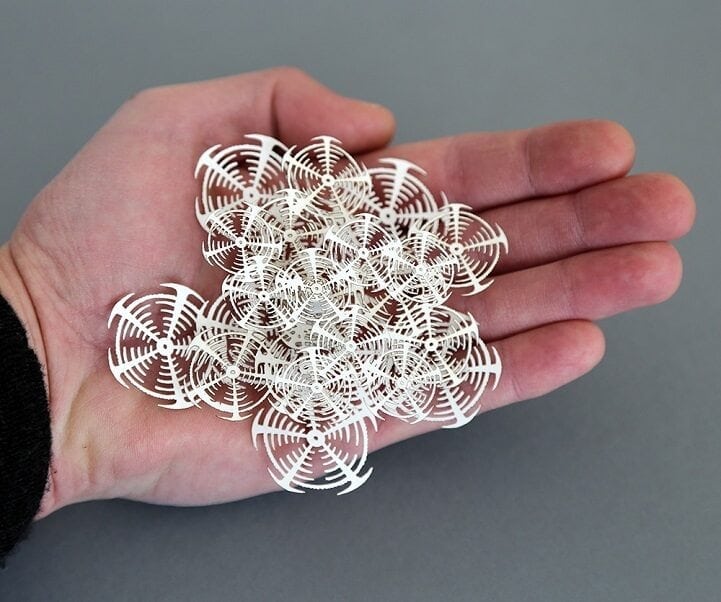
- His illustrations influenced art, design, ornament, and later paper sculpture and editorial graphics.
- His legacy is significant but contested, especially where scientific ambition overlapped with racial and ideological speculation.
Read the full overviewWhat made Haeckel important?, How did he show nature?, What is Haeckel’s place in the history of biology?, Why do designers and artists still cite him?
What made Haeckel important?
Haeckel mattered because he did more than classify organisms. He tried to make evolution visible. His drawings, diagrams, and books translated microscopic and marine life into precise lines, symmetrical forms, and dense labels that made living systems feel ordered and comprehensible. That visual clarity helped carry Darwinian thinking into broader public view.
He also pushed biology toward a more systematic vocabulary. Terms such as ecology and stem cell entered scientific language through this period of active naming, when natural history was becoming a modern discipline. Haeckel’s influence therefore lies not only in the specimens he studied, but in the language and visual methods he used to think about life.
How did he show nature?
Haeckel’s best-known images come from books such as Kunstformen der Natur and from plates of medusae, radiolarians, and other organisms that he studied closely under the microscope. These illustrations combine scientific observation with a strong compositional sense: repeated radial forms, careful contour lines, and decorative balance. Many plates resemble ornament as much as taxonomy, which is part of why they remain so influential in design and print culture.
His work often began with biological specimens preserved, observed, and drawn in the studio, then translated into engravings or lithographic plates for publication. The result was not neutral documentation. It was a visual argument that nature itself produced elaborate structure, pattern, and formal order. That mixture of accuracy and stylization made the images useful to scientists and attractive to artists.
What is Haeckel’s place in the history of biology?
Haeckel was an early and forceful advocate of evolution on Darwinian lines in the German-speaking world. He proposed a genealogical tree that linked all living things and promoted a view of organisms as related through descent. That framework helped normalize evolutionary thinking at a time when it was still contested in many scientific and cultural circles.
At the same time, his work contained serious errors and harmful speculation. Some of his embryological claims were overstated, and his broader theories were later used in ways that should not be separated from their ideological consequences. Any account of Haeckel needs to hold both sides together: he was a major organizer of biological thought, and also a figure whose ideas were not simply academic, but politically and ethically charged.
Why do designers and artists still cite him?
Haeckel’s plates continue to circulate because they turn zoology into form. Radiolarians, jellyfish, sponges, and microscopic shells appear in his images as almost architectural arrangements of line, rhythm, and symmetry. Designers, illustrators, ceramicists, and paper artists borrow from that visual logic when they want organic detail without losing structure.
His influence can be seen in book design, wallpaper, textile motifs, paper sculpture, and exhibition graphics that use natural forms as a basis for pattern. The appeal lies partly in the subject matter and partly in the method: tight observation combined with formal emphasis. Haeckel showed that scientific illustration could be both a record and a sourcebook for visual invention.
Frequently Asked Questions
Was Haeckel a scientist or an artist?
He was both, although his primary identity was as a scientist. He trained and worked as a biologist and physician, but his drawings became central to his reputation. The images were not decorative extras; they were part of how he organized evidence and communicated ideas about life.
Which terms did Haeckel coin?
He introduced or popularized several terms that remain important in biology, including ecology, phylogeny, phylum, anthropogeny, stem cell, and Protista. Not every term entered usage in exactly the same way, but his naming shaped the language of modern biological classification. His vocabulary helped define fields that now seem basic to the discipline.
Why are Haeckel’s images still reproduced so often?
They combine scientific specificity with strong design. The plates are full of symmetrical forms, transparent structures, and layered detail that work well in print, exhibitions, and digital reproduction. Their persistence also comes from the fact that they sit at the boundary between reference image and visual art, which gives them a lasting afterlife beyond biology.