Frank Zappa was an American composer, guitarist, singer-songwriter, bandleader, producer, and filmmaker whose work moved between rock songs, jazz ensembles, orchestral writing, and taped sound collage. He became known for treating popular music as a material to be cut, arranged, overdubbed, and edited with the same control normally associated with studio production or contemporary classical composition.
| Born | December 21, 1940, Baltimore, Maryland, U.S. |
|---|---|
| Died | December 4, 1993, Los Angeles, California, U.S. |
| Known for | Experimental rock, compositional collage, sharp satire, studio authorship |
| Main roles | Composer, guitarist, singer-songwriter, producer, film director |
| Associated act | The Mothers of Invention |
| Active years | 1960s–1993 |
What made Zappa unusual?
Zappa did not separate “serious” composition from rock performance. He wrote for amplified bands, small jazz groups, orchestras, and tape-based projects, often in the same period, and he controlled the recording process closely. That meant arrangement, overdubbing, editing, and mixing were not afterthoughts but part of the piece itself.
His music often mixed precision and disorder: tightly written unison passages, abrupt tempo changes, comic lyrics, virtuosic guitar lines, and dense studio layering. Even when the surface felt anarchic, the construction was deliberate. That combination made him a rare figure in 20th-century music: a popular musician with a composer’s obsession with form.
Where did his work come from?
Zappa emerged from the Los Angeles music scene in the 1960s, where garage rock, rhythm and blues, doo-wop, and studio experimentation all sat close together. He absorbed those sounds and treated them as raw material. Early work with The Mothers of Invention used satire, tape manipulation, and a wide range of American vernacular styles to challenge the expectation that rock should be straightforward or sincere.
He also drew from modern classical music, especially the mid-century American and European avant-garde. Techniques associated with musique concrète, chance procedures, and elaborate orchestration appeared alongside blues riffs and surf-guitar textures. The result was not a fusion in the polite sense; it was a collision of methods, and that collision became his signature.
How did he work in the studio?
Zappa treated the recording studio as an instrument. He produced most of his albums himself, often building tracks from multiple takes, comped performances, and edited sections. This gave him unusual authority over the finished object: the album was not merely documentation of a concert but a constructed piece of media.
That approach extended to visual presentation as well. He oversaw album covers, film projects, and promotional imagery, which helped turn his catalog into a coherent authored body of work. For designers, photographers, and illustrators, Zappa projects often meant working with a strong central concept rather than a loose assignment.
Why does Frank Zappa matter?
Zappa matters because he widened the acceptable range of what a rock-era musician could do. He helped normalize the idea that a band leader could also be a composer, editor, producer, and visual strategist. His catalog is a record of how studio process, musicianship, and image-making can be organized around a single mind.
His influence reaches beyond fans of his music. Later artists in experimental rock, progressive music, comedy performance, and independent production borrowed his freedom from genre boundaries and his distrust of polished clichés. He also left behind a large body of recordings that still function as examples of intensive authorship: densely arranged, technically demanding, and materially specific.
What does Zappa look like in practice?
A typical Zappa track might begin with a comic lyric or a simple riff, then shift into an intricate instrumental section with horn lines, odd-meter drumming, and tightly written guitar figures. Another piece might rely on tape edits, spoken fragments, or orchestral blocks that feel assembled rather than performed in one breath. The point is often not transparency but structure.
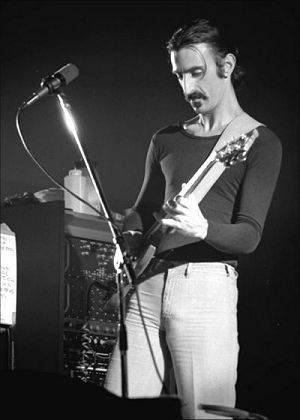
In visual culture, Zappa’s image often appeared as part of a larger authored package: photographed, styled, and placed within covers that signaled satire, complexity, or abrasion. A portrait of him usually carries that same tension. He reads as both performer and producer, a musician whose public face was inseparable from the systems that framed his work.
Frequently Asked Questions
Was Frank Zappa mainly a rock musician?
Rock was the most visible part of his career, but it was only one part. He also wrote orchestral music, chamber pieces, and tape-based works, and he made a point of treating all of them as serious composition. That breadth is central to his reputation.
Why is The Mothers of Invention important?
The Mothers of Invention was the band through which many listeners first encountered Zappa’s methods. The group gave him a flexible format for satire, ensemble writing, and abrupt stylistic shifts. It also established the collaborative but tightly controlled model that followed him through much of his career.
Did Zappa really produce most of his own records?
Yes. He usually took direct control of production, which let him shape arrangement, editing, and final sound without relying on an outside producer. That control is a major reason his recordings feel so specific and so closely authored.
Articles mentioning Frank Zappa