
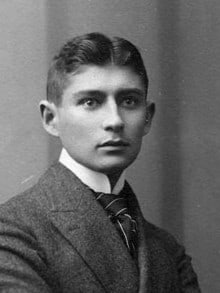
Franz Kafka was a German-language writer whose short fiction and novels turned bureaucracy, guilt, and bodily unease into some of the most recognisable images in modern literature. Born in Prague in 1883 and working for much of his life as an insurance clerk, he wrote at night and published only a small body of work before his death in 1924, but that work reshaped how later writers, artists, and filmmakers pictured alienation and power.
| Born | 3 July 1883, Prague, then part of the Austro-Hungarian Empire |
|---|---|
| Died | 3 June 1924, Kierling near Vienna |
| Language | German |
| Known for | Novels, novellas, and short stories marked by surreal logic and institutional pressure |
| Occupation | Writer; insurance official |
Why does Kafka matter?
Kafka matters because his fiction gives everyday life the structure of a nightmare without abandoning ordinary settings. Offices, apartments, courtrooms, and family rooms become places where rules exist but never fully explain themselves. That combination made his work central to 20th-century ideas of absurdism, existentialism, and modern bureaucracy, and it gave rise to the adjective Kafkaesque for situations that feel oppressive, irrational, and impossible to resolve.
He also matters as a writer of form. Kafka’s sentences are precise, controlled, and often plain, which makes the events inside them feel even stranger. Instead of ornament, he uses clarity; instead of heroic action, he builds scenes from delays, misunderstandings, and shifting authority. That style has been absorbed into literature, theatre, visual art, and cinema far beyond the narrow circle of readers who know his major books.
What did Kafka write?
Kafka’s best-known works include The Trial, The Castle, and The Metamorphosis. In The Metamorphosis, a travelling salesman wakes to find himself transformed into a giant insect, a premise that has become one of the most famous openings in modern fiction. In The Trial, a man is arrested and drawn into a legal process whose charges are never made clear. In The Castle, a surveyor struggles to gain access to an elusive authority that keeps receding just out of reach.
These stories are not built around explanation. Kafka lets institutions remain opaque and forces characters to move through systems that seem both familiar and absurd. The result is a form that many later artists borrowed: domestic spaces warped by invisible rules, bodies altered by stress or shame, and a world where language promises order but delivers confusion. That is why his fiction continues to surface in design criticism, contemporary art, and urban imagery whenever a work wants to picture power as something faceless and intimate at once.
What did Kafka’s life in Prague look like?
Kafka was born into a German-speaking Jewish family in Prague, a city shaped by overlapping Czech, German, and Jewish cultures. He studied law at university, then spent most of his working life at the Workers’ Accident Insurance Institute for the Kingdom of Bohemia. The job gave him a stable salary and a close view of administrative systems, claim forms, and workplace regulation, all of which fed the procedural atmosphere of his fiction.
Prague appears in Kafka’s life less as a picturesque backdrop than as a lived civic environment of offices, streets, apartments, and institutions. The city later built a strong cultural identity around him, and visitors still encounter his name in museums, memorials, bookshops, and walking routes. For a publication interested in how things are made, Kafka is important not only as a writer but as someone who transformed the texture of modern city life into literary form.
How does Kafka show up in visual culture?
Kafka’s influence in visual culture often appears through distortion, enclosure, and scale. Artists and designers borrow his atmosphere rather than his plots: narrow corridors, heavy doors, clotted paperwork, mutated bodies, and figures trapped inside systems they cannot read. In installation art, that can mean walls that compress the body or text that refuses to resolve into a single message. In illustration and graphic design, it can mean sparse layouts, cold type, and images that make administration feel uncanny.
His name also travels as shorthand. A ruined permit process, a labyrinthine housing office, or an absurdly indirect rule may be described as Kafkaesque because the term captures a specific kind of modern frustration. That shorthand is useful, but it can flatten the writing itself. Kafka’s work is not only about dread; it is also about precision, restraint, and the unsettling force of ordinary language pressed against systems that no longer make sense.
Frequently Asked Questions
Was Franz Kafka a surrealist?
No. Kafka wrote before surrealism became a defined movement, and he did not belong to that circle. His work is sometimes described as surreal because it places impossible events inside ordinary settings, but his method is more controlled than dreamlike. The strange events in his fiction are usually presented with calm, legalistic clarity.
Why is the word Kafkaesque used so often?
The word is used because Kafka captured a very specific kind of modern anxiety: official systems that are everywhere and still impossible to understand. It describes a situation where procedure replaces meaning and where the person inside the system has no clear way to appeal. The term became common because it names an experience many people recognise quickly.
What should be read first?
The Metamorphosis is usually the easiest starting point because it is short and immediately legible. The Trial gives a fuller sense of Kafka’s world of bureaucracy and accusation, while the short stories show how much he could do in a few pages. Reading any one of them makes his method clear: plain language, exact surfaces, and a world that keeps refusing explanation.
Articles mentioning Franz Kafka

