
Grenada is an island country in the southeastern Caribbean made up of the main island of Grenada and six smaller islands in the southern Grenadines. It is a Commonwealth realm with a capital at St. George’s, and it sits between the eastern Caribbean and the northern coast of South America. Grenada is widely called the “Island of Spice” because nutmeg and mace have shaped its landscape, economy, and image abroad.
Stories from Grenada
3 stories

About Grenada
- An island country in the southeastern Caribbean Sea
- Made up of Grenada and six smaller islands
- A major global source of nutmeg and mace
- A Commonwealth realm with strong colonial and maritime histories
- Known in art and tourism for its beaches, volcanic terrain, and spice cultivation
Read the full overviewWhere is Grenada, and what makes it distinct?, Why is Grenada called the Island of Spice?, How does Grenada appear in art and design?, What is Grenada made of, materially and economically?
Where is Grenada, and what makes it distinct?
Grenada lies northwest of Trinidad and Tobago, northeast of Venezuela, and southwest of Saint Vincent and the Grenadines. That position places it near the edge of the Lesser Antilles, in a zone shaped by trade winds, volcanic islands, and shipping routes. The main island is mountainous and compact, with a coastline of bays, coves, and fishing settlements rather than long flat plains.
Its size has never limited its visibility. Grenada’s name carries weight because of its agricultural exports, especially spice crops, and because its islands combine a small-scale human geography with a strong visual identity: bright harbours, dense vegetation, dark volcanic beaches, and inland hills planted with nutmeg trees.
Why is Grenada called the Island of Spice?
Grenada earned that nickname through the cultivation of nutmeg and mace, two products derived from the fruit of the nutmeg tree. Nutmeg is the seed; mace is the bright red aril that surrounds it once the fruit opens. These crops arrived through colonial plantation systems and later became central to smallholder farming across the island.
The spice trade matters not only as an economic fact but as a cultural one. Grenada’s farms, drying houses, and export history give the island a distinct material identity. In visual culture, that often appears through references to harvest, scent, tropical abundance, and the textured surfaces of spice shells, seed husks, and drying racks.
How does Grenada appear in art and design?
Grenada often enters art and design as a setting of contrast: lush but vulnerable, idyllic but historically layered. Painters and photographers are drawn to its saturated greens, steep terrain, and coastal light, while writers and curators use it to signal the Caribbean as both an actual place and an image shaped by tourism, trade, and colonial memory. Its landscape reads clearly on the page and on the canvas because it carries strong forms and colours.
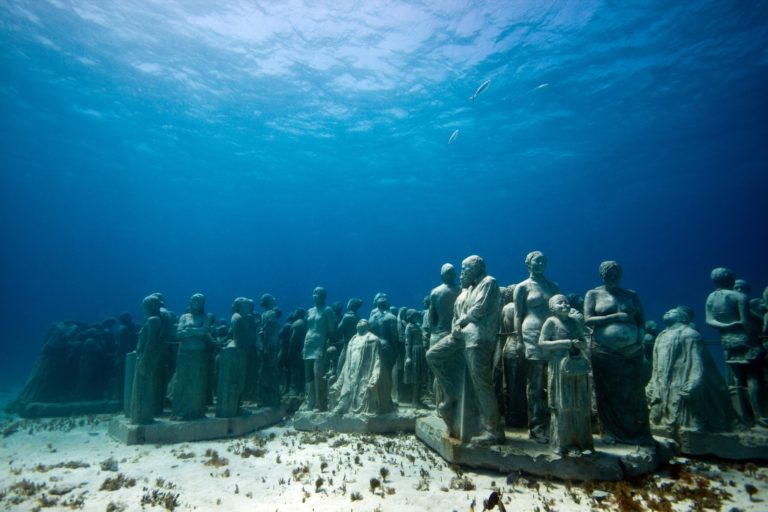
The island also appears in work concerned with environmental and public space. The Underwater Sculpture Park off Grenada’s coast is one of the best-known examples: a submerged installation that uses marine conditions as part of the artwork’s life. It shows how Grenada’s geography can become a medium, not just a backdrop.
What is Grenada made of, materially and economically?
Grenada’s economy has long mixed agriculture, services, and tourism, with spice production at the centre of its reputation. Nutmeg, mace, cocoa, bananas, and smaller-scale food crops have all played roles in village economies and export markets. That agricultural base has helped shape building forms too: drying sheds, farms, markets, and roadside stalls are part of the island’s everyday visual rhythm.
Materially, Grenada is defined by volcanic rock, fertile soil, tropical vegetation, and a built environment adapted to humidity, salt air, and storms. Those conditions influence how things are made and maintained: painted timber, concrete, corrugated metal roofs, and open-air structures are common responses to climate. The island’s look is therefore inseparable from weather, soil, and cultivation.
Frequently Asked Questions
Is Grenada a country or just an island?
Grenada is both an island and a sovereign country. The state includes the main island of Grenada and six smaller islands, with the main island carrying most of the population and infrastructure. Its political status as a Commonwealth realm means it retains a constitutional link to the British monarchy.
Why do artists and curators use Grenada in their work?
Artists often use Grenada because it offers a strong visual setting and a dense historical context. Its spice economy, colonial past, and Caribbean seascapes provide material for work about labour, memory, tourism, and environmental change. The island can stand for both a specific place and a wider Caribbean condition.
What is the Underwater Sculpture Park in Grenada?
It is a group of sculptures placed on the seabed off Grenada’s coast, designed to be viewed by divers and snorkellers. The work changes as marine life grows over it, so the sea becomes part of the artwork’s surface and meaning. It is notable because it treats the ocean not as a distant backdrop but as an active exhibition space.