
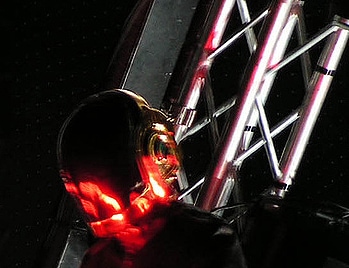
Guy-Manuel de Homem-Christo is a French musician, producer, and filmmaker best known as one half of Daft Punk, the house and electronic duo he formed with Thomas Bangalter. Born Guillaume Emmanuel de Homem-Christo in 1974, he helped shape a polished, highly visual strain of French electronic music that moved easily between club tracks, pop hooks, and carefully built identities.
- French producer and performer associated with French house, disco edits, and electronic pop.
- Co-founder of Daft Punk with Thomas Bangalter.
- Co-ran the label Crydamoure with Éric Chedeville.
- Also recorded as Le Knight Club with Chedeville.
- Worked in film direction as well as music.
What made him known?
De Homem-Christo came to prominence in the 1990s as Daft Punk began turning French house into a global style. The duo’s early records drew on filter-heavy disco loops, drum machines, and tight sampling, but their impact was larger than a sound. They treated image, anonymity, and design as part of the work, using helmets, graphics, and controlled public appearances to make electronic music feel authored and cinematic.
Within that project, de Homem-Christo helped define the duo’s melodic side. Where some French house leaned toward repetition alone, Daft Punk often balanced repetition with bright chord changes, pop structure, and a clean, forward-facing sheen. That balance made their tracks work both in clubs and as recorded compositions.
How did Crydamoure fit into his work?
Alongside Daft Punk, de Homem-Christo built a smaller and more personal outlet through Crydamoure, a label he ran with Éric Chedeville. The label issued music tied to the Roule/Crydamoure circle of French house, including productions that favored warm loops, chopped samples, and a looser, more playful feel than Daft Punk’s main catalogue. It gave him room to work with local collaborators and test ideas outside the weight of Daft Punk’s public profile.
He and Chedeville also performed together as Le Knight Club, another project rooted in the same sample-based French house language. These side projects matter because they show de Homem-Christo not just as a member of a famous duo, but as a producer embedded in a wider scene of labels, aliases, and small-run releases that helped define French electronic music in the late 1990s and early 2000s.
What does his style look like in practice?
De Homem-Christo’s work is often recognizable through precision rather than excess. Tracks built around him tend to use short loops, carefully chosen vocal fragments, and a strong sense of arrangement. The surfaces are smooth, but the music is built from visible parts: sample sources, drum programming, and mixing decisions that are easy to feel even when the original materials are transformed beyond recognition.
That same clarity carried into Daft Punk’s visual language. The duo’s robot personas, stage design, and album art turned electronic music production into an object with a distinct finish. De Homem-Christo’s role was not limited to sound design; it included the broader shaping of how the project appeared, moved, and was remembered.
Why does he matter beyond Daft Punk?
His importance lies in how he helped make French house legible to a wider audience without stripping away its club roots. Daft Punk’s success opened the door for a generation of producers who worked with house, disco, and funk samples in more refined, pop-facing forms. De Homem-Christo was central to that shift, especially in the way he fused dancefloor structure with a highly considered image.
His later work in film direction points to the same instinct: the urge to build mood through sequence, framing, and atmosphere. Whether in a record sleeve, a club track, or a music video, his output tends to treat sound and image as linked crafts rather than separate jobs.
Frequently Asked Questions
Is Guy-Manuel de Homem-Christo only known for Daft Punk?
No. Daft Punk is his most famous project, but he also worked through Crydamoure and Le Knight Club, both of which connected him to the broader French house scene. Those projects show a producer interested in labels, aliases, and collaboration, not only in the main duo.
What kind of music did he make?
He worked mainly in French house and electronic music, often using samples, filtered loops, and strong melodic structure. The results usually sit somewhere between club music and polished pop production.
Did he work outside music?
Yes. De Homem-Christo also worked as a film director, extending the same visual control that shaped his music projects. That crossover matters because his career has always treated image and sound as part of one system.
Articles mentioning Guy-Manuel de Homem-Christo
