
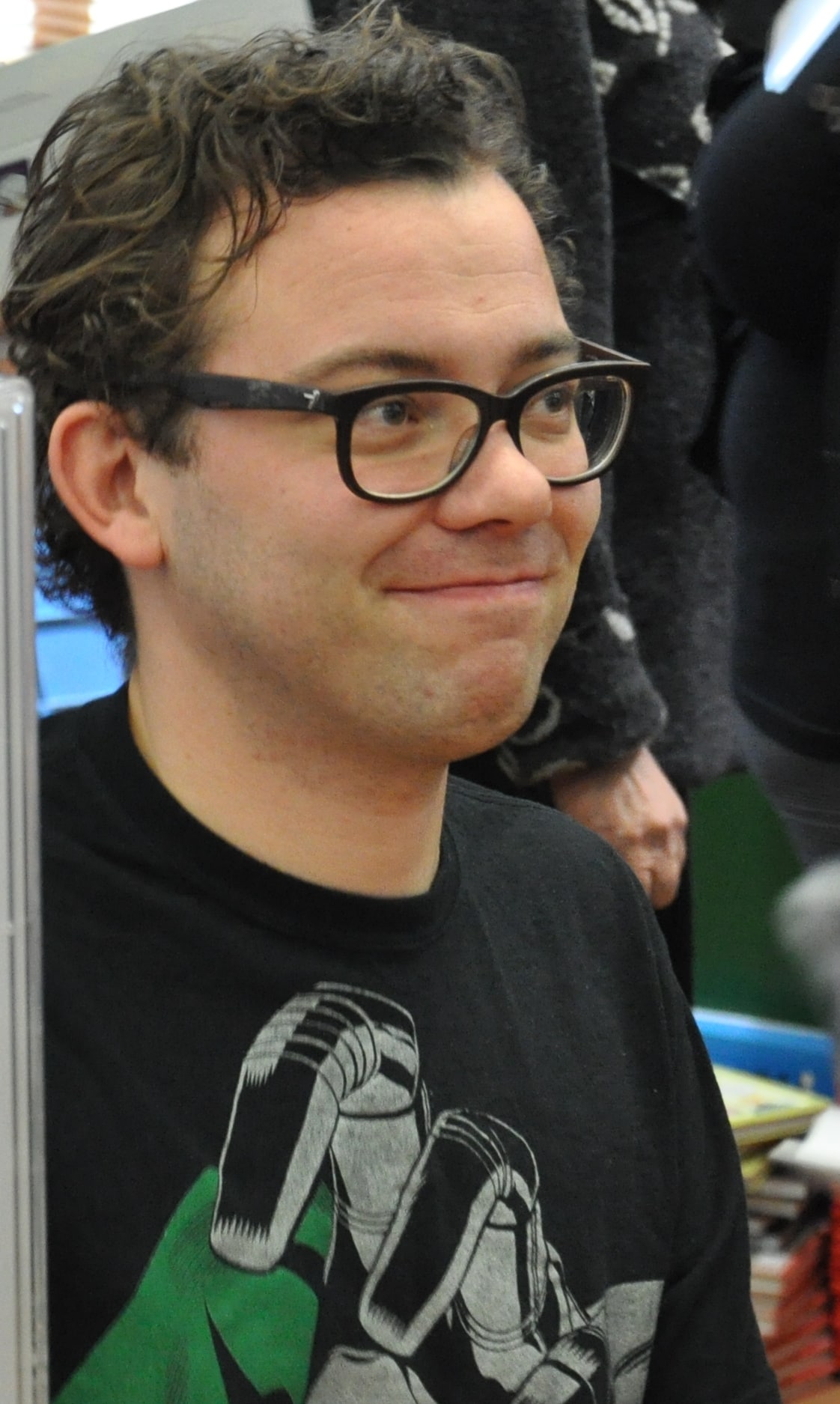
Hugleikur Dagsson is an Icelandic artist and cartoonist known for black-humoured satirical comics, video work, and visual art. Born in 1977 and often called Hulli, he built his reputation through short, blunt drawings that turn everyday situations, taboos, and social habits into deadpan jokes. His comics have appeared in books and in The Reykjavík Grapevine, making him one of the best-known contemporary Icelandic humorists in print.
- Born in 1977 in Iceland; graduated from the Iceland Academy of the Arts in 2002.
- Works across comics, visual art, and video art.
- Best known for minimal drawings and dark, satirical one-panel jokes.
- His work relies on compression: a small image, a few words, and a sharp punchline.
- He also worked in radio as a film critic and host, extending his public voice beyond the page.
What makes his comics distinctive?
Dagsson’s comics use a stripped-down drawing style that puts pressure on the joke. The figures are simple, often rough, and the lines stay spare, so the idea lands faster than the image itself. That economy matters: his humour depends on timing, bluntness, and the gap between cheerful cartoon form and bleak or awkward subject matter.
The content often leans into death, sex, religion, politics, shame, and social cruelty. Rather than building long narratives, Dagsson usually aims for a single nasty twist or an anticlimax that exposes a cultural habit. The result feels closer to an illustrated insult, or a tiny stage sketch performed in a sentence and a half.
Where did Hugleikur Dagsson come from?
Dagsson studied at the Iceland Academy of the Arts, where he received a B.A. in 2002. That training places him within a generation of Icelandic artists working across media rather than staying inside one fixed discipline. His practice reflects that background: comics sit alongside visual art and video art, and the humour often feels informed by performance, editing, and image-making as much as by traditional cartooning.
He also worked in radio as a film critic on Radíó X and hosted a programme called Hugleikur on the same station. That public presence helped establish him as a voice in Icelandic media, not only as a gallery artist or book cartoonist. His work circulated through magazines and books, which gave it a wider audience than a small art scene alone could provide.
Why does his work matter in Icelandic visual culture?
Dagsson matters because he helped define a contemporary Icelandic comic voice that is cynical, minimal, and proudly unsentimental. His humour does not soften itself for broad appeal; instead, it pushes on the limits of what can be funny, especially in a small society where public life can feel intimate and socially coded. That sharpness gave his comics a clear identity at home and abroad.
His work also shows how comics can function as visual criticism. A Dagsson drawing may look quick or even disposable, but it often condenses a social comment into a few strokes and a caption. In that sense, his pages are closer to editorial satire than to comforting gag cartoons, and that is part of their lasting appeal.
How is his work usually presented?
Dagsson’s comics appear in books, magazines, and online reproductions, where their directness survives the loss of scale. The format usually stays simple: one panel, a short caption, and a visual gag that lands immediately. That simplicity makes the work easy to share and hard to misread; the joke depends on the whole composition arriving at once.
Outside comics, his visual and video art extends the same deadpan sensibility into other forms. Even when the medium changes, the tone tends to stay constant: dry, abrupt, and deliberately uncomfortable. That consistency is part of his recognisable authorship, and it is why his name remains strongly associated with Icelandic dark humour.
Frequently Asked Questions
Is Hugleikur Dagsson mainly a cartoonist or a fine artist?
He is best known as a cartoonist, especially for satirical comics built on black humour. At the same time, he works in visual art and video art, so his practice is broader than printed comics alone. The comics remain the most widely recognised part of his output.
What does “black humour” mean in his work?
In Dagsson’s case, it means jokes built around death, cruelty, embarrassment, taboo, and social discomfort. The humour comes from saying the thing that polite conversation avoids, then pushing it a little further. The result is deliberately abrasive, but it is usually meant to be comic rather than shocking for its own sake.
Where has his work been published?
His comics have appeared in books and in The Reykjavík Grapevine magazine. That mix of book publication and magazine circulation helped spread his work beyond a single venue. It also suits the format of his comics, which can work as stand-alone jokes or as collected sequences.