
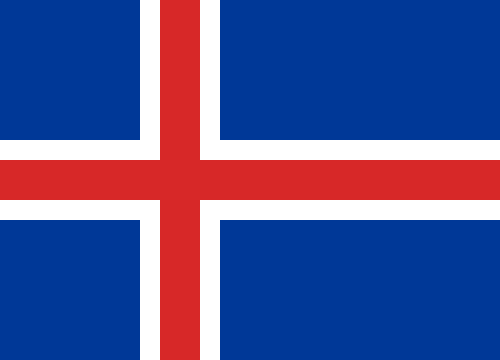
Iceland is a Nordic island country in the North Atlantic, set on the Mid-Atlantic Ridge where the Eurasian and North American tectonic plates pull apart. It is one of Europe’s least densely populated countries, with most people living in and around Reykjavík on the southwest coast. Its landscapes combine active volcanoes, geothermal fields, glaciers, black-sand coasts, and broad lava plains, making it a place where geology is visibly part of everyday life.
- Capital: Reykjavík
- Location: North Atlantic, between Greenland and mainland Europe, near the Arctic Circle
- Population: about 320,000
- Landscape: volcanoes, glaciers, hot springs, lava fields, fjords, and coastal plains
- Why it matters: Iceland is a major reference point for landscape photography, design, and visual culture because its terrain and weather create striking light and texture
Why does Iceland look so dramatic?
Iceland sits on a tectonic boundary and above a volcanic hotspot, so earthquakes, eruptions, geothermal activity, and fresh lava are all part of the island’s long geological story. Glaciers cover large highland areas, while warmer lowlands support grassland, moss, and towns. The result is a sharp contrast of elements: steam rising from vents, ice sitting near fire, and dark rock cut by water and weather.
That physical instability shapes how Iceland is seen. New lava fields, ash deposits, glacier outwash plains, and braided rivers create surfaces that appear unfinished or newly formed. For photographers, filmmakers, architects, and artists, this gives Iceland a strong visual identity built from edge conditions: light that changes quickly, terrain that resists easy movement, and forms that feel raw rather than polished.
What is life and making like in Iceland?
Most of Iceland’s population lives in the southwest, especially in the Reykjavík metropolitan area, because the interior is rugged and sparsely settled. The country depends on fishing, renewable energy, tourism, and creative industries, all of which are shaped by proximity to the sea, wind, and geothermal resources. Geothermal heat and hydroelectric power are central to daily life and to many forms of production, from greenhouse agriculture to bathing culture and energy-intensive manufacturing.
Design and craft in Iceland often respond to available materials and climate. Wool, fish skin, basalt, turf, timber, and metal appear in traditional and contemporary work, while modern architecture often uses concrete, glass, corrugated metal, and geothermal systems to cope with cold, wind, and darkness. Buildings and objects tend to prioritize durability, insulation, and clarity of form, which suits a place where weather is not background but a force that shapes technique.
Why do photographers keep returning to Iceland?
Iceland has become one of the most photographed places in the world because it offers concentrated visual variety in a relatively small area. A single journey can move from waterfalls to black beaches, from glacial lagoons to volcanic deserts, from moss-covered rock to aurora-lit skies. This makes the country useful not only for landscape work, but also for projects about scale, isolation, weather, and the relationship between infrastructure and wilderness.
Its light also matters. In summer, long daylight hours allow extended shooting windows and low-angle illumination that stretches shadows across lava and ice. In winter, the darker season opens space for aurora photography and atmospheric studies of storm, snow, and sea spray. For visual culture, Iceland acts less like a backdrop than a subject in its own right: one defined by texture, contrast, and movement.
How Iceland appears in architecture and visual culture
Contemporary Icelandic architecture often works with the landscape instead of trying to dominate it. Concrete forms, turf references, blackened exteriors, and low profiles can echo lava fields and weathered coastlines, while thermal bathing complexes and civic spaces use local energy systems as part of the experience. This practical relationship between material, climate, and design gives many Icelandic buildings a restrained but distinct character.
In visual culture, Iceland is frequently used to stand for remoteness, purity, elemental force, or otherworldliness. That can be reductive, but it comes from real features: intense weather, severe topography, and a built environment concentrated in a few habitable zones. The most successful images and objects made there usually avoid spectacle alone and instead show process, such as volcanic layering, wind erosion, or the way human structures sit lightly against a powerful terrain.
Frequently Asked Questions
Is Iceland physically part of Europe?
Yes. Iceland is usually classified as a Nordic European country, even though it lies far out in the North Atlantic. Its position on the Mid-Atlantic Ridge makes it geologically unusual, but culturally and politically it belongs to Europe.
Why is Reykjavík so important?
Reykjavík is the capital, largest city, and main hub for government, culture, and commerce. Because much of the rest of the country is sparsely populated, the city and its surrounding southwest region hold a disproportionate share of the population and infrastructure.
What makes Iceland useful for artists and designers?
Iceland offers extreme but legible conditions: strong light, active geology, wind, cold, and large open spaces. Those conditions produce clear forms, bold textures, and a close relationship between material choice and environment. As a result, work made there often feels grounded in process rather than decoration.
At a glance
- Address
- Iceland
- Coordinates
- 65, -21.933332
Articles mentioning Iceland


