
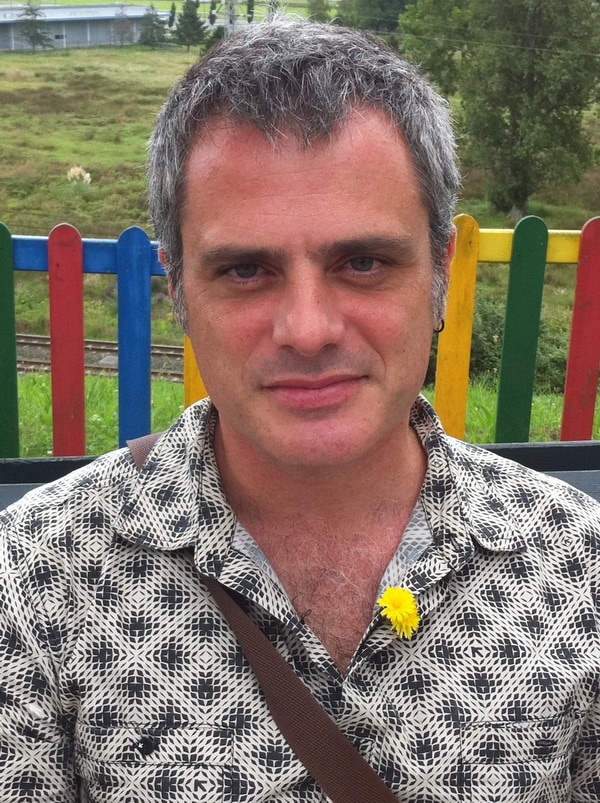
Joseba Eskubi is a Spanish painter and sculptor known for biomorphic, often decaying forms that sit between figuration and abstraction. Born in 1967, he works in Bilbao and teaches at the Faculty of Fine Arts at the University of the Basque Country in Leioa. His images place soft, swollen shapes in unstable, dreamlike spaces, giving his work a distinctly surreal and bodily character.
| Born | 1967 |
|---|---|
| Nationality | Spanish |
| Based in | Bilbao, Spain |
| Mediums | Painting, sculpture |
| Training | Faculty of Fine Arts of the Basque Country |
| Role | Artist and professor |
What defines his work?
Eskubi’s paintings are built from rounded, amorphous masses that look as if they have swollen, melted, or begun to rot. He often pushes forms away from clean edges and finished surfaces, preferring blunted contours, damp-looking textures, and colours that suggest flesh, fungus, clay, or bruised matter. The effect is not literal horror but a sense that the image is alive, unstable, and in a state of continuous change.
That approach places his work close to surrealism without repeating its older imagery. Instead of dream logic made of clear symbols, Eskubi uses material ambiguity: forms that seem both organic and artificial, both intimate and alien. His sculpture extends the same language into three-dimensional space, where softness, compression, and bodily strain become physical rather than painted illusions.
Where did his visual language come from?
Eskubi studied at the Faculty of Fine Arts of the Basque Country, an environment that gave him a strong grounding in painting and contemporary art practice. His work also reflects the broader Basque and Spanish tradition of artists who treat the body as a site of pressure, fragility, and transformation. Rather than presenting polished ideal forms, he works with distortions that feel searched for rather than designed in advance.
His teaching role at the University of the Basque Country places him within the institutional life of art as well as its studio practice. That matters because his work is not a detached specialism; it is grounded in sustained attention to process, surface, and the awkward behaviour of materials. In his hands, painting becomes less a window onto an image than a place where image, matter, and decay interfere with one another.
How are the paintings made to look so soft and unstable?
Eskubi’s surfaces depend on painterly decisions that keep edges unsettled. Forms often seem pushed up from below the surface rather than simply placed on it, which gives the work a swollen, tactile quality. Colour is usually restrained and earthy, with tonal shifts that help the forms read as physical substances rather than cleanly separated objects.
That emphasis on softness is important. It gives the work a paradoxical feel: the images can seem grotesque or eerie, yet they also appear vulnerable, almost tender. The result is a visual language of mutation, where painting records the slow collapse of stable form instead of announcing a fixed subject.
Why does Joseba Eskubi matter?
Eskubi matters because he shows how contemporary painting can still be bodily, strange, and materially specific without relying on straightforward narrative. His work keeps surrealism alive as a method of making forms unstable, but he shifts the emphasis from fantasy to matter. Decay, swelling, and softness become compositional tools rather than themes added afterward.
For viewers and readers interested in how things are made, his practice is useful because it treats painting as an object with its own physical conditions. The image is not separate from the surface that carries it. It emerges through it, and in Eskubi’s work that emergence often looks like something half-formed, half-eroded, and still becoming visible.
Frequently Asked Questions
Is Joseba Eskubi primarily a painter or a sculptor?
He works in both painting and sculpture, but his reputation is strongest in painting. The sculptural side of his practice helps explain the physical weight and volume that his images often seem to have. Even in two dimensions, his forms feel modelled, compressed, or built up like objects.
Is his work abstract or figurative?
It sits between the two. Eskubi’s forms suggest bodies, organs, shells, or other living matter, but they rarely settle into clear depiction. That ambiguity is central to the work, because it lets the viewer recognise something without fully naming it.
Why is decay such a strong part of his imagery?
Decay gives his paintings their uneasy energy. It lets the work suggest time, vulnerability, and transformation rather than static perfection. In Eskubi’s practice, decay is not simply an ending; it is a visible stage in the life of form.
Articles mentioning Joseba Eskubi
