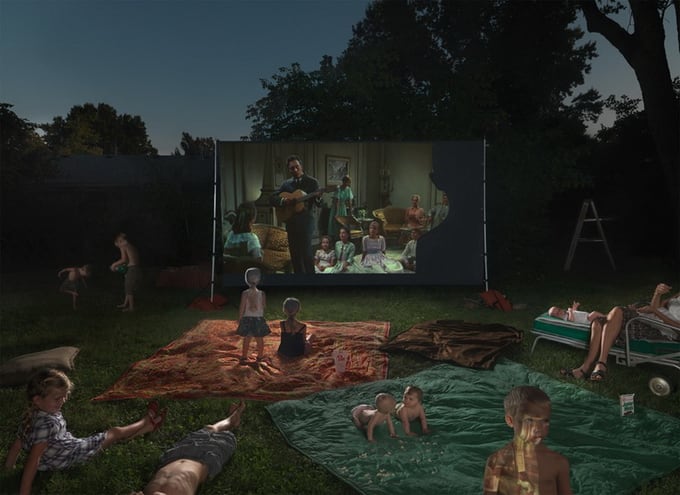
Julie Blackmon is an American photographer known for staged color photographs of family life, domestic interiors, and suburban unease. Based in Missouri, she builds pictures from the material of her own household and family history, using children, pets, rooms, toys, food, and ordinary clutter to turn familiar scenes into something theatrical and strange.
| Field | Photography |
|---|---|
| Based in | Missouri, United States |
| Known for | Staged photographs of domestic life, motherhood, and suburbia |
| Subjects | Family members, home interiors, children, household objects |
| Approach | Constructed scenes that combine realism with fantasy |
| Key idea | The everyday family snapshot as a site of tension, memory, and invention |
What Blackmon photographs
Blackmon’s work focuses on the domestic world: kitchens, living rooms, bedrooms, backyards, cars, school-age children, and the small messes that gather around them. Her images often look like snapshots at first glance, but they are carefully arranged and lit. Props and gestures matter as much as faces. A bowl of fruit, a toy scattered on the floor, a child half in motion, or a mother absorbed in a task can carry the whole scene.
That attention to ordinary material gives the work its force. Blackmon does not treat the home as a neutral setting. She treats it as a stage where care, repetition, exhaustion, humor, and private fantasy all occur at once. The pictures often suggest that family life is both specific and universal: rooted in one Missouri household, yet recognizable to anyone who has lived inside the routines of domestic space.
How does she make the pictures?
Blackmon’s photographs are constructed rather than observed. She works with staged compositions, drawing on her own family members and home environment as a source of characters, settings, and visual detail. The result is not documentary in the strict sense. It borrows the look of the lived-in moment while allowing for editing, ordering, and invention.
This method lets her move between realism and the slightly unreal. A child’s expression, the placement of furniture, or the way objects crowd the frame can push a scene into the uncanny without breaking the sense of everyday life. Her practice depends on photography’s ability to make the familiar feel provisional. It can look like a memory, a joke, a warning, or a dream, often at the same time.
Why does her work matter?
Blackmon matters because she takes domestic labor and family life seriously as subjects for contemporary art. Photography has long used women, children, and the home as motifs, but her work resists simple sentiment or nostalgia. Instead, it shows how the household contains performance, discipline, tenderness, and pressure. The home becomes a place where identity is made and managed.
Her pictures also speak to a broader tradition in American photography that examines suburbia and the middle-class domestic sphere. What distinguishes Blackmon is her refusal to let the scene settle into pure critique. Her images hold discomfort and affection together. They reveal how beauty can arise from clutter, repetition, and the visual chaos of everyday care.
What does her style look like in practice?
Blackmon’s style is vivid, busy, and tightly composed. Color often plays a major role: reds, yellows, blues, and patterned fabrics create a heightened surface that makes the images feel alert and artificial at once. Frames are crowded. Figures are frequently caught mid-action. The eye moves from person to object to background detail, as if the scene might spill beyond the picture edge.
In practice, this means her photographs are less about isolated subjects than about relationships among things. Furniture, wallpaper, toys, clothing, and gestures all contribute to meaning. The effect is close to theater, but with the emotional register of family life. Blackmon’s best-known images make the domestic world look both intimate and unstable, where order is always temporary and imagination is part of the furniture.
Frequently Asked Questions
Is Julie Blackmon a documentary photographer?
Not mainly. Her photographs use real family members and domestic settings, but the scenes are staged and directed. That places her closer to constructed narrative photography than to straight documentary work.
What themes run through her work?
Motherhood, childhood, memory, and the pressures of family life appear again and again. Suburban domesticity is central too, especially the tension between comfort and overload. Her images often show how ordinary routines can become psychologically charged.
Why are her photographs often described as uncanny?
They look familiar before they look strange. Blackmon uses the visual language of everyday family pictures, then disturbs it through composition, color, and posed action. The result is a scene that feels lived-in but slightly dreamlike, as if it belongs to memory rather than the present tense.
Articles mentioning Julie Blackmon