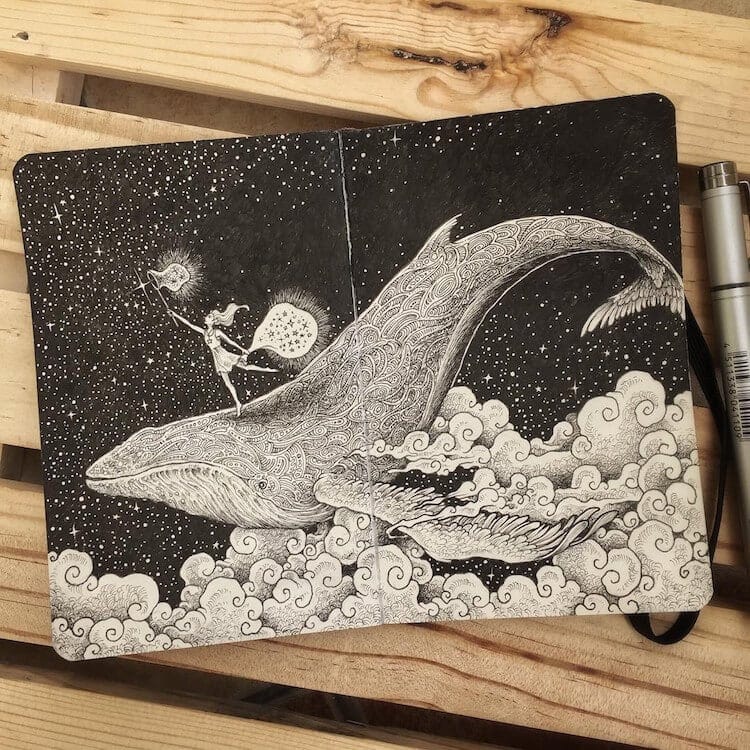
Kerby Rosanes is a Philippines-based illustrator known for dense black-ink drawings that combine animals, faces, and decorative patterning. Born in 1991, he built a career from personal drawing practice and part-time freelance work, then became widely known through online art communities and design media.
| Field | Details |
|---|---|
| Born | 1991 |
| Base | Philippines |
| Known for | Pen-and-ink illustration, pattern-heavy drawings, surreal animal imagery |
| Practice | Hand-drawn line work, intricate fills, highly detailed black-and-white compositions |
| Recognition | Design blogs, international magazines, online art communities |
What kind of illustrator is Kerby Rosanes?
Rosanes works in illustration, but his drawings often sit close to poster art, tattoo imagery, and contemporary pattern drawing. His images usually begin with a clear central form — often an animal, skull, face, or human figure — then accumulate layers of marks, floral motifs, geometric fragments, and ornamental texture.
The result is highly legible at first glance and increasingly complex on closer inspection. That balance has helped his work travel well online: the main silhouette reads quickly, while the finer line work rewards zooming in and repeated looking.
How does he make the work?
Rosanes is associated with pen drawing, especially black ink on white paper. The visual impact comes from line density rather than colour, shading through repeated marks, crosshatching, stipple-like texture, and tightly packed pattern fields. This gives the drawings a carved or engraved feel even when they are made with simple drawing tools.
His style depends on control. The forms need to stay clear while the surface becomes busy, so the draftsmanship has to hold together at multiple scales. That mix of strong outline and intricate fill is a major reason his work is so recognisable.
Why did his drawings spread so widely online?
Rosanes’ drawings fit the rhythm of digital sharing. They are striking as thumbnails, but they also reveal more detail as the image is enlarged. Design blogs and online art communities tend to favour work that can be described quickly and visually scanned, and his art offers both immediate impact and technical detail.
International magazine coverage also helped frame the work as part of a broader wave of contemporary ink illustration. That attention placed him alongside other artists using precision drawing and decorative density to push illustration beyond simple representation.
What does his style look like in practice?
In practice, a Rosanes drawing often starts with an animal body or portrait shape, then turns into a field of image-making decisions: where to leave white space, where to compress marks, and where to shift from contour to ornament. Wings, fur, leaves, smoke, feathers, and armour-like textures may all be treated as pattern rather than as naturalistic surface.
That approach creates a hybrid language. The drawings feel rooted in observation, but they also borrow from sacred decoration, psychedelic imagery, tattoo flash, and graphic design. The work matters because it shows how a single ink process can carry both illustration and ornament without losing clarity.
Frequently Asked Questions
Is Kerby Rosanes mainly a fine artist or an illustrator?
He is best understood as an illustrator, because his work is built around line, image-making, and visual communication. At the same time, the density and ambition of the drawings place them close to fine art practice. The boundary is not important to the work itself, which is valued for its craftsmanship and visual invention.
What materials does he use?
His best-known work is made in black ink, usually with pens on paper. That material choice matters because it supports the crisp outlines, tight patterning, and strong contrast that define his style. The limited palette also forces attention onto drawing technique rather than colour effects.
Why is he important to contemporary illustration?
Rosanes helped popularise a highly detailed ink style that feels both handmade and digitally shareable. His drawings show how illustration can move beyond straightforward depiction into pattern, symbolism, and visual excess while remaining readable. For many viewers, he is a clear example of how pen drawing can still feel current and widely circulated.
Articles mentioning Kerby Rosane