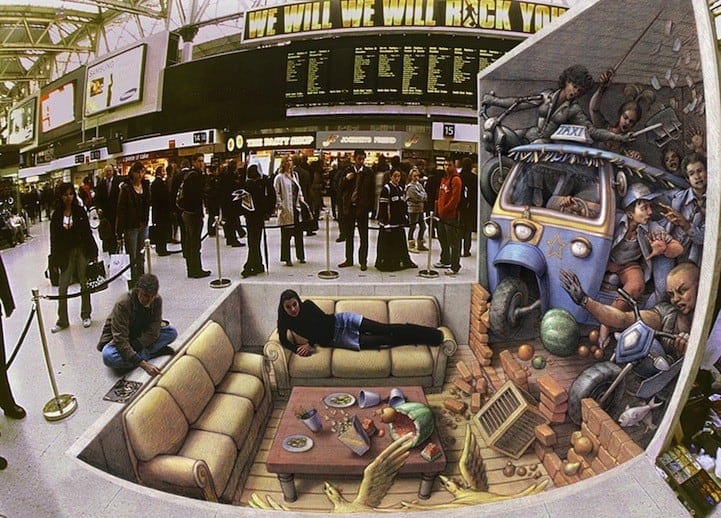
Kurt Wenner is an American artist known for developing modern 3D pavement art, a form of street drawing that uses distorted perspective to make flat surfaces appear deep, raised, broken open, or inhabited by figures. His work combines drawing, illusionism, and large-scale public performance, and it helped turn temporary sidewalk chalk images into a recognised visual genre.
| Field | Artist, illustrator, pavement art pioneer |
|---|---|
| Known for | Inventing and popularising 3D pavement art |
| Related technique | Anamorphic perspective, forced perspective, trompe-l’œil drawing |
| Mediums | Chalk, pastel, paint, large outdoor pavement surfaces |
| Active since | Late 20th century |
| Influence | Street art, festival art, illusion-based public drawing |
What made Wenner’s work different?
Wenner did not simply copy older anamorphic tricks. He pushed them into a new system built for the street, where the viewer stands on one chosen point and the drawing only resolves from that position. That meant inventing a geometry that could hold up across very large sidewalk or plaza surfaces, often under changing light, foot traffic, and weather.
The result is an image that can look like a shaft dropping into the ground, a staircase climbing out of the pavement, or a figure standing in a hole that is not really there. The illusion depends on precise distortion, but the finished work often reads as immediate and theatrical rather than technical. That balance helped make the form legible to a wide public.
How does 3D pavement art work?
3D pavement art uses perspective to control how the eye reconstructs an image from a fixed viewpoint. Artists map the composition so that objects near the “camera” are stretched and skewed, while distant parts compress sharply. From the correct angle, those distortions cancel out and the picture appears spatially coherent.
Wenner’s contribution was to treat the pavement like a stage set for a single viewing position. He developed methods for laying out gridded drawings, plotting vanishing points, and translating conventional forms into shapes that look wrong in plan but right in view. The technique can be done in chalk or pastel and may take hours or days, depending on size and complexity.
Why did it matter?
Wenner helped move pavement drawing from a street novelty into a recognised art form with its own rules, authors, and audiences. Before that shift, sidewalk art often sat between performance, decoration, and advertising. His images showed that temporary street drawing could carry the same ambition as mural painting or fine-art illusionism, while remaining open to public participation.
His work also broadened the visual language of anamorphosis. Artists and festivals around the world now use the same basic logic for public installations, brand activations, museum commissions, and social media images. Even when later artists adopt different subjects or styles, many still rely on the format Wenner helped codify: a single viewpoint, a distorted field, and a dramatic transformation when seen in the right place.
What does his work look like in practice?
Wenner’s images often feature classical architecture, figures, mythological scenes, or openings that seem to cut through the ground. They are usually bold, legible, and designed for immediate impact in public space. Because the surface is horizontal and exposed, the drawings often use strong tonal contrast and simplified forms so the illusion reads at a distance.
The making process is physical as well as optical. Large works require chalk snapping, careful measurement, and constant checking from the intended viewpoint. The finished image may survive only until rain, wind, or pedestrian traffic erase it, which gives the work a temporary, event-like character rather than the permanence of a framed painting.
Frequently Asked Questions
Is Kurt Wenner the inventor of 3D pavement art?
Wenner is widely credited with inventing modern 3D pavement art as a distinct practice. Anamorphic drawing existed long before him, but he adapted it for public ground surfaces and developed a system suited to street-scale illusion. That distinction matters: he did not invent perspective tricks, but he did build a new genre around them.
Is 3D pavement art the same as anamorphic art?
3D pavement art is a type of anamorphic art, but not every anamorphic image is pavement art. Anamorphosis can appear in paintings, prints, murals, and objects designed for a specific viewpoint. Wenner’s work is known for bringing that technique into outdoor public space on sidewalks, plazas, and streets.
What materials does Wenner use?
He commonly works with chalk and pastel on pavement, though large public drawings can also involve paint or mixed temporary materials. The choice depends on the surface, the scale, and how long the image is meant to last. The medium is part of the effect: fragile materials suit an art form built to be seen, photographed, and eventually erased.
Articles mentioning Kurt Wenner