
Trompe-l’œil is a visual technique that makes a painted, printed, stitched, or built surface look like something else, usually by imitating depth, texture, shadow, and scale so convincingly that the image seems three-dimensional. The phrase is French for “deceive the eye.” It appears across painting, mural art, ceramics, textiles, sculpture, and architecture whenever makers use realism to create an illusion.
Stories from Trompe-l’œil
12 stories




About Trompe-l’œil
- It relies on precise perspective, lighting, and shadow to simulate physical presence.
- The effect can be painted on a flat wall, glazed onto ceramics, stitched into textiles, or built into architectural details.
- It has deep roots in Western art history, especially in Roman wall painting and later European illusionist painting.
- Modern trompe-l’œil often mixes realism with humor, unease, or conceptual commentary.
- It differs from simple realism because the goal is not only to depict an object accurately, but to fool the eye into reading it as real.
Read the full overviewHow trompe-l’œil works, Where did it come from?, Why does it matter in art and design?, What does it look like in practice?
How trompe-l’œil works
Trompe-l’œil depends on visual cues that the eye uses to judge form and space. Makers exaggerate cast shadows, sharpen edges, match highlights to imagined light sources, and place objects at angles that mimic the way real things sit in space. A painted nailhead, a torn sheet of paper, a folded curtain, or a crack in plaster can be rendered so carefully that the surface seems to break open or project forward.
The illusion is strongest when the image sits in a real context that supports the fiction. A mural painted to look like a balcony, a ceramic vessel glazed to resemble rotten wood, or a curtain painted to reveal a hidden scene all work by borrowing the visual logic of the material they imitate. The viewer recognizes the trick at the same moment the trick succeeds.
Where did it come from?
The technique is old. Roman wall painting used it to suggest windows, architecture, and still lifes in homes with limited actual depth. In later European painting, especially during the Renaissance and Baroque periods, artists refined perspective and optical realism, making trompe-l’œil a display of skill as well as deception. It became a way to show that the maker understood how the eye reads space.
The term itself comes from French art discourse, but the practice is broader than any one language or school. Illusionist painting appears in many periods and places, from ceiling frescoes that open onto imagined skies to domestic decorative painting that imitates carved mouldings, drapery, or framed objects. In contemporary work, it also shows up in street art, ceramics, textiles, and installation art, where the old trick can be used for spectacle or critique.
Why does it matter in art and design?
Trompe-l’œil matters because it tests the boundary between surface and object. It asks what counts as representation and what counts as material fact. A flat wall can pretend to be a recess, a sketch can pretend to be a worn object, and a crafted surface can stand in for another medium altogether. That tension makes the technique useful in both fine art and design.
In contemporary practice, the illusion often carries more than virtuosity. Artists use it to point at labor, artificiality, memory, damage, or consumption. A painted tear in wallpaper can suggest hidden history; a ceramic object made to look like decayed wood can turn softness into permanence; a mural that appears to open a building into another space can alter how architecture is read from the street. The point is rarely only to impress. It is to make perception uncertain.
What does it look like in practice?
In practice, trompe-l’œil can be highly polished or deliberately rough. Some works imitate polished marble, polished metal, and crisp architectural edges. Others copy humble materials: peeling paper, tape, cardboard, fabric seams, nails, dust, or cracked paint. The technique is common in objects that play with scale, such as miniature scenes that read as life-sized details, or life-sized objects that look like models.
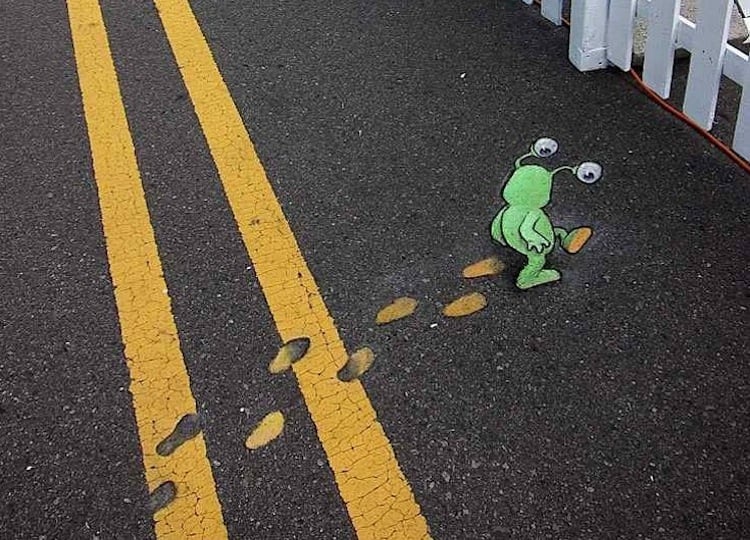
It also crosses media. In murals and chalk drawings, it often uses perspective to make objects seem to protrude from sidewalks or walls. In ceramics, glaze and form can mimic bark, rust, or folded cloth. In textiles and sewn works, artists can stitch shadows and folds so the image behaves like a three-dimensional object even when it lies flat. The illusion is always built from material means, even when it aims to hide them.
Frequently Asked Questions
Is trompe-l’œil the same as realism?
No. Realism aims to depict things convincingly, but trompe-l’œil aims to deceive the eye into reading the image as a physical object or space. The illusion depends on how the work sits in relation to its support, not just on accurate depiction. A realistic portrait may still look like a portrait; a trompe-l’œil curtain may seem ready to be lifted.
Is forced perspective the same thing?
Not exactly. Forced perspective is an architectural or spatial trick that manipulates scale and distance so objects appear larger, smaller, closer, or farther away than they are. Trompe-l’œil usually works through visual depiction on a surface, though both use optical manipulation and can produce similar effects.
Where is trompe-l’œil used today?
It appears in mural painting, street art, ceramics, decorative painting, installation, and occasionally fashion and textiles. Contemporary makers often use it to imitate broken, worn, or hidden materials rather than only luxurious ones. That shift gives the technique a fresh role: not just to show skill, but to mislead, amuse, or reveal how surfaces are read.