
Kylli Sparre is an Estonian fine art photographer known for staged images that fuse ballet, surrealism, and portraiture. Working under the name Sparrek, she builds photographs around the female body in motion, using gesture, pose, and setting to create scenes that feel theatrical and dreamlike. Her work matters because it turns dance training into a visual language for photography, replacing straightforward documentation with carefully composed images about balance, tension, and inner states.
Kylli Sparre’s work on FreeYork


About Kylli Sparre
- She began as a ballet dancer before moving into photography.
- Her images often feature the female figure in isolated, symbolic settings.
- She uses pose and composition more than overt narrative to create meaning.
- Her pictures are closely associated with surreal, fairy-tale, and performance-based imagery.
- Her practice shows how a performer’s training can shape photographic form.
From ballet to photography
Sparre’s background in ballet is central to her work. Years of training shaped her sense of line, rhythm, posture, and stage presence, even after she left dance as a profession. Rather than treating photography as a separate field, she carried those habits into the camera, using the body as a primary material and choreographing each frame with the discipline of a rehearsal.
That shift matters because her photographs do not simply record a dancer. They translate the logic of dance into still image. A lifted arm, a bent foot, or a suspended torso can carry the same expressive weight as a full movement phrase. The result is less about virtuosity than about restraint, balance, and emotional precision.
What does Kylli Sparre’s photography look like?
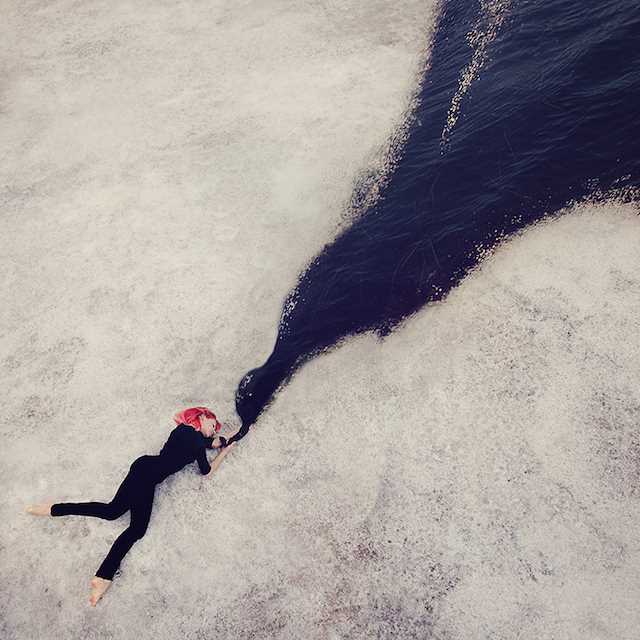
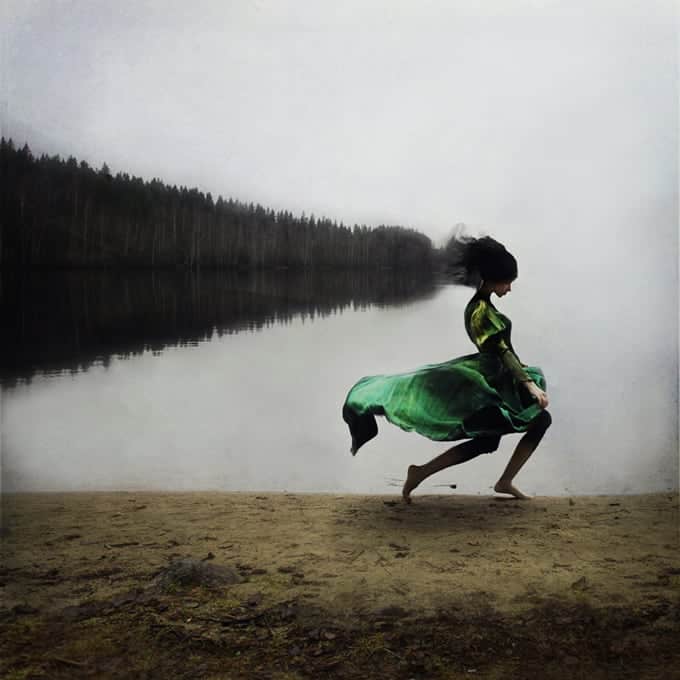
Her photographs are usually staged and highly controlled. A single figure often appears against a clean backdrop, a dark field, or a landscape that feels emptied of ordinary life. The body may be floating, folded, stretched, or awkwardly perched, and the image is often built around contradiction: elegance mixed with discomfort, grace paired with vulnerability, stillness charged with implied motion.
She frequently uses the female form as both subject and symbol. In some images the body looks almost weightless; in others it seems caught between performance and uncertainty. This visual tension gives her work its surreal quality. The pictures do not rely on digital spectacle for effect so much as on precise staging, costume, lighting, and pose.
Why her work stands out
Sparre’s photographs sit between fashion imagery, conceptual art, and dance photography, but they do not settle neatly into any of those categories. She uses the polished surface of fine art photography to explore internal experience: isolation, longing, self-possession, and the strange beauty of uncertainty. Her subjects often seem to be performing for no audience except themselves.
That inward focus gives the work a quiet intensity. Instead of chasing dramatic action, Sparre finds power in subtle gestures. A twisted wrist or a carefully turned back can suggest an entire emotional state. This economy of movement is one reason her images linger: they feel composed from the grammar of ballet, but they speak in the language of dream logic.
How the collaboration between body and image works
In Sparre’s practice, the camera does not simply capture a pose; it completes it. The photograph becomes the final stage of a choreography made for the lens. Background, costume, shadow, and posture all function like parts of a set design, each one contributing to a controlled visual sentence.
That approach also explains why her work often feels self-contained and symbolic. The image does not depend on a long caption or a sequence of frames. It communicates through composition alone. For readers coming from articles about her surreal self-portraits or dance-based series, the key idea is that Sparre uses photography to extend ballet’s formal discipline into a different medium, one where motion is implied rather than performed.
Questions
Is Kylli Sparre primarily a dancer or a photographer?
She is known primarily as a fine art photographer, although ballet shaped her artistic development. Her earlier dance training remains visible in the precision and bodily control of her images. Photography became the medium through which she continued to work with movement and expression.
Why are her photographs described as surreal?
They often place a human figure in an unusual or dreamlike situation, using pose, scale, and setting to create ambiguity. The scenes feel staged rather than documentary, and the body sometimes appears to defy ordinary gravity or logic. That surrealism comes from composition and performance, not only from editing effects.
What themes appear most often in her work?
Her photographs often return to femininity, solitude, bodily presence, and emotional tension. She uses the body to show quiet states rather than explicit stories. The work also reflects a strong interest in how discipline and vulnerability can coexist in the same image.