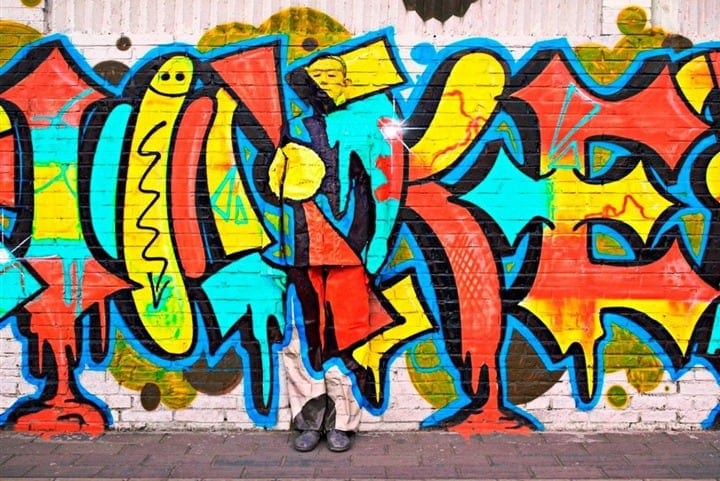
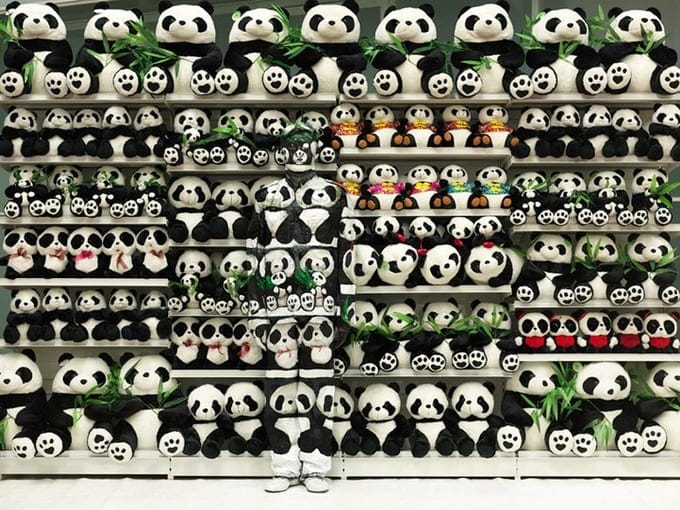
Liu Bolin is a Chinese visual artist known for camouflage performance art and staged photography in which he paints his body and clothing to blend into walls, shopfronts, shelves, or public spaces. Born in Shandong province in 1973, he trained at the Shandong College of Arts and later earned an MFA from the Central Academy of Fine Arts in Beijing. His best-known project, Hiding in the City, turned disappearance into both image and act.
- His work combines performance, body painting, photography, and site-specific installation.
- Hiding in the City began in 2005 and made him widely known as “the invisible man.”
- Each image depends on meticulous hand painting and careful alignment with the background.
- The finished work is usually a photograph, but the performance is central to how it is made.
What does Liu Bolin actually make?
Liu Bolin makes photographs that begin as performances. He stands motionless in front of a chosen surface while assistants paint his body, clothes, and sometimes surrounding props so that he disappears into the scene. The camera records the completed camouflage, but the visible image is only the end point of a longer process built around patience, precision, and physical endurance.
The work often starts with a strong social or political setting: supermarket aisles, newspapers, construction barriers, ruined buildings, or branded display walls. By merging himself with these places, Bolin turns the body into a tool for looking at what societies overlook, erase, or overproduce. The result is both illusion and critique.
How the camouflage works
The technique depends on exact matching rather than digital manipulation. Bolin and his team study the background, then use paint to copy its colors, lines, shadows, and textures onto his body and clothing. Even a small shift in posture can break the illusion, so the pose must hold long enough for the camera to capture the alignment.
This method gives the work its particular tension. The viewer first sees a nearly empty space, then notices the outline of a figure, and finally understands that the figure is present but visually absorbed into the surroundings. The image reads as a disappearance, but it is built through labor, visibility, and repeated attention to detail.
Why did Hiding in the City matter?
Hiding in the City made Bolin’s name because it condensed a simple visual trick into a broader cultural statement. The series began in Beijing in 2005 after the demolition of his studio, and that loss shaped the work’s concern with instability, urban change, and the individual’s place inside larger systems. The city became both subject and surface.
The series also stood out because it fused performance art with photography in a legible, immediately striking way. Unlike many performances that survive mainly through documentation, Bolin’s images are designed as finished works, but they still carry the evidence of time, concentration, and bodily strain. That combination helped the work travel widely in museums, galleries, and the press.
What themes does Liu Bolin return to?
Across later series, Bolin has used camouflage to address consumer culture, political pressure, environmental damage, and the visibility of artists, workers, and citizens in public life. He has blended himself into supermarket packaging, city walls, media imagery, and national symbols, often making the background speak as loudly as the figure. The body becomes a measure of how power is organized in plain sight.
The work can look playful at first, but it relies on a serious visual discipline. Bolin treats the body almost like a brush or a printing surface, and the surrounding environment as the image to be copied. That makes his practice relevant not only to performance art, but also to photography, painting, and installation, where the boundary between subject and setting is always under pressure.
Frequently Asked Questions
Is Liu Bolin a performance artist or a photographer?
He is both, but the performance comes first. The photograph is the final object, yet the work depends on real time, bodily stillness, and painted camouflage carried out in a specific place. Without the live action, the image would lose much of its meaning.
Why is he called “The Invisible Man”?
The nickname comes from his ability to disappear into his surroundings through paint and careful posing. It is not a fixed persona so much as a description of the visual effect he creates. The title also points to the themes of erasure and social invisibility that run through his work.
Does he use digital editing?
His signature works are not built on digital concealment. The illusion is created physically through body painting, costume, and alignment with the setting before the photograph is taken. Minor post-production may occur in some images, but the core effect comes from the performance itself.
Articles mentioning Liu Bolin