
Maude White is a cut-paper artist based in New York State’s Hudson Valley, known for intricate paper silhouettes, figurative scenes, and shadow-play compositions. She works by cutting sheets of paper with a blade rather than drawing or painting, turning a fragile material into dense, detailed images that often read like lace, engraving, or theatrical stage sets.
Maude White on FreeYork
What does Maude White make?
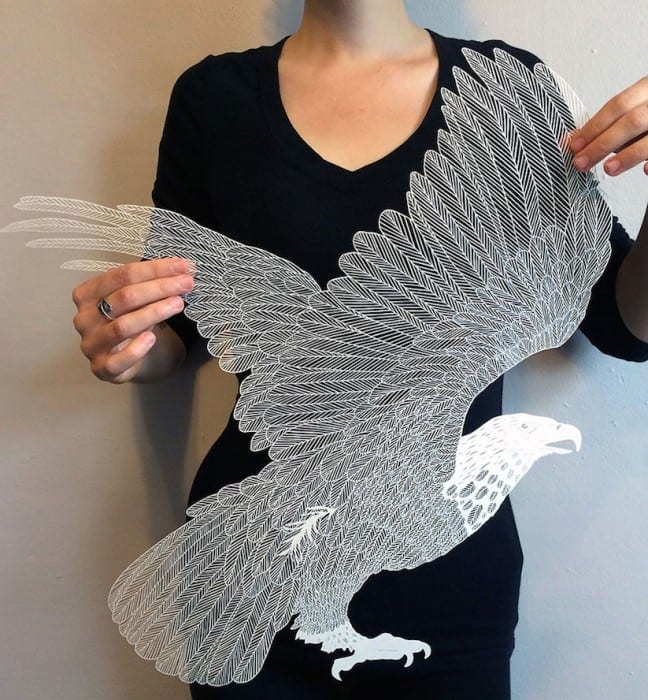
White makes hand-cut paper works with a sharp focus on line, rhythm, and negative space. A finished piece can look delicate from a distance, but close viewing reveals the labor of many small cuts, each one shaping figures, foliage, hair, clothing, or architectural detail. The paper itself becomes both drawing surface and subject.
Her work often relies on silhouette and contrast. Rather than building an image with pigment, she removes material to create form, so the remaining paper carries the image. That approach gives her work a distinctive visual tension: it can feel airy and ornamental, but it also depends on precision, control, and a steady hand.
How is her paper cutting different from simple craft?
Paper cutting has long histories in folk decoration, illustration, theatre, and protest art, but White’s practice sits in the contemporary art and design space. Her pieces are not decorative borders or classroom cutouts; they are composed images with narrative and atmospheric intent. The cut lines can model light, gesture, and expression as effectively as a pencil or brush stroke.
Material matters here. Paper is cheap, common, and easy to damage, which makes the act of cutting feel risky. White uses that fragility to her advantage, making work that looks light but requires exacting execution. In that sense, her practice belongs to a wider tradition of artists who treat paper as a structural medium rather than a support for something else.
Where did she become known?
White has been featured in online and print coverage, including profiles and articles in Urban Outfitters and Artvoice, which helped bring her work to a broader audience beyond gallery viewers. Her pieces have also been shown in international galleries, placing her within a transnational conversation about contemporary paper art and handcrafted image-making.
One notable assignment was the shadow theater segment in a film by Stefan Sagmeister. That kind of collaboration suits her method, because cut paper translates well to moving image, where layered silhouettes can be animated through light and camera movement. It also shows how paper cutting can function across illustration, installation, and film rather than staying in a single category.
Why does Maude White matter?
White matters because she treats a traditional hand technique as a modern visual language. Her work shows how a humble material can produce images that feel cinematic, intimate, and highly controlled at the same time. In a digital age, that physical evidence of hand labor carries weight, but the appeal is not nostalgia; it is the clarity and precision of the finished image.
She also helps keep paper cutting visible as a serious contemporary practice. The medium can be easy to dismiss as craft, but White’s work demonstrates how cut paper can support complex composition, emotional tone, and commercial or editorial use. For designers and visual artists, her practice is a reminder that subtraction can be as expressive as addition.
Questions
Is Maude White’s work illustration or fine art?
It sits between the two. Her pieces use the visual logic of illustration, especially in their storytelling and silhouette-based composition, but they are also presented as finished artworks. That overlap is part of what makes her practice legible in both galleries and editorial contexts.
What materials does she use?
Her core material is paper, cut by hand with blades or knives. The effect depends on clean edges, careful planning, and the relationship between the cut shape and the untouched sheet. Light and shadow are also part of the medium, especially in work intended for theatrical or filmic presentation.
Why is her work often compared to shadow theater?
Because the images depend heavily on silhouette, depth, and contrast. Cut paper naturally creates shapes that read strongly when lit from behind or projected, which gives the work a stage-like quality. Her contribution to a shadow theater segment in a film made that connection especially clear.