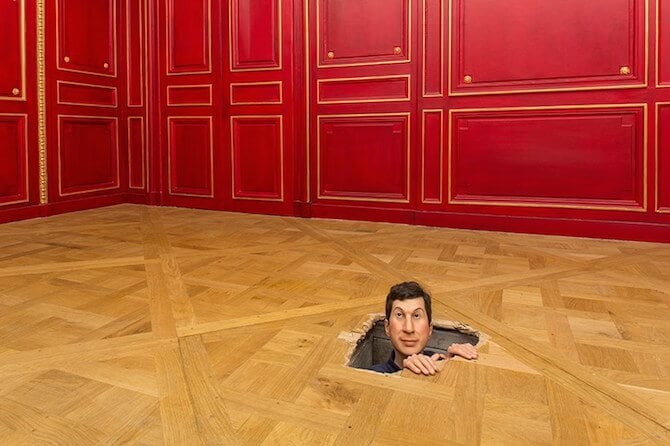
Maurizio Cattelan is an Italian contemporary artist known for sculptures, installations, and pranks that use deadpan humor to mock power, art-world seriousness, and public taste. His work often looks simple at first glance, but it relies on exact staging, convincing materials, and sharp political timing to land its point.
- Born in Padua in 1960, Cattelan emerged in the 1990s as a self-taught artist with a taste for provocation.
- He works across sculpture, taxidermy, wax, fiberglass, and everyday objects arranged as if they were accidents or jokes.
- His best-known works often place authority figures, animals, or doubles in humiliating or uncanny situations.
- He is widely associated with satire, but the satire is usually built through careful object-making and exhibition design.
- His pieces can be visually polished, emotionally hostile, and deliberately ambiguous at the same time.
What Cattelan makes
Cattelan’s work is usually understood as conceptual art, but it depends heavily on material form. He has made life-size figures, taxidermied animals, simplified props, and staged environments that mimic the look of a crime scene, a memorial, or a joke gone too far. The surface finish matters: wax skin, polished resin, mounted fur, and believable clothing help the work hover between fake and real.
That ambiguity is central to his method. Cattelan rarely explains a piece in a straightforward way, and he often allows the title to do part of the work. A sculpture may look like a portrait, a disaster, or an act of disrespect, then shift once its context is known. The result is work that reads fast in a gallery but lingers because it is hard to settle into one meaning.
Where did his style come from?
Cattelan came out of the European art scene of the late 1980s and 1990s, when irony, institutional critique, and a dislike of solemn modernist heroics were already well established. He sharpened those tendencies into something more theatrical and more commercial-looking. Rather than building an obviously handmade style, he often borrows the visual language of advertising, memorials, children’s books, or showroom display.
His background outside a formal academy helped shape that approach. He has described himself as an outsider, and that position shows in the way his work treats art-world conventions as material to be manipulated. The effect is not naïve rebellion. It is closer to precision sabotage, with each object calibrated to trigger embarrassment, laughter, or discomfort.
Why is Maurizio Cattelan important?
Cattelan became one of the best-known artists of his generation because he made ridicule look expensive and exact. He proved that sculpture could still function as a public event, not only as an object on a plinth. His work travels easily through magazines, auction houses, museum collections, and social media because it compresses into a single image that carries a strong punch line.
He also matters because he changed how contemporary satire can operate inside the art market. His pieces criticize institutions while also thriving within them, which keeps the work unstable. That tension is part of the point: Cattelan does not stand outside the system so much as he exposes how well irreverence can be packaged, sold, and remembered.
What does a Cattelan work look like in practice?
A Cattelan piece often resembles a scene frozen just after something has gone wrong. A body may be collapsed, a figure may be trapped, an animal may appear to have wandered into an impossible situation. The craftsmanship is usually strong enough to make the illusion persuasive, but not so smooth that the object disappears into realism. Viewers are meant to notice the construction as well as the joke.
La Nona Ora, made in 1999, is one of the clearest examples. It shows Pope John Paul II knocked to the ground by a meteorite, combining religious portraiture, spectacle, and absurd violence in a single image. Other works follow similar logic: the subject may be famous, sacred, or powerful, but the treatment pushes it into humiliation or fragility. That is where his visual language becomes distinct: meticulously made objects that behave like insults.
Frequently Asked Questions
Is Maurizio Cattelan a sculptor or a conceptual artist?
He is both, although his reputation leans toward conceptual art. The ideas carry the work, but the objects are made with real attention to scale, texture, and installation. Without that material precision, the jokes would flatten out.
Why do people find his work offensive?
His pieces often target religion, authority, national symbols, and the art world itself. He uses humiliation and bodily vulnerability as visual tools, which makes the work hard to separate from insult. Offense is not just a side effect; it is often part of the structure.
What is the point of the humor in his art?
The humor lets Cattelan compress criticism into an image that is easy to recognize but hard to dismiss. It also prevents the work from becoming pure moral commentary. The joke keeps the viewer off balance long enough for the seriousness underneath to register.
Articles mentioning Maurizio Cattelan