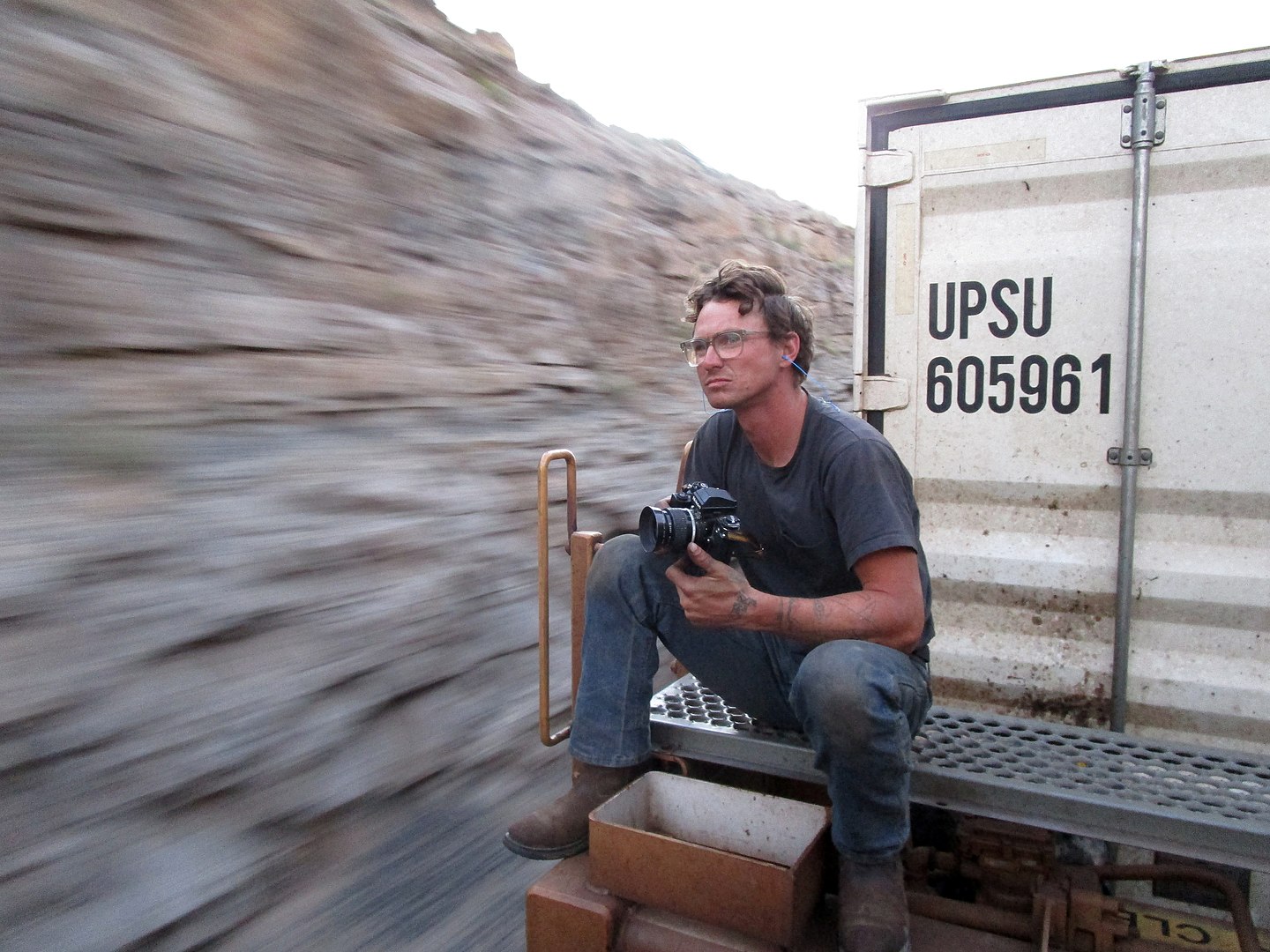
Mike Brodie is an American photographer known for candid black-and-white and Polaroid images made while he was riding freight trains across the United States in the 2000s. Working under the name Polaroid Kidd, he documented the people, routes, temporary homes and improvised routines of rail travel from the inside, using a camera as a companion to a life on the move.
| Born | 1985 |
|---|---|
| Origin | Pensacola, Florida, United States |
| Known for | Self-taught photography made while freight-hopping |
| Best-known camera | Polaroid SX-70 |
| Also known as | Polaroid Kidd |
Who is Mike Brodie?
Brodie left home at 18 in 2003 and began travelling the rails, first as a way of living and then as the setting for his photography. A friend gave him a camera, and he started making pictures of the people he met along the way: other riders, drifters, friends, lovers and companions. The work is direct and intimate, with no visible studio setup or formal posing. It feels made from proximity because it was.
He is self-trained, and that matters to the way the photographs look. Brodie did not come from a fine-art background or a newspaper darkroom; he learned by handling the camera in the same spaces he was trying to understand. That gives the pictures a rough, immediate quality that suits their subject: motion, uncertainty, youth and the social codes of life around trains.
What does his photography look like?
Brodie’s images are known for their closeness and speed. Many were made with a Polaroid SX-70, which produces instant prints with a soft, tactile surface and a narrow, enclosed frame. That format matches the scale of his subjects: sleeping bags in boxcars, faces in doorways, bare rooms, tracks, and people standing in yards or beside moving freight. The camera’s instant output also meant the photograph could exist as an object right away, passed around or carried along with everything else.
His pictures often register as snapshots, but they are shaped by disciplined attention. He returned to the same scenes and people, which gives the work a sense of continuity rather than travel-blog novelty. The emotional tone is unsentimental but not detached. The photographs show friendship, exhaustion, risk and a kind of improvised freedom, without turning those things into symbols.
Why does Mike Brodie matter?
Brodie became important because he made a body of work from within a subculture that is often viewed from the outside, usually as danger, romance or delinquency. His photographs do not flatten freight hopping into an aesthetic of rebellion. They record the practical reality of that life: how people sleep, move, wait, share food and keep company. That makes the images useful as visual documents as well as art photographs.
He also matters because his route to photography sits outside the usual institutions. The work was not shaped by a school assignment, a commercial brief or an editorial commission. It emerged from personal movement, cheap materials and repeated use of one compact camera. For FreeYork, that makes him a clear example of photography as a made thing: a practice built from travel, handling, timing and the physical properties of a specific tool.
What happened after the rail years?
After the period most associated with his train photographs, Brodie’s public profile grew in the art world and photography press. That later attention often framed the freight-hopping images as a completed body of work rather than an ongoing habit. The pictures continue to circulate because they are both specific and legible: they describe a distinct American subculture without needing much explanation.
What survives best is the sense of a life recorded from the middle of it, not after the fact. That is one reason the photographs remain persuasive. They do not ask to be read as myth. They show how a camera can become part of a way of living, and how a way of living can shape a photographic style.
Frequently Asked Questions
Why is Mike Brodie called Polaroid Kidd?
Polaroid Kidd was Brodie’s pseudonym during the years he made his freight-travel photographs. The name points to the instant film he used and the youthfulness of the work’s origin. It also separates the image-maker from the traveller, since the pictures came from a life lived on the rails rather than from a conventional studio identity.
What camera did Mike Brodie use?
He is best associated with the Polaroid SX-70, a folding instant camera known for its distinctive square format and immediate prints. The camera’s portability suited travel, and its physical output matched the fast, temporary conditions in which he worked. The device became part of the visual identity of the photographs themselves.
Is Mike Brodie mainly a documentary photographer or an artist?
He is often described as both, depending on the context. The pictures function as documentary evidence of freight-hopping culture, but they also stand as formally strong photographs shaped by editing, framing and rhythm. Their value comes from that overlap: lived experience translated into a coherent visual body of work.