
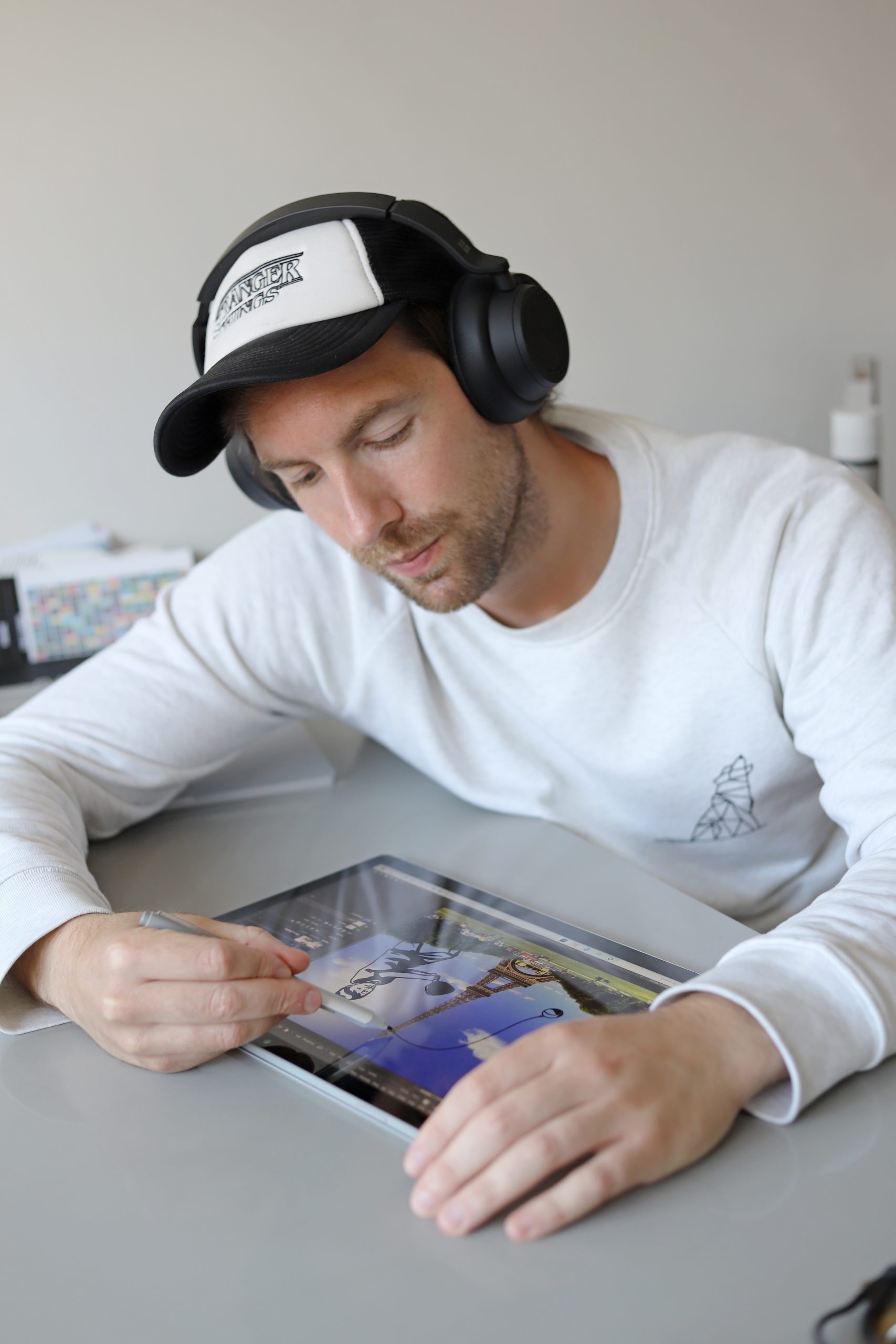
Paperboyo is the artist identity of Rich McCor, who creates photographs by placing cut paper cutouts against real-world landmarks and scenes so that the edited composition becomes the artwork. He is known for turning famous buildings, monuments and city details into visual jokes, puns and small illusions, usually shared through his Instagram-led practice and made on location while travelling.
| Fact | Detail |
|---|---|
| Real name | Rich McCor |
| Known as | Paperboyo |
| Medium | Paper cutouts, photography, digital composition |
| Where he works | On location in cities and landmarks around the world |
| Based in | London |
| Best known for | Transforming landmarks with simple paper interventions |
How Paperboyo’s work is made
Paperboyo’s images begin with a site-specific observation. McCor studies a landmark, street view or object in the built environment, then makes a paper cutout that interacts with it through scale, perspective or silhouette. The cutout might add a missing shape, complete a visual pun, or make a famous structure appear to become something else entirely. The final photograph is the finished work, not a record of a separate sculpture.
The technique is disarmingly simple: paper, scissors or a craft knife, careful placement, and photography. That simplicity matters. The cutout has to be clean enough to read instantly, but loose enough to let the surrounding architecture or landscape stay recognisable. The joke lands because the real place is still present; the paper intervention only shifts its meaning for a moment.
Why does Paperboyo matter?
Paperboyo sits at the point where illustration, street art and travel photography meet. The work depends on public space and on the cultural charge of well-known landmarks, which means the images carry both a local encounter and a global visual reference. A bridge, tower or museum facade becomes more than a backdrop; it becomes a collaborator in the composition.
The practice also shows how little material is needed to make a memorable image. Instead of large installations or complex digital effects, McCor uses a low-tech method that can be carried in a bag and adapted quickly to different places. That economy has made the work widely shared online, where a single strong image can travel far beyond the site where it was made.
What does a Paperboyo image look like?
A typical Paperboyo image places a small, crisp paper figure in relation to a much larger real structure. A cutout might turn the sun into a balloon, a building into a character, or a skyline element into part of a visual sentence. The paper often appears black or white against the scene so that the outline is legible at a glance, though the exact style changes with the location and the joke.
These works are not meant to disguise the landmark. They highlight it by editing it. The pleasure comes from noticing the match between cut paper and built form, and from the way a familiar place briefly behaves like a drawing.
How did he come to this style?
McCor built Paperboyo through travel and social-media practice, using the camera as a tool for making quick, site-responsive interventions. The identity grew around a clear and repeatable method, which is one reason it is easy to recognise. The name itself suggests the material and the playfulness of the work: paper, folded into a public performance of image-making.
Living in London while travelling for projects gives the practice two scales. In London, the work can draw on the density of architecture and tourism that defines the city. Elsewhere, the same method can be applied to recognisable monuments, giving each image a local twist without changing the basic process.
Frequently Asked Questions
Is Paperboyo a person or a studio name?
Paperboyo is the working name of Rich McCor. It functions as an artist identity rather than a separate organisation or collective. The name is strongly tied to the visual method, which makes it easy to associate with the work itself.
What materials does Paperboyo use?
The core material is paper, cut into simple shapes and figures. He also relies on photography to frame and preserve the intervention, and sometimes digital editing may help refine the final image. The physical element remains central because the paper cutout has to interact with the real scene.
Is the work made on location or in the studio?
The images are generally made on location, using the environment that inspired the idea in the first place. The cutouts may be designed beforehand, but the key decisions happen in relation to the site, light and perspective. That site-specific approach is what gives the work its wit and immediacy.
Articles mentioning paperboyo
