
Riyadh is the capital and largest city of Saudi Arabia, and the administrative centre of Riyadh Province. It sits on a high plateau in the central Arabian Peninsula, within the historical regions of Najd and Al-Yamama, and forms the core of a metropolitan area of nearly 7 million people. Today it is also one of the most visible sites of rapid urban change in the Gulf, especially through infrastructure, architecture, and public works.
Stories from Riyadh
7 stories



About Riyadh
- Capital of Saudi Arabia and Riyadh Province
- Located in the centre of the Arabian Peninsula on a plateau
- Historical association with Najd and Al-Yamama
- Population of the city: about 5.25 million
- Metro area: close to 7 million people
Read the full overviewWhy does Riyadh matter?, What does the city look like on the ground?, How has Riyadh changed through design and infrastructure?, What is Riyadh’s place in Saudi culture?
Why does Riyadh matter?
Riyadh matters because political power, economic investment, and large-scale design decisions meet there. As the seat of the Saudi state, it concentrates government institutions, major transport planning, and many of the country’s most ambitious building programmes. That makes the city a useful lens for understanding how Saudi Arabia presents itself through architecture, landscape design, mobility systems, and public space.
The city’s size also matters. A metropolis of this scale needs roads, metro lines, civic centres, utilities, parks, and districts that can absorb sustained growth. For designers, planners, and architects, Riyadh has become a test case for how a desert capital can expand while trying to remain legible, climatically responsive, and symbolically modern.
What does the city look like on the ground?
Riyadh’s physical form is shaped by heat, distance, and low-rise sprawl. Much of the city spread outward in car-oriented development, with wide roads, separated districts, and large plots that reflect late twentieth-century planning. The architecture ranges from concrete apartment blocks and office towers to mosques, shopping malls, and institutional buildings, often set against a broad, open skyline.
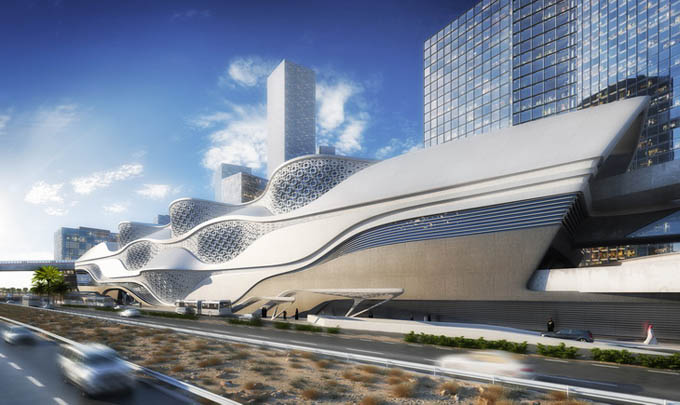
Recent projects have added a more deliberate visual identity. New stations, cultural buildings, and public spaces increasingly use stone, metal, glass, shade structures, and patterned surfaces to create places that are not only functional but memorable. In a city defined for decades by movement at the scale of the automobile, these projects try to produce walkable interiors, recognisable landmarks, and interiors that temper the sun.
How has Riyadh changed through design and infrastructure?
Riyadh’s recent transformation is strongly tied to infrastructure. Metro construction, road upgrades, and major public developments have changed how the city is navigated and how it is represented. The metro, in particular, has introduced a new kind of civic architecture: stations that are not just transit nodes but urban rooms, built to carry large numbers of people while also signalling a more connected future.
That shift has brought international design firms into close contact with local conditions. Projects such as the reflective metro hub by Snøhetta show how global architectural language is adapted to Riyadh’s climate and urban identity. Mirrors, screens, deep shade, and material surfaces can turn a station into both infrastructure and image, linking everyday movement to the city’s broader reinvention.
What is Riyadh’s place in Saudi culture?
Riyadh is not the country’s oldest or most traditionally picturesque city, but it is one of the most consequential. Its history as a political centre and its location in Najd give it a strong role in the modern formation of the Saudi state. The city therefore carries both administrative weight and symbolic force, standing for central authority, national development, and the pace of change.
For that reason, Riyadh often appears in design coverage as a place where future-facing projects are especially concentrated. The city has become associated with scale, speed, and ambition: new metro lines, cultural districts, and public realms are all part of a larger effort to reshape how urban life is experienced in the capital. Its importance lies not only in size, but in how visibly it stages the country’s current direction.
Frequently Asked Questions
Is Riyadh a historic city?
Yes, but its historic importance is tied more to politics and state formation than to a preserved old urban fabric. It grew from the wider Najd region and became the centre of modern Saudi governance. Much of the city’s present form, however, is the result of twentieth- and twenty-first-century expansion rather than premodern continuity.
Why do designers and architects pay attention to Riyadh?
Riyadh is a major site of urban investment, so it attracts large commissions and experimental public projects. Its climate, scale, and car-oriented layout create strong design challenges, especially for transit and public space. That makes it a place where architecture has to do practical work while also creating a distinct civic image.
What is the most characteristic feature of Riyadh’s urban environment?
Its scale is one of the most characteristic features: long distances, wide roads, and expansive development shape daily movement. The city also has a harsh desert climate, so shade, enclosure, and material reflectance matter a great deal. These conditions influence everything from street life to metro station design.