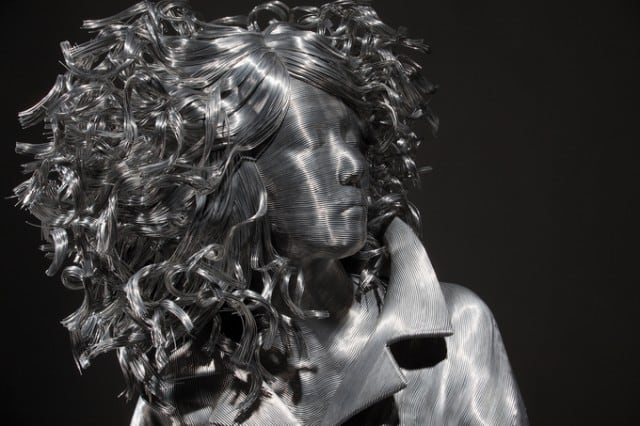
Seung Mo Park is a South Korean artist known for large-scale sculptures and wall-mounted images made by wrapping and layering thin aluminum wire over armatures, often over photographic sources. His best-known work turns a dense industrial material into surfaces that read like shaded drawings, portraits, or floating figures.
| Essential fact | Details |
|---|---|
| Who | South Korean artist |
| Known for | Wire sculptures and wire-based image works |
| Main material | Aluminum wire |
| Typical look | Gray, silvery forms that shift between image, relief, and sculpture |
| Common subjects | Portraits, bodies, animals, and layered figural scenes |
How Park makes images out of wire
Park’s practice centers on a simple but exacting process: he winds thousands of strands of aluminum wire around a framework until a coherent image appears. From a distance, the work can look like a photograph rendered in graphite or a low-contrast print. Up close, it resolves into a dense tangle of metal line, with each strand contributing to tone, contour, and depth.
This method matters because it turns drawing into construction. The line is not printed on a surface but built in space, strand by strand. Light plays across the wire and changes the image depending on angle, so the works are never fixed in a single visual state.
Why aluminum wire?
Aluminum wire gives Park a material that is light, malleable, and reflective. It can be bent tightly without the heaviness of steel, yet it still holds form when packed into layers. The metallic sheen also helps the work shift between object and image: at one moment it reads as sculpture, and at another as a ghostly monochrome picture.
The choice of wire also connects the finished work to labor-intensive making. Each surface records a repetitive hand process, closer to weaving or embroidery than to casting or carving. That slow accumulation gives the pieces their tonal depth and their sense of fragility, even when the scale is monumental.
What do his sculptures look like in practice?
Park is best known for wall pieces and freestanding figures that seem to emerge from a field of line. Many works begin with a photographic reference, especially portraits or human bodies, then are translated into wire so the source image becomes softened, blurred, and partially abstracted. The result often feels suspended between recognition and disappearance.
In larger installations, the wire can create the impression of motion or atmosphere rather than fixed anatomy. Forms may dissolve at the edges, and negative space becomes as important as the material itself. This gives the work a visual tension: it appears airy from afar, but it is actually built from a laboriously accumulated mass of metal.
What makes Seung Mo Park important?
Park matters because he expands what sculpture can do with a humble industrial material. Aluminum wire is usually associated with structure, fastening, or armature; in his hands it becomes a medium for drawing, modeling, and image-making. That shift has made his work widely recognizable in contemporary visual culture.
His practice also bridges categories that are often kept apart. It is sculpture, but it behaves like a drawing; it is figurative, but it also depends on abstraction; it is physically solid, but visually unstable. That combination has made his work a strong reference point for artists and designers interested in process, line, and the transformation of everyday materials into precise visual form.
Frequently Asked Questions
Is Seung Mo Park a sculptor or a painter?
He is primarily a sculptor, but his work borrows heavily from drawing and painting. The wire acts like line, while the layered density produces shading and image-like gradation. That hybrid quality is part of what makes his work distinctive.
Does he only use aluminum wire?
Aluminum wire is the material most closely associated with his work, especially in the pieces that made him widely known. Its lightness and flexibility suit his method of layered construction. Other supports or armatures may be involved, but the visual identity of the work comes from the wire itself.
Why do his works often look like photographs from a distance?
Park uses tightly packed wire to create tonal transitions, much like the highlights and shadows in a photograph. From far away, those layers fuse into a single readable image. At close range, the illusion breaks apart into individual strands and visible handwork.
Articles mentioning Seung Mo Park