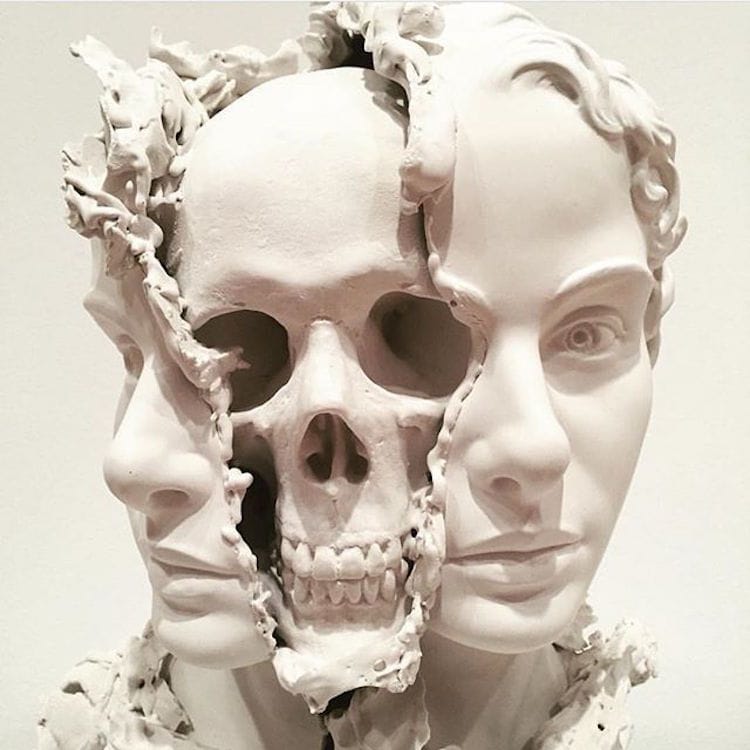
Taiji Taomote is a contemporary artist best known for sculpture and installation work that uses bodily fragmentation, smooth synthetic surfaces, and unsettling hybrid forms to make the familiar feel unstable. His pieces often combine the look of polished craft with imagery of bones, skin, organs, and animal or mythic bodies, creating objects that sit between figurative sculpture and surreal display.
| Field | Contemporary sculpture and installation |
|---|---|
| Known for | Split, hybrid, and bodily forms with a surreal edge |
| Materials | Varies by work; often finished to read as clean, glossy, or highly fabricated |
| Visual character | Fragmented anatomy, smooth contours, uncanny realism |
| Why it matters | Shows how sculpture can use the body as a site of anxiety, metamorphosis, and display |
What kind of artist is Taiji Taomote?
Taomote works in a sculptural language that turns the body into a mutable object. Rather than presenting anatomy in a strictly realistic way, he isolates parts, splits forms open, and reassembles them so they look both precise and impossible. The effect depends on tension: the work feels carefully made, but the subject matter resists comfort.
This places him in a broader contemporary line of artists who treat the human figure as material for transformation rather than portraiture. The work is not about likeness or identity in a narrow sense. It is about what a body can become when it is translated into object, symbol, and strange surface.
Why does his work feel so unsettling?
Taomote’s sculptures often play with the edge between the polished and the grotesque. A surface may appear smooth and elegant, yet the form beneath it suggests rupture, exposure, or anatomical disassembly. That contrast matters: it keeps the viewer from settling into a single reading of the object.
The unease comes from recognition. Even when the body is abstracted, the forms still carry traces of skulls, limbs, cavities, and skin-like membranes. The sculpture can feel like a specimen, a relic, a costume, or a dream image at once, which is part of its force.
How are these sculptures made?
Taomote’s work belongs to a practice that depends on fabrication as much as modelling. The finished pieces often look carefully assembled and refined, suggesting casting, carving, moulding, sanding, and surface finishing rather than a quick gestural approach. That control over surface is central to the effect, because the material finish helps the forms read as both real and artificial.
Even without a single fixed medium across every work, the visual logic is consistent: construction matters, and the final object is designed to hold attention as a manufactured thing. The technical polish is not decorative. It intensifies the disquiet by making the impossible anatomy look deliberate and exact.
What does Taiji Taomote contribute to contemporary sculpture?
Taomote’s significance lies in how he uses sculpture to stage transformation without resolving it. The work does not simply illustrate horror, fantasy, or surrealism. It uses sculptural methods to make those states physical, so the viewer encounters them as objects occupying space.
That makes the work useful for thinking about how contemporary sculpture can move beyond pedestal and monument. It can function as an image, a body, a relic, and an engineered surface all at once. In Taomote’s case, the result is a practice that treats the figure as unstable material and turns that instability into the subject of the work.
Frequently Asked Questions
Is Taiji Taomote associated with a specific art movement?
He is best understood through contemporary sculpture and surreal figuration rather than through a single formal movement. His work draws on traditions of surrealism, anatomical image-making, and highly finished fabricated sculpture. The emphasis is on the body as a site of transformation, not on allegiance to one school.
What materials does Taomote use?
The available public descriptions of his work suggest a flexible studio practice rather than one fixed medium. His sculptures often appear highly finished, which points to processes such as casting, carving, moulding, and surface treatment. The exact materials vary by piece, but the visual result is usually controlled, smooth, and precise.
Why is his work often described as surreal?
It is described that way because it takes recognizable bodily forms and rearranges them into images that do not obey normal anatomy. The forms feel dreamlike, uncanny, and symbolic rather than naturalistic. That surreal quality is created through sculpture itself, not just through subject matter.
Articles mentioning Taiji Taomote