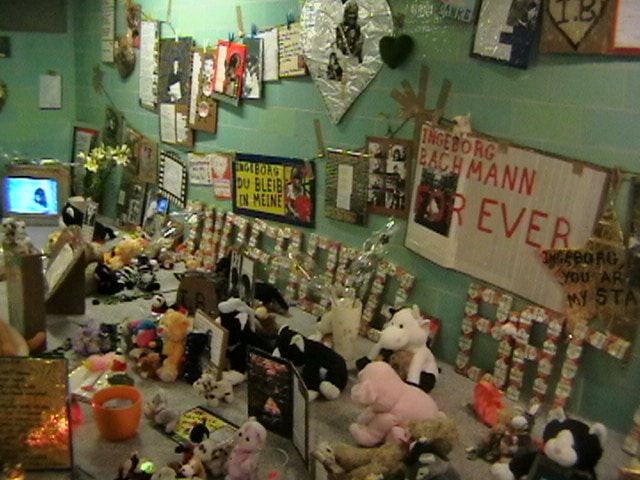
Thomas Hirschhorn is a Swiss artist known for large-scale installations built from cardboard, tape, foil, printouts, and other low-cost materials. Born in Bern in 1957, he makes crowded environments that mix sculpture, collage, text, images, and political argument. His work treats making as an act of urgency rather than polish, and he often builds spaces that feel temporary, overloaded, and intentionally rough.
- Swiss artist born in Bern in 1957.
- Best known for installation-based work using cheap, everyday materials.
- Combines sculpture, collage, text, and printed matter into dense public environments.
- Often addresses philosophy, media, war, class, and political power.
- His work is important for showing how raw materials can carry serious intellectual and social content.
What kind of artist is Thomas Hirschhorn?
Hirschhorn works across installation, sculpture, collage, and public art, but his projects often look less like finished objects than like temporary sites of production. Cardboard panels, duct tape, aluminum foil, photocopies, packaging, plastic sheeting, and handwritten texts recur throughout his practice. These materials are deliberately ordinary and fragile, which gives the work a directness that resists luxury display and polished finish.
His art often occupies the space between exhibition, protest, and information overload. Rather than isolating a single image or form, he builds environments that force many things to coexist: posters, slogans, books, photographs, mannequins, newspaper clippings, and rough construction. The result is not minimalist clarity but a dense field of references, with the viewer moving through a hand-built argument.
Where did his practice come from?
Hirschhorn emerged in Europe in the 1980s and 1990s, when many artists were rethinking the role of sculpture after conceptual art and postmodernism. Instead of returning to traditional materials such as bronze or marble, he chose what he could gather, cut, tape, and assemble quickly. That decision mattered because it linked form to ethics: the work would not hide its construction, its cost, or its provisional nature.
His practice also grew from an interest in political philosophy and mass media. He frequently cites writers and thinkers in his installations, but he does not present their ideas in a tidy academic form. He pushes them into public, messy, spatial settings where reading becomes physical and where theory sits alongside debris, print, and improvised architecture.
Why does Thomas Hirschhorn matter?
Hirschhorn matters because he showed that low-grade materials can support ambitious art without becoming decorative or cynical. Cardboard and tape are not used here as a cheap stylistic trick; they are structural and conceptual. They make the work unstable, temporary, and visibly made by hand, which keeps attention on labor, circulation, and the conditions under which culture gets built.
His work also widened the idea of what installation can do in public space. He has made projects that function as forums, libraries, monuments, or temporary commons, often in sites outside the conventional gallery. These works ask art to operate at the scale of civic encounter, where spectatorship, reading, and social exchange all happen at once.
What does his work look like in practice?
A Hirschhorn installation can resemble a shanty-built archive or a battlefield of printed matter. Surfaces may be wrapped in foil, layered with photocopies, marked with tape, or covered in handwritten notes. Books and images are not neatly framed; they are pinned, stacked, pasted, or strewn across walls, tables, and floors, creating a sense of immediate assembly rather than careful display.
He often favors repetition and excess. The same image may appear many times, and the same material may be used everywhere, so the installation becomes a kind of visual pressure system. What gives the work force is the tension between its precarious materials and its serious ambitions: it is rough, but it is never casual.
Frequently Asked Questions
Is Thomas Hirschhorn a sculptor or an installation artist?
He is usually described as an installation artist, though sculpture remains central to his work. His pieces often combine built form, collage, text, and found material, so they do not fit neatly into one category. The label changes less important than the method: he constructs environments rather than isolated objects.
Why does he use cardboard and tape so often?
Those materials are cheap, available, and easy to work with, but they also carry meaning. They keep the work visibly provisional and refuse the authority of permanent, expensive materials. In his hands, cardboard and tape become a way to talk about labor, fragility, and the politics of making.
Is his work political?
Yes, often explicitly so. Hirschhorn uses art to address war, inequality, media culture, philosophy, and public responsibility, but he rarely turns those subjects into slogans. Instead, he builds situations where political ideas appear through materials, accumulation, and public use.
Articles mentioning Thomas Hirschhorn