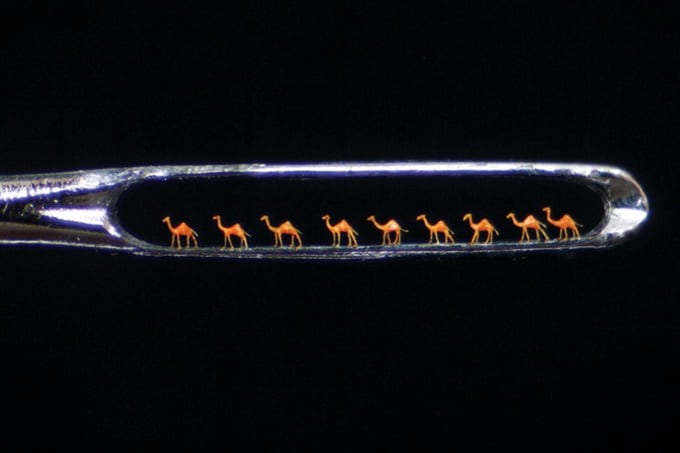
Willard Wigan is an English sculptor known for making microscopic artworks that fit inside a needle’s eye or on the head of a pin. Working from Birmingham, he built a reputation for sculpture at a scale so small that many pieces can only be seen properly under magnification. His art turns precision, patience, and hand control into the subject as much as the finished object.
- Born: 1957, Birmingham, England
- Known for: Micro-sculpture made at microscopic scale
- Materials: Often tiny fragments of gold, silver, dust, or sculpted fibres, depending on the work
- Scale: Some works measure around 0.005 mm across
- Honour: MBE awarded in 2007 for services to art
What does Willard Wigan make?
Wigan makes miniature sculptures that are far smaller than conventional figurines, miniature paintings, or dollhouse objects. He is best known for placing finished works in spaces such as the eye of a needle, the opening of a sewing pin, or on a match head. The tiny size is not a novelty added at the end; it is the central idea of the work.
These sculptures are usually figurative or symbolic, and the subject matter often needs a strong silhouette to remain legible at microscopic scale. Because the pieces are so small, their impact depends on the contrast between their physical invisibility and the effort required to make them.
How is micro sculpture made?
Micro sculpture demands an extreme working environment. Wigan has been reported to use microscopes, fine tools, and controlled hand movements to shape materials that can be damaged by breath, vibration, or the pressure of a normal brushstroke. At this scale, even dust can become a building material or a hazard, which means the studio process is as important as the image itself.
The practice sits between sculpture, craft, and precision engineering. Traditional sculptural methods such as carving, modelling, and assembly still apply, but they are reduced to their smallest possible gesture. The maker must account for material behaviour in a way that ordinary sculpture does not require: a fibre may stand in for a beam, a grain may read as a body, and a tiny sliver of metal may carry the whole form.
Why does his work matter?
Wigan’s work matters because it challenges the normal relationship between scale and attention. Sculpture usually claims space; his work often hides inside a space no one would notice without instruction. That reversal changes the viewer’s idea of what counts as skill, labour, and artistic seriousness.
His practice also belongs to a long tradition of technical virtuosity in art, where mastery is demonstrated by doing something that appears impossible. In Wigan’s case, the impossibility is not only the size of the finished work but the fact that the process must be carried out with almost no margin for error. The result is art that depends on discipline, not spectacle.
Where did this practice come from?
Wigan developed his style in England, drawing on a personal fascination with making extremely small objects. He is often presented as a self-taught or unconventional sculptor rather than a figure emerging from a single academic school. That background matters, because micro art sits outside the main histories of monumental sculpture and public installation.
His public recognition grew alongside exhibitions and media coverage that made the works famous for their size as much as their form. The 2007 MBE from the Prince of Wales marked official acknowledgment of a practice that had already become distinctive in contemporary art and popular culture.
Frequently Asked Questions
What is micro art?
Micro art is artwork made at a scale so small that it is difficult or impossible to see clearly without magnification. It can include sculpture, drawing, or assemblage, but the defining feature is the extreme reduction in size. In Wigan’s case, the work is sculptural and often installed in tiny supports such as needle eyes or pin heads.
How small are Willard Wigan’s sculptures?
Some of Wigan’s sculptures are said to measure around 0.005 mm, which places them well below the threshold of unaided sight. The exact size varies from piece to piece, but all of them rely on microscopic precision. The scale is part of the meaning, not just a technical fact.
Why is Willard Wigan famous?
He is famous for making some of the smallest sculptures ever widely exhibited and discussed. The combination of visual delicacy, technical difficulty, and unusual presentation made his work memorable to both art audiences and the general public. His MBE also brought official attention to a practice that might otherwise have remained a niche curiosity.
Articles mentioning Willard Wigan