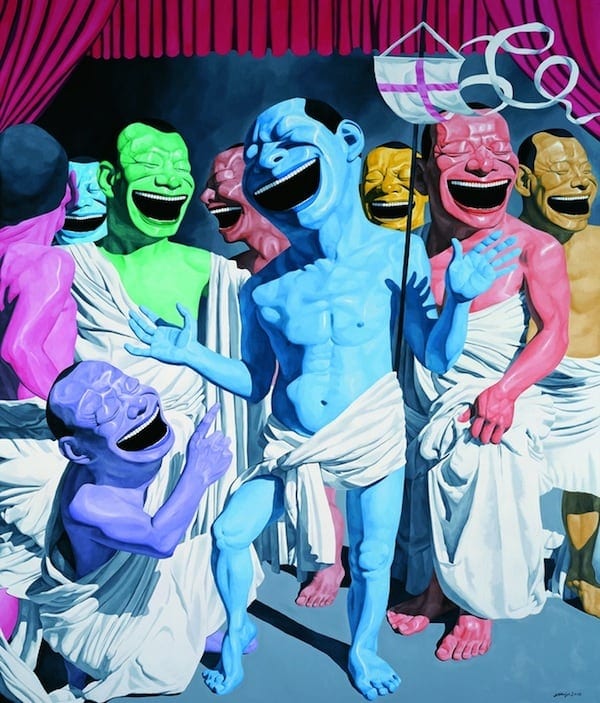
Yue Minjun is a contemporary Chinese artist known for paintings, sculptures, watercolors, and prints that repeat his own face in a wide-open laugh. Based in Beijing, he built a recognizable visual language from a single image: a self-portrait with pink skin, closed eyes, and a grin that can read as comic, forced, or unsettling. That repeated figure has made him one of the most recognizable artists to emerge from China in the 1990s.
- Best known for self-portraits showing the artist laughing or smiling stiffly
- Works across oil painting, sculpture, watercolor, and print
- Often associated with Chinese “Cynical Realism,” though he rejects the label
- Uses repetition, bright color, and cartoon-like simplification to create an ambivalent tone
- His images are widely collected and easily identified, which helped define his public profile
What does Yue Minjun actually make?
Yue Minjun’s most familiar works are oil paintings in which the artist appears again and again in different situations: floating, saluting, falling, posing, or standing in rows. The face barely changes. The mouth is stretched into a laugh, the eyes are shut tight, and the expression can look as much like a mask as a feeling. He has also translated that image into bronze-like sculptures, watercolors, and prints, keeping the same visual joke while changing medium.
That consistency matters. Instead of building a career around many styles, Yue turned one repeated figure into a brand of sorts, but a brand with ambiguity built in. The paintings are polished and legible, yet they resist a single reading. They can seem humorous, surreal, self-protective, or critical of public life and performance.
Where did his style come from?
Yue came of age in China during a period of rapid social and cultural change after 1989. Many artists working then moved away from academic realism and into forms that treated political imagery, mass culture, and personal identity with irony or detachment. Yue’s work emerged in that atmosphere. The stylized laughter in his paintings often gets linked to the tension between private feeling and public display in post-socialist China.
His approach also draws power from reduction. He uses a small set of elements—his own face, saturated color, simplified bodies, clean surfaces, and staged compositions—to make each work instantly readable. The repetition has a mechanical quality, but the results are carefully made. In practice, that means oil paint is handled with precision, forms are controlled, and the surfaces are usually smooth rather than visibly expressive.
Is Yue Minjun part of Cynical Realism?
Yue is frequently grouped with Chinese “Cynical Realism,” a term used for artists who responded to the 1990s with satire, irony, and emotional distance. The label fits some aspects of his work, especially the knowing grin and the sense that the image is performing for an outside gaze. But Yue has said he does not accept the category, even if he also does not spend much energy policing it.
That disagreement is useful because it shows how art history often names a movement after the fact. Yue’s work overlaps with Cynical Realism in mood and timing, but it is not limited to it. The paintings are less like slogans than visual objects built from repetition, self-portraiture, and theatrical restraint. Their meaning shifts depending on context: one image can read as absurd comedy in a gallery and as a pointed social image in a book or museum display.
Why does his work stand out?
Yue Minjun’s art stands out because it is easy to identify and hard to pin down. The laughing figure has become one of the most reproduced images in contemporary Chinese art, but its meaning is never fixed. The grin can suggest confidence, panic, irony, compliance, or numbness. That instability gives the work its staying power.
It also matters that he carried the same motif into different forms. In sculpture, the figure becomes more physical and object-like; in watercolor, it can feel lighter and more provisional; in print, repetition becomes even more central. Across those media, the same face continues to ask a basic question: what does it mean to keep smiling when the context is unclear?
Frequently Asked Questions
Why is Yue Minjun always laughing?
The laughter is the core image in Yue Minjun’s work, but it does not point to simple happiness. It functions more like a fixed expression that can suggest unease, irony, self-mockery, or social performance. The repetition makes the smile feel less personal and more symbolic.
What medium is he best known for?
He is best known for oil painting, especially large canvases featuring the repeated laughing self-portrait. He has also made sculpture, watercolor, and prints using the same motif. The shift across media changes the feel of the image without changing its basic structure.
Does Yue Minjun belong to a specific art movement?
He is often linked to Chinese Cynical Realism because of the timing, tone, and irony in his work. Yue himself rejects the label, which leaves his practice in a useful middle ground: close enough to the movement to be discussed within it, but distinct enough to stand on its own. That ambiguity is part of how his art has been interpreted.
Articles mentioning Yue Minjun