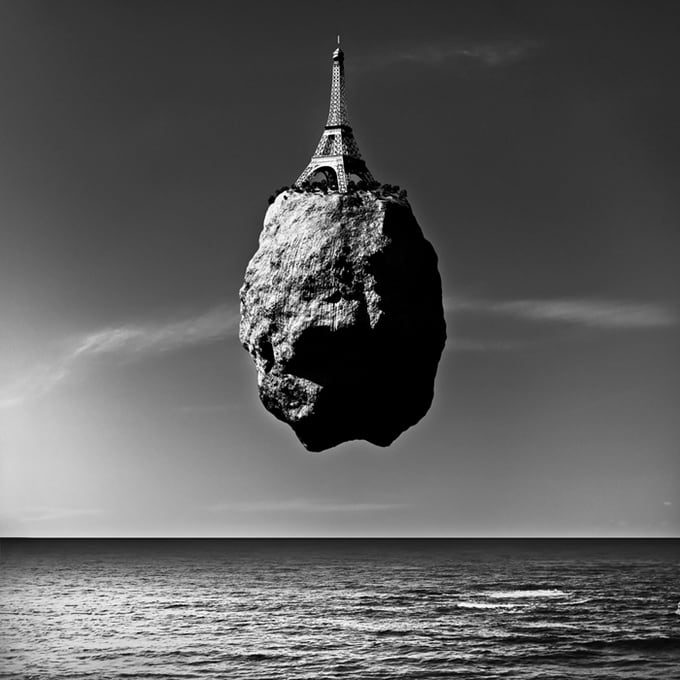
Giuseppe Lo Schiavo is an Italian visual artist and photographer known for staged images that combine performance, set building, and digital post-production. His work often uses bodies, architectural forms, and symbolic objects to create scenes that feel part studio construction, part illusion, and part contemporary myth.
| Field | Visual art, photography, staged image-making |
|---|---|
| Nationality | Italian |
| Known for | Surreal and cinematic photographs built from performance, props, and compositing |
| Materials and methods | Live models, constructed sets, props, lighting, photography, digital editing |
| Notable concern | How images can make gravity, scale, and space feel unstable |
What kind of artist is Giuseppe Lo Schiavo?
Giuseppe Lo Schiavo works at the point where photography meets constructed image-making. He does not simply document a scene; he builds situations that can be photographed, then refines the result through editing. The finished image usually preserves the clarity of photography while introducing a visual logic that feels impossible, theatrical, or dreamlike.
That approach places him among artists who treat the photograph as an engineered object rather than a neutral record. Lighting, pose, architecture, costume, and post-production all matter equally. His images often read like single frames from a larger story, but the story is usually secondary to the image’s physical ingenuity.
How does his work use levitation and other visual tricks?
Levitation is a useful clue to his style because it shows how he handles gravity as a visual problem. A body may appear suspended, a structure may seem to float, or an object may be positioned in a way that breaks ordinary spatial expectations. Those effects can come from wire rigs, careful balancing, hidden supports, compositing, or a combination of methods.
The result is not simple trickery for its own sake. The point is to create tension between what the eye recognises as a photograph and what the mind knows should not be possible. That tension gives the work its charge: the image is legible, polished, and precise, yet slightly unstable.
Where does this style come from?
Lo Schiavo’s work sits within a broader tradition of staged photography and digital image construction. It also draws from performance art, fashion imagery, and cinematic art direction, where the final picture depends on collaboration between subject, set, costume, and camera. The practice reflects a contemporary studio workflow in which shooting and editing are part of a single process.
His images also connect to older visual traditions that used illusion to test perception, from baroque theatricality to surrealism. What changes in a digital age is the ease with which physical staging can be extended or altered after the shoot. That makes the image both handcrafted and synthetic, which is central to its appeal.
Why does Giuseppe Lo Schiavo matter?
He matters because his work shows how photography can still surprise without abandoning craft. The images depend on real materials and production decisions: bodies placed with precision, objects fabricated or sourced for a specific shot, light shaped to hide support systems, and editing used to stitch the scene into coherence. The art lies in making all of that disappear into a convincing surface.
For a reader coming from a piece on levitation, he is a strong example of how an apparently magical effect is usually the result of careful design. His work turns technical control into an aesthetic language. That makes him relevant not only to photography, but to anyone interested in how visual culture manufactures wonder.
Frequently Asked Questions
Is Giuseppe Lo Schiavo mainly a photographer or a digital artist?
He is best understood as a visual artist who uses photography as one of his main tools. The final image often depends on digital post-production, but it begins with physical staging, camera work, and lighting. That blend is central to the work.
What materials are involved in his process?
His images usually involve live models, props, constructed sets, lighting equipment, and digital editing software. Some works may also rely on hidden supports or other practical devices to create impossible positions. The material logic matters because the illusion is built from real-world components.
Why is his work associated with surreal imagery?
His scenes often displace ordinary scale, balance, or bodily movement, which makes them feel dreamlike. Surrealism is not just a style label here; it describes the way the image puts familiar things into unfamiliar relations. The result is an image that feels coherent but not entirely plausible.
Articles mentioning Giuseppe Lo Schiavo