
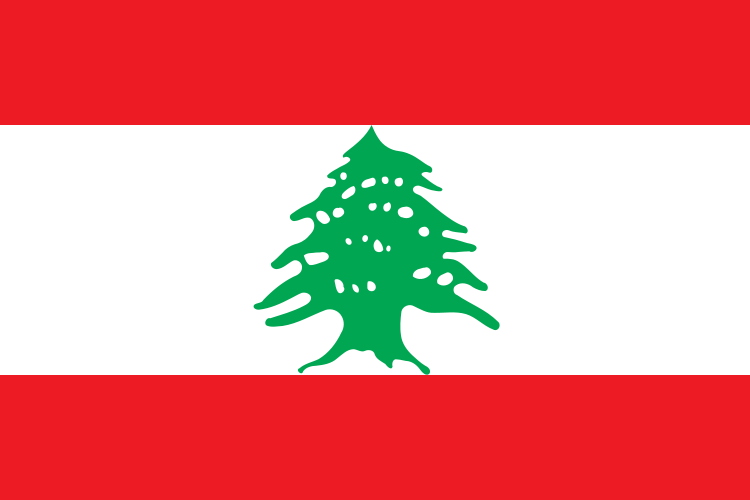
Lebanon is a country on the eastern Mediterranean coast, bordered by Syria to the north and east and Israel to the south. Its compact territory has long made it a meeting point for trade routes, religions, languages and craft traditions, and that density still shapes its visual culture. Ancient settlements, Ottoman-era cities, French Mandate architecture, postwar reconstruction and a strong contemporary design scene all sit close together in the same small geography.
- A coastal mountain country with a long urban history and deep regional connections.
- Known for layered identities: Arab, Mediterranean, Levantine, Christian, Muslim and diasporic.
- Its architecture and material culture reflect repeated rebuilding after conflict and political change.
- Beirut has functioned as a publishing, design, fashion and art hub for the wider Arab world.
- Lebanese makers often work across craft, memory and survival, using local materials and inherited techniques.
Where is Lebanon, and why does its location matter?
Lebanon sits between sea and mountain, with the Mediterranean to the west and the Levantine interior to the east. That position has made it a corridor rather than a closed national space. Goods, images and people have moved through it for millennia, from Phoenician maritime trade to modern migration and exile.
The country’s geography has also shaped settlement. Coastal cities such as Beirut, Tripoli and Tyre developed as ports, while inland valleys and mountain towns preserved distinct religious and communal life. The result is a place where dense urban life, village craft and seasonal agriculture coexist within short distances.
What does Lebanese culture look like in practice?
Lebanese visual culture rarely reads as uniform. It draws from Ottoman domestic architecture, French-influenced city planning, Arab calligraphy, church and mosque ornament, and the domestic craft traditions of woodwork, metalwork, weaving and ceramics. Contemporary artists and designers often work with these layers rather than choosing one as an identity marker.
That mixture matters because Lebanon has also become a place where making is tied to memory and repair. After civil war, economic collapse and the 2020 Beirut port explosion, many makers turned to salvaged material, fragmented archives and hand processes as a way to register loss. In that context, a brick, candle, textile or photograph can carry both formal and political meaning.
Why does Lebanon matter in art, design and craft?
Lebanon has long punched above its size in publishing, fashion, graphic design and contemporary art. Beirut especially became a regional centre for experimental magazines, galleries, studios and workshops, supported by a multilingual culture and an audience used to moving between Arabic, French and English. That openness helped local practices circulate across the Middle East and into Europe and North America.
Craft traditions remain central to this reputation. Contemporary projects often work with glass, clay, wax, thread, embroidery and brass, not as nostalgia but as active materials for new forms. The work of Lebanese artists and makers frequently combines handmaking with conceptual frameworks, as seen in projects that treat domestic objects, ritual forms or destroyed urban material as carriers of history.
How has displacement shaped Lebanon?
Lebanon has been shaped as much by people leaving as by people arriving. Waves of emigration created a large global diaspora, while nearby conflicts brought refugees and repeated internal displacement. This movement has affected family structures, patronage, labour and the circulation of images and objects.
In visual terms, displacement often appears as instability of place: empty rooms, worn surfaces, portable belongings and photographs made in provisional settings. Lebanese portraiture and documentary work frequently carries that tension. It looks at private interiors, storefronts, streets and temporary shelters as sites where identity is negotiated rather than fixed.
Frequently Asked Questions
Is Lebanon mainly a Middle Eastern or a Mediterranean place?
It is both. Lebanon belongs politically and culturally to the Arab East, but its coastline, climate and trade history also tie it closely to the Mediterranean. That double orientation is one reason Lebanese culture often feels layered rather than singular.
Why is Beirut so often mentioned in relation to Lebanese art and design?
Beirut has long been Lebanon’s publishing, commercial and cultural centre. Its galleries, studios, schools and workshops drew artists, designers and writers from across the region, especially in the second half of the twentieth century. Even after repeated crises, it remains the city most associated with Lebanese creative production.
What materials are closely associated with Lebanese making?
There is no single national material, but several recur: clay, glass, wax, thread, stone, brass and paper. These materials appear in both traditional craft and contemporary work, often because they are locally available and easy to shape by hand. Many Lebanese projects use them to connect domestic life, ritual and memory.