
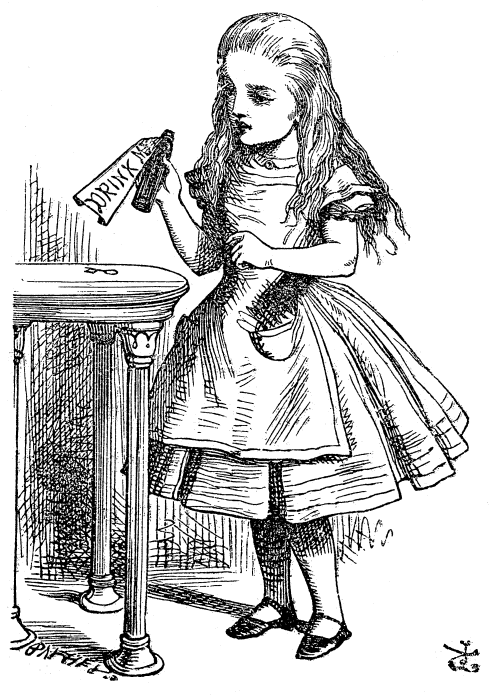
Alice is the young fictional heroine of Lewis Carroll’s Alice’s Adventures in Wonderland and Through the Looking-Glass, a curious Victorian girl whose fall into a rabbit hole opens onto a world of unstable scale, logic, and language.
- She first appears in 1865 in Alice’s Adventures in Wonderland and returns in the 1871 sequel Through the Looking-Glass.
- Alice is not a symbol only of childhood innocence; she is also a practical observer who keeps asking how the world works when the world refuses to obey ordinary rules.
- Her image has spread far beyond the books into illustration, theatre, film, fashion, advertising, and classroom imagery.
- Many artists use Alice’s figure to signal curiosity, absurdity, and the collision between disciplined order and dream logic.
Who is Alice?
Alice is a fictional child protagonist created by Lewis Carroll, the pen name of Charles Lutwidge Dodgson. She is usually read as a well-mannered, articulate girl from middle-class Victorian England, placed in situations that strip away familiar social rules. In the books, she stays recognizable because she keeps testing her surroundings with logic, memory, and politeness, even when those habits stop making sense.
That combination matters. Alice is not just a passive traveller through nonsense; she is the book’s measuring device. Her body changes size, her speech is challenged, and her certainty is repeatedly shaken, which gives Carroll a way to stage puzzles about identity, authority, education, and language.
Why does Alice matter in visual culture?
Alice became one of the most durable figures in modern illustration because she can carry many visual meanings at once. John Tenniel’s original drawings established her with a plain dress, apron, and long hair, a look that later artists have echoed, simplified, exaggerated, or recast. That outfit has become a shorthand for Victorian childhood, but also for vulnerability, discipline, and exposure to the unknown.
Designers and image-makers return to Alice because she sits between exactness and fantasy. She can appear in classroom murals, fashion editorials, surrealist collage, stage costume, children’s publishing, and digital illustration without losing her identity. Her image works especially well when a maker wants to contrast neat surfaces with irrational content, as in chalk drawings, painted backdrops, or graphic compositions that tilt familiar scale out of joint.
What does Alice look like in practice?
In practice, Alice usually appears as a young girl in a simple dress, often with an apron, dark stockings, and a headband or ribbon. The classic look comes from Tenniel’s engravings and later Disney’s 1951 film adaptation, which fixed a paler, blond version in mass culture. Some artists keep the original brown hair and plain dress; others turn her into a stylized silhouette, a schoolgirl figure, or a more surreal body that changes proportion as the story demands.
Her presence often signals more than costume. In visual work, Alice can mark a scene of transition: a doorway, a fall, a distorted room, oversized objects, or a classroom suddenly turned strange. That is why she continues to appear in contemporary art and illustration, where her figure offers a ready-made way to show curiosity meeting systems that no longer behave.
How did Alice become so widely recognized?
Alice’s wide recognition comes from repetition across media. The books were illustrated, adapted, staged, and reprinted constantly, and each version reinforced a small set of images: the rabbit, the key, the tea party, the chessboard, the shrinking bottle, the mushroom. Alice stands at the centre of those scenes as the one constant human figure, so she became the easiest element to carry from page to poster to screen.
Her flexibility also helped. She is specific enough to feel real, but generic enough to be redrawn by different eras and markets. That makes Alice useful to publishers, artists, advertisers, and educators who want a figure that instantly reads as literary, playful, and slightly unsettling.
Frequently Asked Questions
Is Alice based on a real person?
Yes, the character was inspired in part by Alice Liddell, a child known to Lewis Carroll in Oxford. The fictional Alice is not a direct portrait, though, and the books reshape any real-world source into a literary figure with her own logic and voice. Over time, the character has become more influential than the historical namesake.
Why is Alice often used in art and design?
Alice offers a clear visual shorthand for imagination under pressure. Her story already contains strong pictorial devices: size change, impossible spaces, and objects that seem ordinary until they do something impossible. Designers use her because she can make an image feel playful, uncanny, or critical without much explanation.
What is the difference between Alice in the books and later adaptations?
The books present Alice as brisk, observant, and often annoyed by nonsense, which keeps her grounded. Later adaptations sometimes soften her into a more passive child or emphasize whimsy over argument. Visual culture has also changed her look, especially through film and merchandising, but the core idea remains the same: a child moving through a world that refuses stable rules.