
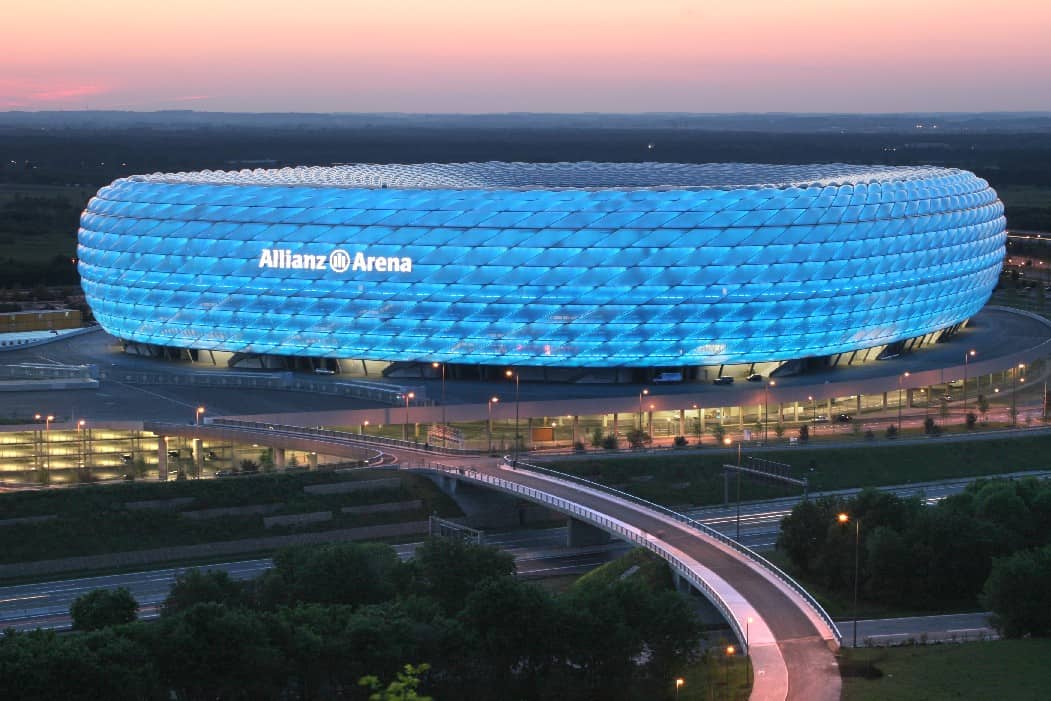
Herzog & de Meuron is a Swiss architecture practice based in Basel, founded by Jacques Herzog and Pierre de Meuron. The firm is known for buildings that are technically exacting and materially inventive, often using brick, concrete, glass, metal, and printed or patterned surfaces to give ordinary construction a sharper visual identity.
- Founded in Basel by Jacques Herzog and Pierre de Meuron, both born in 1950.
- The practice works across museums, stadiums, housing, towers, infrastructure, and adaptive reuse.
- Its projects often treat the facade as a primary design field, not just an outer shell.
- It is associated with careful detailing, collaboration with engineers and fabricators, and distinctive material finishes.
- Many of its buildings are designed to shift with context rather than repeat a single formal style.
What kind of architecture practice is it?
Herzog & de Meuron began in Basel in the 1970s and grew into one of the most influential architecture firms in Europe. Jacques Herzog and Pierre de Meuron trained at ETH Zurich, and their work developed through a period when architecture was moving away from rigid modernist formulas toward projects that could be more site-specific, more tactile, and more open to experimentation.
The firm is not known for one signature shape. Instead, it usually starts from the brief, the site, and the material possibilities of a project. That approach has made the office especially visible in public buildings, where it can combine engineering, urban presence, and a strong surface language without relying on decorative excess.
What does Herzog & de Meuron architecture look like?
The work often appears controlled at first glance, but the interest lies in how surfaces are made. A facade may use stacked brick, perforated metal, translucent polycarbonate, patterned concrete, or glass with a carefully tuned reflectivity. The effect is rarely purely ornamental. Texture, color, depth, and light are used to shape how a building sits in its surroundings.
Several projects show the range of the practice. The Tate Modern extension in London turns a power-station complex into a civic museum campus. The Beijing National Stadium, designed with Ai Weiwei, uses an exposed steel lattice that became one of the most recognizable sports structures of the 2000s. Other works, including housing and smaller cultural buildings, often push less dramatic but equally precise material strategies.
Why does the firm matter?
Herzog & de Meuron matters because it helped shift high-profile architecture toward a more material and place-responsive vocabulary. The firm demonstrated that contemporary architecture could be intellectually ambitious without being visually generic. Its projects show how a building can be made memorable through construction logic, surface treatment, and spatial sequence rather than through a single iconic gesture.
The practice has also been influential because it moves easily between building types. Museums, stadiums, commercial buildings, and residential projects all appear in its portfolio, and each one tends to be approached as a specific problem rather than as a variation on a house style. That flexibility has made the firm a reference point for architects working at large scale and for clients seeking cultural distinction.
How does the firm work in practice?
In practical terms, Herzog & de Meuron’s buildings depend on close coordination between concept and fabrication. Material samples, mockups, and technical testing play a large role, especially when a project depends on a facade or structure that must be both durable and visually distinct. This is architecture that often lives or dies in the details of joints, panel sizes, brick coursing, or surface treatment.
The office also works through adaptation. It has been especially strong in converting existing industrial or civic structures into new uses, where old envelopes are retained, cut, extended, or wrapped in new layers. That willingness to reuse and reframe existing fabric gives the practice a place in contemporary debates about sustainability, preservation, and the value of embodied material.
Frequently Asked Questions
Are Herzog & de Meuron associated with a specific style?
Not in the narrow sense. Their work varies widely, but it often shares an attention to material surface, precise detailing, and strong relationships between building and site. Rather than repeating one look, the firm adapts its language to the project.
What materials do they use most often?
They work with a broad range of materials, including brick, concrete, steel, glass, stone, and perforated metal. The important point is not the material alone but the way it is handled: thickness, texture, pattern, and construction method usually carry as much meaning as form.
Why do architects and critics talk about them so often?
Because the practice has shaped how large public buildings can be both functional and visually distinct. Its projects often become reference points in discussions of facade design, adaptive reuse, and the relationship between architecture and urban identity. The firm’s influence comes from consistency in quality rather than consistency in appearance.