Leandro Erlich is an Argentine conceptual artist known for large-scale installations that use architecture, mirrors, glass, water, and theatrical staging to make everyday spaces feel unstable. His work often appears as a convincing public scene at first glance, then reveals itself as a constructed illusion. Erlich emerged in the international biennial circuit in the early 2000s and became widely known for pieces that turn familiar places such as stairs, elevators, facades, and swimming pools into perceptual puzzles.
- Conceptual artist from Argentina, working mainly with installation and illusion
- Uses built environments, reflective surfaces, and carefully staged props to disrupt perception
- Exhibited at the Venice Biennale, Whitney Biennial, and Istanbul Biennial
- Known for immersive works that invite physical movement and close looking
- Often makes public-scale pieces that read as ordinary places until viewed more carefully
What kind of artist is Leandro Erlich?
Erlich belongs to a strain of conceptual art that uses real materials to produce doubt. Rather than painting an image of a room or street, he builds part of the room or street itself, then alters it enough to make the scene feel wrong. The effect depends on precise construction: false perspectives, duplicated surfaces, hidden supports, and controlled sightlines. His work does not simply illustrate an idea; the installation becomes the idea in physical form.
That approach links him to installation art, but his pieces are usually more specific than a general environment. They behave like short experiences with a punchline, although the joke is about perception, not comedy. Visitors may find themselves looking into a fake elevator shaft, standing in front of a mirror that is not a mirror, or crossing a pool that is actually a shallow chamber of water above a dry space.
How does he make illusions feel real?
Erlich’s installations depend on ordinary building materials arranged with unusual exactness. He works with glass, mirror film, steel framing, plaster, painted surfaces, water, and lighting to copy the look of familiar places. The key is not spectacle alone. The work has to survive close viewing, because the viewer usually approaches expecting a real architectural element rather than a staged scene.
His best-known pieces often use a single visual trick with great discipline. A mirrored facade can make a building appear to contain people climbing inside it. A pool can appear deep while actually allowing viewers to walk under a water-filled chamber. A sandy traffic jam can look like a frozen urban emergency until the materials and setting reveal the stage-like construction. In practice, the work depends on carpentry, engineering, surface finishing, and a strong understanding of how people read space.
Why did biennials matter to his career?
Erlich’s career developed through major international exhibitions, which are especially important for work that needs physical scale and institutional support. He represented Argentina at the 2001 Venice Biennale and was included again in the main section in 2005. He also appeared in the 2000 Whitney Biennial and the 2001 Istanbul Biennial. Those platforms placed his work in front of curators, critics, and museum audiences at a moment when installation art was gaining wider public attention.
Biennials matter for artists like Erlich because the work is hard to reproduce in a conventional gallery image. The experience depends on entering the space and moving through it. Large exhibitions provide the footprint, fabrication budgets, and institutional context needed to make that possible. They also make it easier for a site-specific piece to enter public memory, since the installation often lives on through photographs after the temporary structure is dismantled.
What makes his public installations memorable?
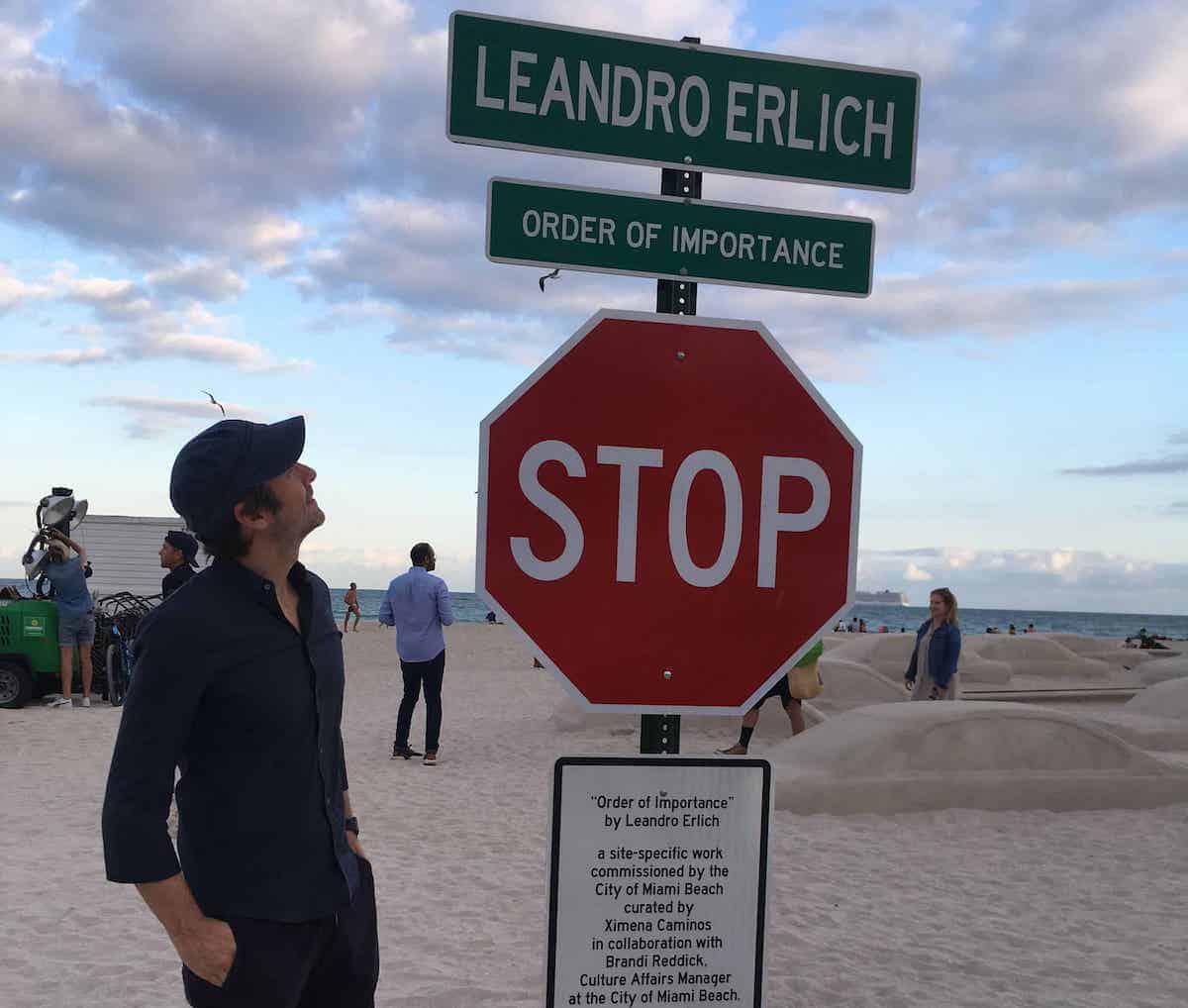
Erlich often places his work in settings where it can collide with everyday life. That can mean a city square, a museum courtyard, or a beach. The Miami sandy traffic jam fits that pattern: it takes a scene associated with urban frustration and relocates it to a leisure setting, shifting the tone while keeping the visual logic intact. The result is immediately readable but slightly absurd, which is central to his method.
These works succeed because they make people negotiate what they think they are seeing. The viewer becomes part of the mechanism, pausing, circling, photographing, and comparing appearances with physical facts. That interactive quality gives the pieces a public life beyond the exhibition itself. They circulate as images, but they are designed as situations, not just pictures.
Frequently Asked Questions
Is Leandro Erlich a sculptor or an installation artist?
He is best described as a conceptual and installation artist. His works often involve sculptural elements, but the final effect depends on the entire constructed environment rather than on an isolated object. Architecture and staging are as important as form.
What materials does he use most often?
He commonly uses glass, mirrors, water, steel, timber, plaster, paint, and other building materials. The exact mix changes from piece to piece, but the aim is usually to make a familiar structure look plausible from one angle and impossible from another. Precision in fabrication is essential.
Why is his work so often photographed?
His installations reward photography because they reveal their trick through framing. A camera can record the illusion cleanly, but it can also show the limits of the illusion as the viewer moves around it. That tension between image and bodily experience is a central part of the work.
Articles mentioning Leandro Erlich