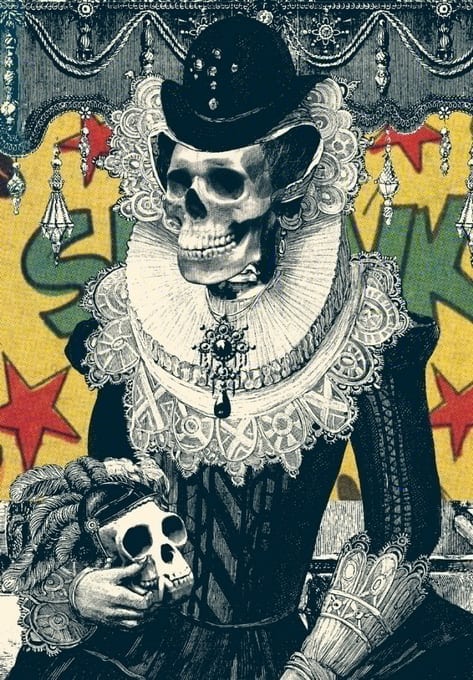
Ali Gulec is a Turkish illustrator and visual artist known for bold, graphic work that combines hand-drawn line, digital composition, and a dark sense of humor. His images often mix clean shapes, layered textures, and surreal or satirical subject matter, making him a recognizable figure in contemporary illustration and poster art.
| Field | Illustration, digital art, poster design |
|---|---|
| Nationality | Turkish |
| Known for | Graphic illustrations with surreal, humorous, and often macabre themes |
| Working methods | Drawing, vector or digital editing, layered collage-like composition |
| Use cases | Editorial illustration, album art, posters, branding, personal art |
What kind of work does Ali Gulec make?
Gulec makes images that sit between illustration, graphic design, and digital art. His work usually starts with a strong central idea: an animal, a face, a skull, a machine, or an unexpected hybrid of these things. He then builds the image with sharp outlines, controlled color, and a composition that reads quickly from a distance but rewards close looking with small details and visual jokes.
That clarity is part of the appeal. Even when the subject turns strange or unsettling, the image remains disciplined. Forms are pared back rather than over-rendered, and the result feels designed as much as drawn. The style suits posters and editorial images, where the main task is to catch attention fast while still carrying an idea.
How does he build an image?
Gulec’s work reflects a process common in contemporary digital illustration: sketch, refine, digitize, and assemble. The visual language often suggests hand drawing first, then digital cleanup and compositing. That approach allows him to keep the energy of line work while controlling contrast, scale, and surface effects in software.
Textures, shadows, and color blocks are used sparingly but deliberately. Rather than burying the image in effects, he tends to isolate a few strong visual moves, such as a pattern, a cutout silhouette, or a surreal insertion into a familiar form. This makes the work feel graphic and reproducible, which is useful in print contexts where illustration has to hold up on posters, covers, and promotional material.
Why does Ali Gulec matter?
Gulec matters because his work shows how illustration can remain expressive while still functioning in a highly designed environment. His images do not treat digital tools as a way to smooth away personality. Instead, they use those tools to sharpen mood, push exaggeration, and stage ideas with precision.
He also belongs to a wider field of illustrators who helped define a post-print, digitally distributed visual culture. In that setting, a memorable image must work across screens, social media, and printed matter. Gulec’s style does that well: it is compact, legible, and distinctive, with enough edge to stand apart from generic commercial artwork.
What does his work look like in practice?
In practice, his images often feature isolated subjects against plain or compressed backgrounds, with bold contours and a limited palette doing much of the structural work. Some pieces lean into black-and-white contrast; others use strong accent colors to direct the eye. The mood can shift from playful to ominous without losing control of the composition.
That visual control is important in illustration. A good image must communicate at a glance, but it also has to sustain repeated viewing. Gulec’s best-known approach relies on a stable graphic grammar: clear silhouette, careful spacing, symbolic detail, and a concept that can be read immediately even when the imagery becomes strange or absurd.
Frequently Asked Questions
Is Ali Gulec primarily an illustrator or a digital artist?
He is best described as an illustrator who works digitally, though the boundary is not strict. His images use illustration’s emphasis on concept, line, and composition, while digital tools support the final construction and finish. In practice, the work sits comfortably across both labels.
What themes appear most often in his work?
His images often return to surreal combinations, dark humor, and stylized figures or creatures. Skulls, animals, masks, and mechanical forms appear in ways that turn ordinary symbols into something more uncanny. That mix gives the work a playful surface and a slightly abrasive edge.
Where is his work typically used?
His illustrations are well suited to editorial, poster, album, and promotional contexts. Those formats reward an image that can communicate instantly and still carry personality after repeated viewing. His style is especially effective where strong graphic presence matters more than realistic depiction.
Articles mentioning Ali Gulec