
Astrophotography is the practice of photographing celestial objects and the night sky, using long exposures, tracking mounts, and sensitive sensors to record stars, planets, nebulae, galaxies, and events such as eclipses or meteor showers. It sits between photography and observational astronomy: the image has to look good, but it also has to hold up as a representation of what was actually in the sky.
Stories from Astrophotography
15 stories


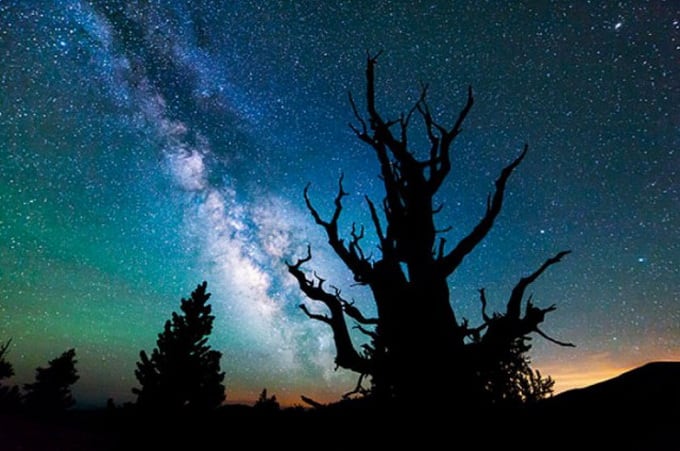


About Astrophotography
- It began with early astronomical experiments in the 1840s and became practical only after lenses, plates, and emulsions improved in the late 19th century.
- Modern astrophotography relies on precise tracking, because the Earth’s rotation will blur stars in seconds or minutes without compensation.
- Different subjects need different setups: wide-field Milky Way images, planetary close-ups, and deep-sky work each use different optics and capture methods.
- Processing is part of the craft. Stacking, calibration frames, and noise reduction often matter as much as the exposure itself.
- Portable smart telescopes and cooled digital cameras have made the field more accessible, but the basic problem remains the same: collecting faint light cleanly.
Read the full overviewHow astrophotography works, What kinds of astrophotography are there?, Why the technology matters, How does astrophotography differ from ordinary night photography?
How astrophotography works
Astrophotography depends on gathering light from objects that are either extremely dim or extremely small in the frame. That usually means a stable tripod or mount, an optical system with a fast aperture or long focal length, and a camera capable of low-noise capture. For deep-sky work, the camera often sits on an equatorial tracking mount that moves at the same rate as the sky, so stars stay fixed during long exposures.
The visual result is rarely a single frame. Most astrophotographers capture many exposures and combine them into a stack to improve signal and suppress noise. Calibration frames such as darks, flats, and bias frames help correct sensor noise, dust shadows, and uneven illumination. In practice, the final image is built as much in software as in the camera.
What kinds of astrophotography are there?
Astrophotography covers several distinct branches. Wide-field landscape astrophotography places the Milky Way, comets, or aurora above foreground terrain and usually uses shorter focal lengths. Deep-sky astrophotography focuses on nebulae, star clusters, and galaxies, often with refractors or reflectors designed for flat fields and precise focus across the sensor. Planetary astrophotography uses high magnification, short exposures, and video capture to freeze atmospheric turbulence, then selects the sharpest frames.
Each branch rewards different equipment choices. A 14mm lens can frame an entire sky scene, while a long-focal-length telescope can show spiral structure in a galaxy or detail in Saturn’s rings. Some systems now combine both roles in one portable package, using dual cameras, onboard stacking, and app-based alignment to reduce the amount of manual setup required.
Why the technology matters
Astrophotography advanced when recording media became more sensitive and more consistent. Early photographic plates made the first permanent records of celestial objects, but they needed long exposures and careful handling. Later, better emulsions, cooled sensors, and motorized mounts made it possible to capture fainter detail and produce repeatable images. The shift from film to digital changed the field again by allowing immediate review, more aggressive post-processing, and far higher ISO performance.
Optical design also matters. Field flatteners, correctors, and well-corrected refractors reduce distortion at the edge of the frame, which is crucial when the subject is a field of pinpoint stars rather than a single centered object. Telescope makers and camera brands now market products specifically around astrophotography because small improvements in focus, tracking, and sensor cooling can decide whether an image is usable at all.
How does astrophotography differ from ordinary night photography?
Ordinary night photography often aims to show a scene lit by available light, street lamps, or moonlight. Astrophotography, by contrast, is built around recording faint celestial signal and preserving star shapes. That means the exposure strategy, focusing method, and equipment choices are all different. A pleasing night landscape can tolerate blur or bright artificial light; a deep-sky image usually cannot.
Color in astrophotography is also partly constructed. Many targets emit light outside the visible range or at wavelengths too weak for the eye to register clearly, so the final image may be stretched and balanced to reveal structure. The result is not a literal snapshot in the everyday sense, but it is not freeform illustration either. Its authority comes from disciplined capture and careful processing.
Frequently Asked Questions
When did astrophotography begin?
The first photograph of an astronomical object was made in 1840, and the practice became far more useful in the late 19th century as photographic materials improved. Early pioneers had to cope with tiny apertures, weak sensitivity, and primitive tracking. Those constraints kept the work experimental for decades.
What equipment is most important?
A stable tracking mount is often the single most important piece of equipment, especially for long exposures. After that come the optical system and the camera sensor, because both determine how much faint detail can be collected. Good software matters too, since stacking and calibration are standard parts of the workflow.
Is astrophotography just about telescopes?
No. Wide-field astrophotography often uses regular lenses, especially fast wide-angle optics for Milky Way scenes. Telescopes become necessary when the subject is small, faint, or far away in the frame, but many of the most recognizable images in the field come from camera-and-lens setups.