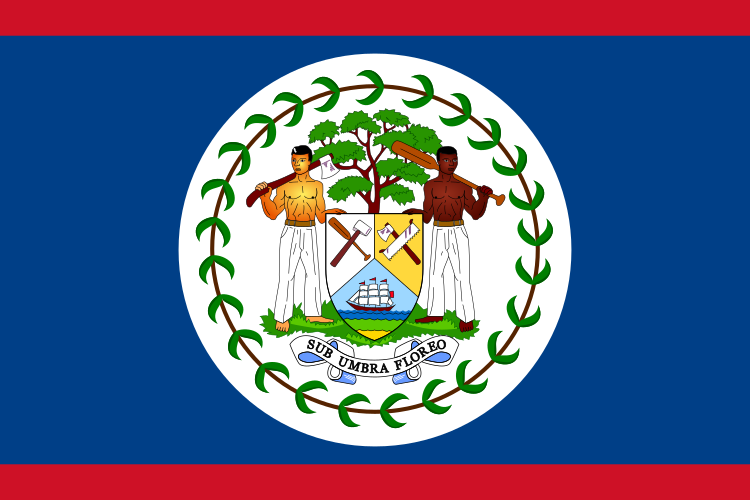
Belize

Belize is a country on the north-eastern coast of Central America, bordered by Mexico to the north, Guatemala to the west and south, and the Caribbean Sea to the east. It has the only official language in mainland Central America that is English, although Belizean Kriol and Spanish are widely spoken. Its small mainland, about 290 km long and 110 km wide, sits beside a long barrier reef system that shapes its economy, landscape, and visual culture.

FactDetail
RegionCentral America, Caribbean coast
CapitalBelmopan
Official languageEnglish
Common spoken languagesBelizean Kriol, Spanish, Maya languages, Garifuna
Neighbouring countriesMexico, Guatemala
Notable landscapeBarrier reef, cayes, tropical forests, wetlands

Where is Belize and what makes it distinct?

Belize is geographically part of Central America, but culturally it also belongs to the Caribbean. That split identity matters in everyday life: the country’s ports, islands, music, food, and language use often feel closer to Caribbean neighbours than to the Spanish-speaking mainland to the west. The presence of English in government, schools, and law also distinguishes Belize from surrounding countries.

The country includes a mainland of forests, lowlands, and river systems, plus more than 400 islands and cayes off the coast. Offshore, the Belize Barrier Reef runs alongside the coastline and forms one of the most recognisable natural features in the region. That reef and the shallow marine environment around it have shaped fishing, tourism, boat building, and the look of coastal settlements.

How did Belize become a country?

Belize’s modern history was shaped by Maya civilisation, British settlement, and colonial administration. Before European arrival, the area formed part of a long-standing Maya world with cities, trade routes, stone architecture, and agricultural systems. British loggers later established themselves on the coast in the 17th century, exploiting logwood and mahogany, and the territory eventually became known as British Honduras.

Belize gained self-government in 1964 and independence in 1981. The colonial past still appears in institutions, legal structures, and the English language, while the population reflects a mix of Maya, Mestizo, Creole, Garifuna, Mennonite, and other communities. That mix gives Belize a layered visual and material culture rather than a single dominant style.

What does Belize look like in practice?

Belize is known less for monumental urban density than for landscape, craft, and coastal life. In towns and villages, timber houses, corrugated metal roofs, painted wood façades, and shaded verandas are common. On the cayes and along the coast, buildings are often raised to deal with flooding, salt air, and storm risk. Bright colour, practical construction, and adaptation to heat and humidity shape the built environment.

Traditional and contemporary craft forms appear across the country. Maya communities continue pottery, weaving, and agriculture-linked making; Garifuna culture carries drumming, basketry, carving, and performance traditions; and local makers work with wood, cane, shell, textile, and recycled materials. Tourism has also encouraged a market for carved masks, painted objects, beadwork, and souvenirs, though much of the strongest work remains tied to local use rather than display.

Why does Belize matter culturally?

Belize matters because it sits at a crossroads of language, ecology, and heritage. Its bilingual and multilingual everyday life gives it a distinct voice in Central America, while its reef and rainforest support forms of making that depend on place: fishing gear, boats, architecture, foodways, and craft objects made from local plant and animal materials. Preservation debates often involve both environment and culture, since loss of habitat can mean loss of livelihood and technique.

For artists, designers, and historians, Belize offers an example of how small-country identity can be built from many sources at once. Colonial architecture, Maya archaeological sites, Caribbean sound, and contemporary tourism all coexist. The result is not a single unified visual language but a set of overlapping ones, each visible in materials, surfaces, and the ways people build, decorate, and use space.

Frequently Asked Questions

Is Belize part of Central America or the Caribbean?

Belize is geographically part of Central America. Culturally and historically, it also has strong Caribbean ties because of its coast, islands, music, languages, and colonial history. Both descriptions are accurate, which is why Belize can feel distinct from nearby Spanish-speaking countries.

What language is spoken in Belize?

English is the official language, a legacy of British colonial rule. In daily life, many people use Belizean Kriol, Spanish, or Maya languages, and Garifuna is also important in some communities. Multilingualism is normal rather than exceptional.

What is Belize best known for?

Belize is best known for the Belize Barrier Reef, its cayes, and its mix of Maya, Creole, Garifuna, Mestizo, and other cultural traditions. It is also known for eco-tourism, archaeological sites, and a built environment adapted to heat, water, and coastal weather. These features make it a place where landscape and culture are closely linked.