
Blu is the pseudonym of an Italian street artist known for large-scale murals, political imagery, and a strict refusal to reveal his real identity. Active since 1999, he works mainly in public space, often using walls as a stage for paintings that combine satire, social critique, and surreal visual invention. He is based in Bologna and has become one of the most influential European muralists of his generation.
Stories from Blu (artist)
10 stories




About Blu (artist)
- Blu is a masked or anonymous practice rather than a public persona, which keeps attention on the work.
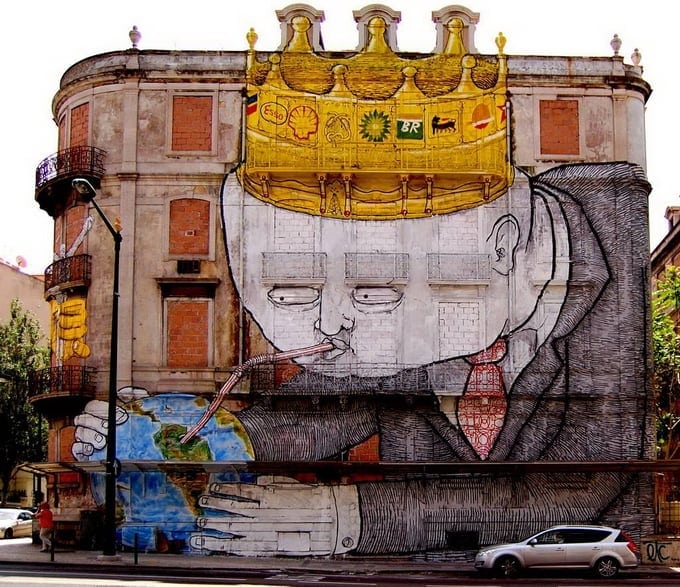
- His best-known pieces are monumental murals painted directly onto buildings and urban infrastructure.
- He often uses bold outlines, flat color, and exaggerated figures to build scenes that read quickly from a distance.
- His subjects frequently address war, money, power, migration, environmental damage, and everyday urban life.
- Because his work is site-specific and exposed to weather, demolition, and overpainting, many murals survive only in documentation.
Read the full overviewWho is Blu?, What does his work look like?, Why did Blu matter to street art?, How does he work in public space?
Who is Blu?
Blu is an Italian muralist and street artist whose name has become a shorthand for ambitious public painting with a sharp political edge. He emerged from the European graffiti and street art scene in the late 1990s, but his work moved beyond tagging and lettering into fully illustrated wall paintings. His pieces usually feature distorted bodies, hybrid creatures, or carefully staged allegories that turn ordinary walls into public narratives.
Keeping his identity private is part of the project. That anonymity fits a practice that treats the city itself as the audience and the wall as the primary medium. Rather than building a studio-facing career around canvases and galleries, Blu works outdoors, where scale, location, and visibility shape the meaning of each piece.
What does his work look like?
Blu’s murals are usually immediate in structure and dense in meaning. He often uses black line, saturated but limited color, and a graphic clarity that allows figures to stand out sharply against brick, concrete, or industrial surfaces. The drawings can look playful at first glance, but the scenes usually carry violence, tension, or absurdity: bodies consumed by machines, figures trapped inside systems, or anonymous crowds pressed into symbolic roles.
He has also used animation, stop-motion, and time-lapse documentation to extend the life of works that are otherwise temporary. That matters because street art exists under pressure from weather, repainting, redevelopment, and municipal removal. In Blu’s case, the loss or alteration of a mural is often part of the artwork’s public afterlife rather than an accident outside it.
Why did Blu matter to street art?
Blu helped define a strand of street art that is more editorial than decorative. His work does not aim mainly to beautify a neighborhood or demonstrate technical bravura, though it often does both. Instead, it uses public scale to push arguments about labor, war, capitalism, authority, and collective life into spaces where people encounter them outside museums and galleries.
He also expanded the visual language of muralism. Many artists in the field rely on highly polished realism or spray-painted lettering; Blu uses a more illustrative mode, closer to political cartooning, poster art, and animation. That gives his walls a distinct rhythm: scenes often unfold in sequences, with figures that repeat, mutate, or collide across a surface.
How does he work in public space?
Blu’s practice depends on scale, access, and often permission that later becomes complicated. Some of his best-known works have covered entire building facades, making the wall part image and part architecture. He has worked in cities across Europe and beyond, and the location usually matters as much as the composition itself. A mural in an industrial district, for example, carries a different meaning from one on a civic building or a gentrifying street.
Because the work is public, it enters debates about ownership almost immediately. A Blu mural can be celebrated as a landmark, removed as graffiti, or erased by redevelopment. That instability is central to the medium. His reputation has grown not only from the images themselves, but also from the public conflicts around them, which have made questions of who controls urban surfaces impossible to ignore.
Frequently Asked Questions
Is Blu the artist’s real name?
No. Blu is a pseudonym, and he has kept his legal identity private throughout his career. The anonymity is not a gimmick so much as a way of keeping the focus on the work and on the walls where it appears.
What materials does Blu use?
He is best known for mural work, so the exact materials vary from site to site. Public pieces may involve paint applied by brush, roller, spray, or a combination of methods, depending on scale and surface. He has also used animation and recorded documentation as part of how the work is shared after it is painted.
Why are some Blu murals no longer visible?
Street art lives in exposed conditions, and large murals are vulnerable to weathering, demolition, and repainting. In Blu’s case, that ephemerality has been especially significant, because some projects have been removed or painted over during disputes about property and control. The disappearance of a mural can become part of the work’s history.