
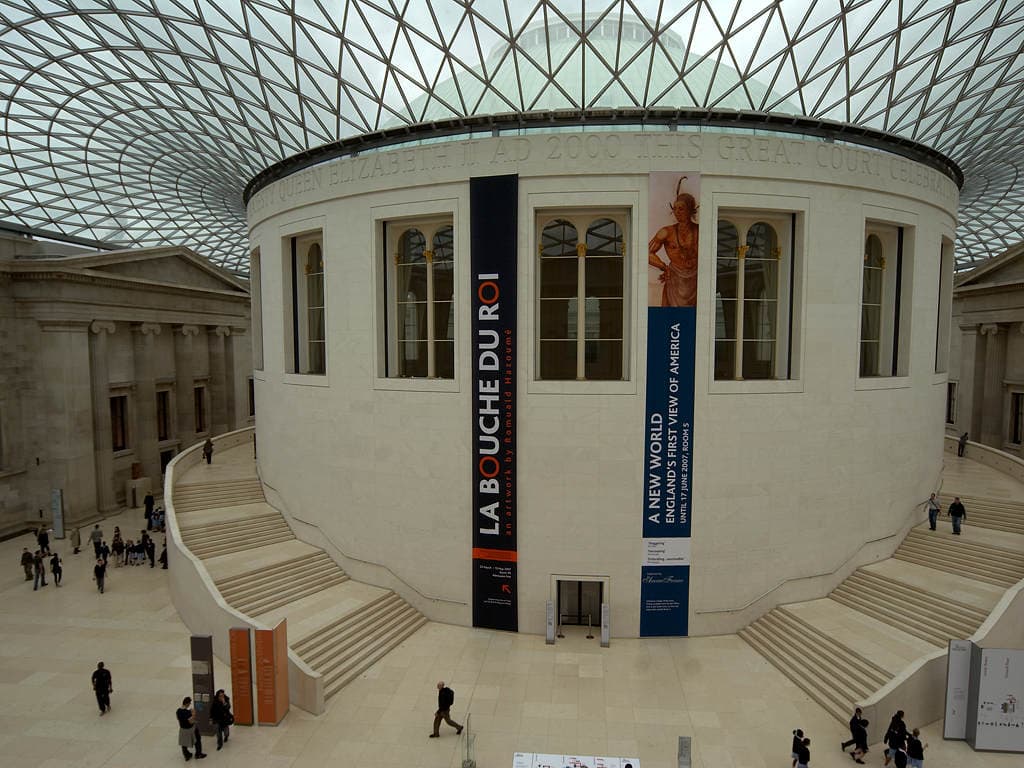
The British Museum Reading Room is a circular library space in the centre of the British Museum’s Great Court in London. It served as the British Library’s main reading room until 1997, and now survives as a preserved historic interior rather than an active research hall.
- Built in the mid-19th century as part of the British Museum’s expansion
- Designed by Sydney Smirke, with a vast domed ceiling and radial plan
- Once functioned as the chief reading room for scholars using the national collections
- Closed as a working library in 1997 when the British Library moved to St Pancras
- Now used for exhibitions and visits inside the museum
Why does the Reading Room matter?
The Reading Room matters because it became one of the most recognisable interiors in British intellectual life. For more than a century, historians, writers, politicians, journalists, and researchers worked under its dome, consulting books and archives in a space that combined ceremony with practical use. Its association with figures such as Karl Marx, Virginia Woolf, and Mahatma Gandhi helped turn it into a symbol of scholarship itself.
Architecturally, the room also marked a shift in how large public knowledge spaces could look. Instead of a long institutional hall, the design used a perfect circle, a central oculus, and a radial system of desks and bookstacks. That layout made supervision easier and gave the room a strong visual identity, which is why it still reads instantly as a library interior even after its original function ended.
How was it designed?
Sydney Smirke designed the Reading Room in the 1850s to solve a practical problem: the British Museum needed a fireproof, light-filled place to store and consult books without risking the collections. The answer was an iron-framed dome inspired partly by the Pantheon in Rome, combined with masonry walls and a carefully engineered internal structure. The dome allowed a large span without interior supports blocking the floor.
The room’s materials and fittings were built for use as much as display. Cast iron, plaster, and painted surfaces created the shell, while the desks, catalogue systems, and shelving once formed a dense working environment at the centre. The plan placed readers around the circumference, with reference material close at hand and staff able to manage access from the middle.
What does it look like in practice?
Seen from inside, the room is dramatic but disciplined. The circular floor, the ring of desks, and the giant ceiling above produce a sense of enclosure rather than grandeur alone. Light falls from the dome and windows in a way that softens the heavy architecture, and the decorative details stay restrained so the room still feels tied to study rather than spectacle.
Today, the Reading Room functions differently, but the interior remains intact enough to communicate its original purpose. Visitors encounter a preserved scholarly environment at the heart of a museum designed for general public access. It now works as a historical object in its own right: a room that once organised research and now explains a past model of public knowledge.
What changed when the British Library moved?
By the late 20th century, the British Library needed more space, better environmental controls, and a building designed for modern archival use. The move to St Pancras in 1997 ended the Reading Room’s role as the library’s central working room. That shift separated the historic interior from the daily demands of handling millions of volumes.
The change also altered how the room is understood. As a library room, it was a place of concentration and administration; as a preserved space, it is an architectural memory of scholarship. It now belongs to the museum’s story of display, conservation, and public access, rather than to the operational history of the national library.
Frequently Asked Questions
Can people still use the British Museum Reading Room for research?
No, it is no longer a working research library. The British Library’s reading and reference functions moved to its St Pancras building in 1997. The room is now preserved within the British Museum and used for public purposes such as exhibitions and visits.
Who designed the Reading Room?
Sydney Smirke designed the Reading Room in the 1850s. He created an innovative circular structure with a dome that solved the problem of covering a large space without internal supports. The design became one of the most distinctive interiors in London.
Why is the Reading Room so famous?
It is famous for both its architecture and its associations with major writers, thinkers, and political figures. The room stood at the centre of British scholarship for generations, which gave it cultural weight beyond its size or ornament. Its preserved state now makes that history visible in a single space.
At a glance
- Address
- Bloomsbury, United Kingdom
- Coordinates
- 51.51942, -0.127075
Articles mentioning British Museum Reading Room
