
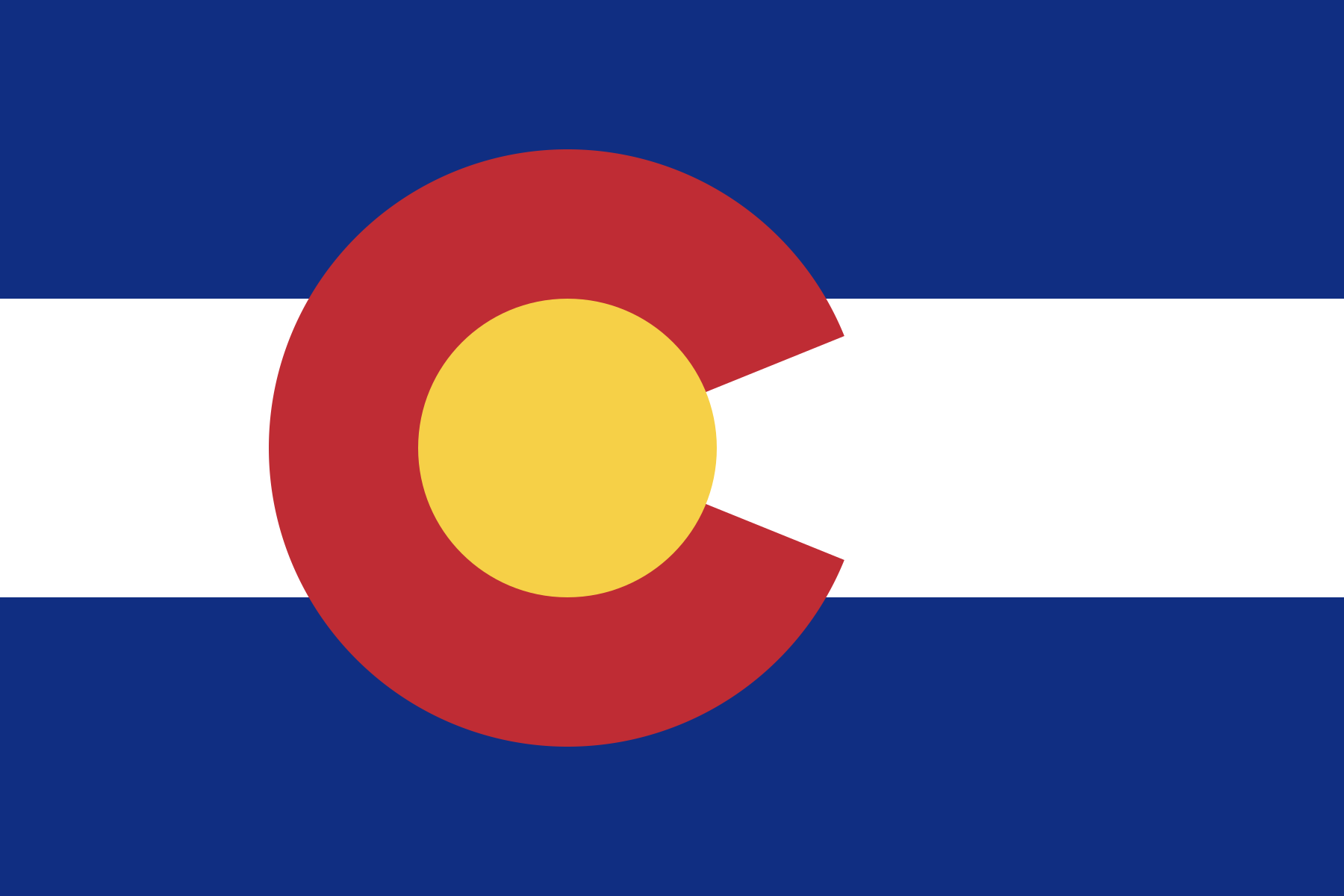
Colorado is a state in the western United States, defined by a high mountain core, a dry plateau to the west, and open plains to the east. It became the 38th U.S. state in 1876 and is known for the Southern Rocky Mountains, the Front Range cities, and a landscape that shifts quickly from alpine terrain to desert-like basins and grassland.
- State in the Mountain West, bordering Wyoming, Nebraska, Kansas, Oklahoma, New Mexico, Utah, and Arizona at the Four Corners.
- Dominated by the Southern Rockies, including many of the state’s highest peaks and ski regions.
- Contains parts of the Colorado Plateau and Great Plains, which gives it unusual geographic variety.
- Home to Denver, Boulder, Colorado Springs, and many mountain towns that shape its cultural image.
- Often appears in visual culture for its light, elevation, outdoor architecture, and landscape-driven design.
What makes Colorado distinct?
Colorado stands out because its geography compresses several different environments into one state. The eastern edge is low, open prairie. Moving west, the land rises into foothills, then into the Rocky Mountains, where roads, houses, studios, and resorts have to respond to steep grades, snow load, thin air, and dramatic seasonal change. Farther west, the land breaks into mesas, canyons, and high desert plateaus.
That range of terrain has a direct effect on how Colorado is built and represented. In architecture, it encourages low-slung plans, large windows, sheltered courtyards, and materials that can handle cold, sun, and snow. In photography and painting, it offers strong contrasts: bright winter light, red rock, deep shadow, and long sightlines. Colorado often reads as a place where landscape is not backdrop but structure.
How did Colorado take shape?
The name Colorado comes from Spanish and means “colored red,” a reference to the reddish silt and rock of the Colorado River region. Long before statehood, the area was home to many Indigenous nations, including the Ute, Arapaho, Cheyenne, Apache, and others. Spanish expeditions, fur trading, mining, railroads, and settlement pushed through the region in the 18th and 19th centuries, especially after the gold rush of 1858 accelerated migration.
Statehood in 1876, during the centennial year of U.S. independence, gave Colorado its common nickname, the “Centennial State.” Mining, ranching, rail infrastructure, and later tourism and defense industries shaped its growth. Today the state combines a strong outdoor economy with major urban centers, universities, and creative communities clustered around Denver, Boulder, and the mountain corridor.
Why does Colorado matter in design and visual culture?
Colorado matters because it offers a clear case of place shaping form. Buildings there often have to work with altitude, harsh winter weather, and high sun. That has encouraged the use of insulated envelopes, exposed structural timber, stone, metal roofing, and deep overhangs. Even contemporary homes and studios that aim for minimalism usually carry traces of the climate in their details: efficient glazing, compact volumes, and materials chosen for endurance.
The state also matters as an image source. Artists and photographers use Colorado for its scale and texture: snowy ridgelines, sandstone formations, ranch land, and aspen groves. Boulder and Denver in particular connect mountain scenery to contemporary art, craft, and design culture. In practice, Colorado often appears as a setting where built form must answer to land rather than compete with it.
What does Colorado look like in practice?
In urban areas such as Denver and Boulder, Colorado’s identity shows up in a mix of modern infill, mountain-modern houses, industrial reuse, and public spaces that emphasize daylight and access to the outdoors. In resort towns and high-country communities, the built environment leans on timber framing, local stone, and steep roofs to manage snow and blend into the setting. On the plains, the architecture is more open and utilitarian, with barns, grain storage, and low-density development.
For makers working in Colorado, the state’s materials and conditions matter as much as its scenery. Clay, wood, wool, hemp, paper, glass, and metal all behave differently in a dry climate with strong UV exposure and large temperature swings. That practical reality helps explain why so much Colorado-made work, from furniture to textile art to experimental sculpture, often stresses structure, craft, and material resilience.
Frequently Asked Questions
Is Colorado part of the West or the Southwest?
Colorado belongs to both the Western United States and, in some classifications, the Southwestern United States. It is also commonly grouped with the Mountain States because the Rockies define much of its geography and culture. These labels overlap rather than cancel each other out.
Why is Colorado so often associated with mountains?
The mountains dominate the state’s western and central regions, including major ranges of the Southern Rocky Mountains. Many of Colorado’s most famous cities, ski areas, and scenic landmarks sit near or within that mountainous zone. As a result, the mountain image has become central to the state’s public identity.
What makes Colorado useful as a setting for creative work?
Colorado offers strong visual contrasts, clear weather, and a landscape that changes quickly over short distances. Those conditions support outdoor photography, landscape painting, site-specific architecture, and material-driven studio work. The state’s mix of urban culture and rugged terrain gives it a wide range of visual references in one place.
}{