
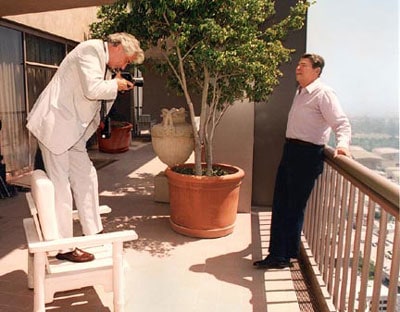
Harry Benson is a Scottish photographer known for candid portraits of celebrities, politicians, and cultural figures, especially photographs made under pressure and in motion. His work appeared in Life, Vanity Fair, People, and The New Yorker, and it helped define a style of access-driven editorial photography that feels immediate rather than posed.
| Born | 1939, Glasgow, Scotland |
|---|---|
| Known for | Photojournalism, celebrity portraiture, magazine assignments |
| Notable subjects | The Beatles, Muhammad Ali, political leaders, film and music stars |
| Signature image | The Beatles in a hotel pillow fight during their first U.S. tour in 1964 |
| Career base | Long association with major American magazines |
Why Harry Benson matters
Benson mattered because he found a way to make high-profile subjects look unguarded without losing composure or clarity. His best pictures are not formal studio portraits, but photographs made in the middle of life: backstage, in hotel rooms, on tour buses, at work, or in the split second after a joke lands. That approach gave magazine photography a looser, more intimate feel while still serving editorial deadlines and publication standards.
He also bridged two worlds that often sit apart: hard-news photojournalism and celebrity portraiture. The same instincts that help a photographer cover a fast-moving event also help capture a famous subject when the mask slips. Benson’s pictures rarely rely on complicated staging. They depend on timing, access, and the ability to read a room quickly.
How did Harry Benson photograph The Beatles?
Benson’s most famous assignment came in 1964, when he was sent to travel with The Beatles on their first American tour. The resulting photographs turned a public relations whirl into memorable visual history. Rather than presenting the band as distant icons, he caught them joking, wrestling, and collapsing into exhaustion, which made them seem both larger than life and recognisably young.
The pillow-fight image became iconic because it condensed the group’s energy into a single frame. It is playful, slightly chaotic, and deeply human. That picture helped shape how later generations imagined the band: not only as musical legends, but as four friends trapped inside fame.
What does his style look like in practice?
Benson often works in close quarters with available light, using the room and the moment instead of elaborate setups. His photographs usually feel direct, sharp, and lightly dramatic. Faces are central, gestures are quick, and the environment is kept legible enough to explain the situation without distracting from the subject.
He is especially effective at catching the instant when performance and private behaviour overlap. A public figure may be smiling for the camera one moment and turning away the next; Benson tends to press into that transition. The result is work that looks effortless but depends on patience, access, and a strong sense of timing.
Why his photographs endure
Benson’s pictures last because they document famous people without flattening them into publicity. His photographs carry social information as well as personality: the hotel rooms, tour schedules, press crowds, and magazine commissions all shape how the subjects appear. He was not simply recording faces; he was recording the machinery around fame.
That combination of intimacy and context gives the work long life in books, retrospectives, and magazine history. Benson’s images still circulate because they show recognizable figures in moments that feel unscripted, even when the assignment itself was highly controlled. That tension is central to their power.
Frequently Asked Questions
Was Harry Benson mainly a portrait photographer or a photojournalist?
He worked across both areas, but his strongest reputation rests on editorial portraiture shaped by photojournalistic instincts. His pictures often begin with access to a person or event, then settle on a revealing moment rather than a stiff pose. That makes his archive useful for both magazine history and visual biography.
What is Harry Benson’s most famous photograph?
The best-known image is the photograph of The Beatles in a pillow fight during their 1964 American tour. It has become one of the enduring visual symbols of Beatlemania because it feels spontaneous and funny while still being tightly composed. The image also shows Benson’s strength: he noticed the moment before it became routine.
What kind of assignment work did Benson do?
He photographed celebrities, political figures, athletes, and cultural events for major magazines. Much of his work involved travel, backstage access, and fast turnaround, which meant responding quickly to changing situations. The assignments demanded both discretion and speed, along with a willingness to work in cramped, improvised spaces.
Articles mentioning Harry Benson
