
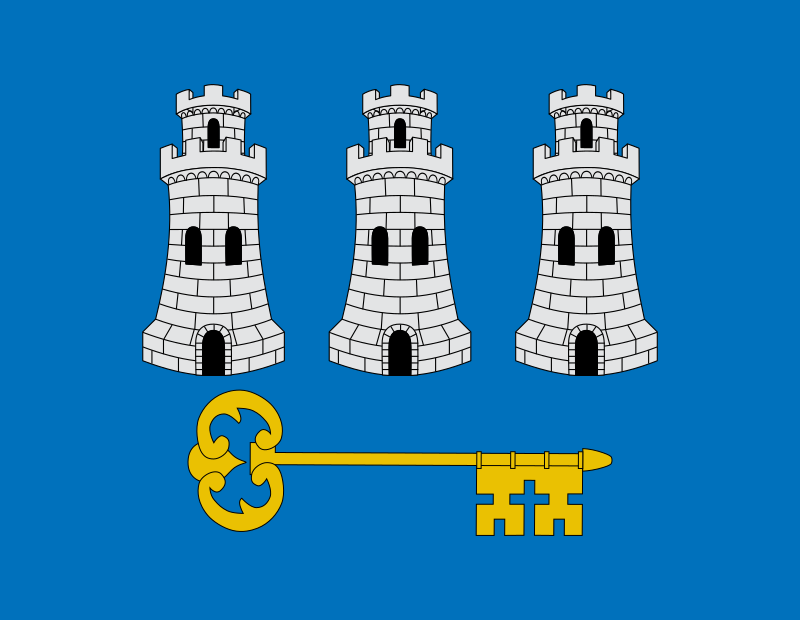
Havana is the capital of Cuba, its largest city, and its main port. It sits on the island’s northwestern coast, where a narrow bay inlet opens into three harbours: Marimelena, Guanabacoa and Atarés. As a city, province, commercial centre and political seat, Havana concentrates administration, shipping, tourism, publishing, music and much of the country’s public life.
- Country: Cuba
- Status: Capital city and province
- Location: Northwestern coast, beside Havana Bay
- Harbours: Marimelena, Guanabacoa, Atarés
- Role: Major port and commercial centre
Why Havana matters
Havana matters because it has long been the point where Cuba meets the wider world. Ships arrived here first, goods moved through its docks, and political power gathered inland from the bay. That mix of trade, administration and coastal settlement gave the city a dense urban form and a public culture that still shapes how Cuba is seen and understood.
For writers, photographers and designers, Havana offers a concentrated visual field. Colonial masonry, narrow streets, balconies, painted facades, sea light, old American cars and dense street life all sit close together. The city’s built environment records several eras at once: Spanish colonial planning, republican-era expansion, revolutionary public symbolism and the patchwork repairs of a place that has been lived in and reused continuously.
What does Havana look like on the ground?
The historic core is best known for its stone forts, plazas and low-rise streets, but Havana is not a single preserved district. It stretches westward and southward from the bay into neighbourhoods of different ages and conditions. Some blocks retain ornate stucco fronts and ironwork balconies; others show cracked plaster, improvised shutters, and concrete additions made to keep older structures usable.
Street life gives the city much of its character. People move between markets, schools, workshops, bus stops and the waterfront, while the architecture frames that movement in strong light and shadow. Colour matters here: painted walls, enamel signs, tile, rusted metal and car paint all form part of the urban palette. For image-makers, Havana often reads as a place where surface carries history in a very direct way.
How did Havana develop?
Havana grew from a strategic harbour settlement into the principal city of Cuba because its location suited maritime control and commerce. The bay offered shelter, while the narrow entrance made it easier to defend. That defensive logic shaped the city’s early military works and port infrastructure, which then encouraged administrative and mercantile growth around the harbour.
Over time, the city expanded beyond the old walls and port edge into a larger metropolitan area. Industrial activity, government offices, housing and cultural institutions spread west and south from the bay. Like many port capitals, Havana developed unevenly: wealth and ceremony gathered in some districts, while labour, congestion and informality shaped others. That unevenness is visible in the fabric of streets, from restored buildings to structures waiting for repair.
Why do photographers keep returning to Havana?
Photographers return to Havana because the city offers strong graphic contrasts and clear signs of lived time. The combination of decayed surfaces, intense daylight, public gatherings and carefully staged civic spaces creates images that feel both immediate and historical. Portraiture also works well here, because Havana’s streets provide expressive backdrops without overwhelming the subject.
In editorial photography, Havana often appears through recurring motifs: pastel walls, old cars, dance, domestic interiors opening onto the street, and the presence of the sea. That visual familiarity can become a trap if it turns the city into a set of clichés. Stronger work stays attentive to material detail: the texture of peeling paint, the repair of a shutter, the wear on a pavement, the way a balcony is used, or how light lands on a façade at midday.
Frequently Asked Questions
Is Havana the same as Old Havana?
No. Old Havana is the historic centre, the oldest part of the city and the area most associated with colonial architecture and formal plazas. Havana as a whole is much larger and includes many districts built or expanded later. The wider city contains residential, commercial and industrial zones far beyond the old core.
Why is Havana so often photographed in colour?
Colour is central to how Havana appears in photographs because the city’s surfaces carry strong pigment and visible wear. Sunlight intensifies painted walls, vehicles, signs and clothing, while age exposes layers beneath the top coat. That makes colour part of the city’s material reality rather than a decorative choice.
What makes Havana important in visual culture?
Havana combines recognisable urban forms with a dense social life, so it gives visual culture a setting that is both specific and immediately legible. Its streets, architecture and public spaces carry clear signs of history, repair and use. That makes it useful for photography, film, illustration and editorial storytelling when the goal is to show how a city looks after decades of change.