
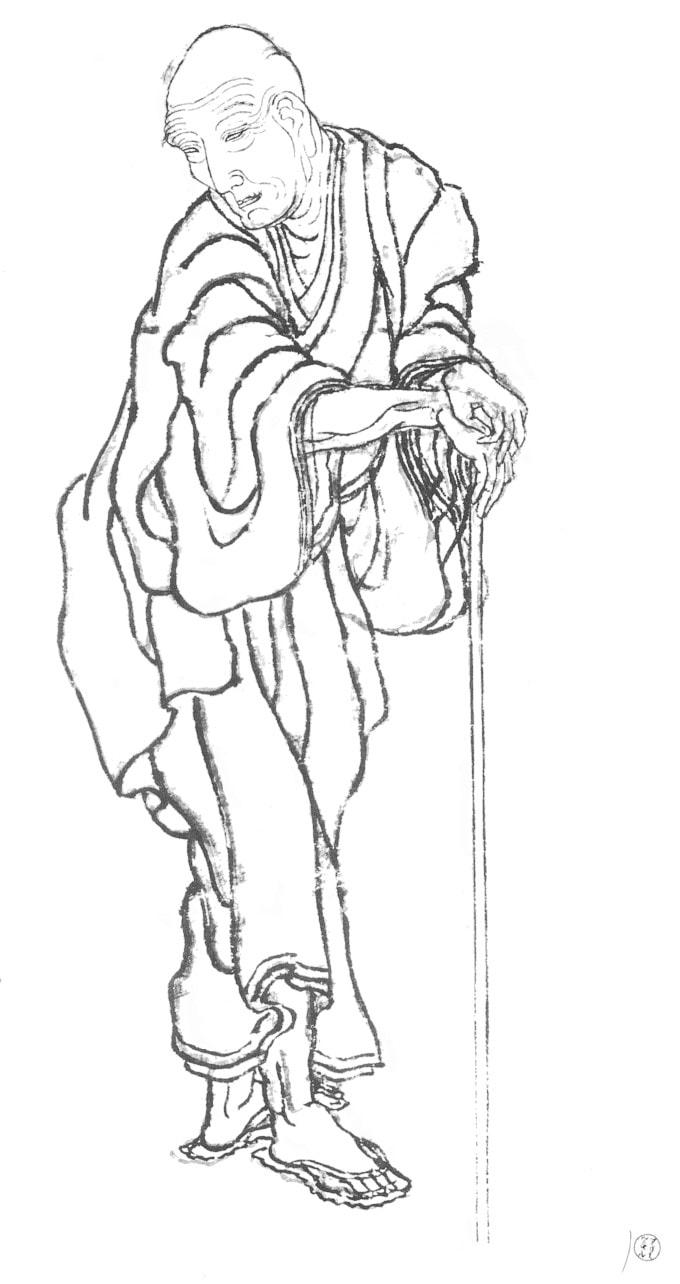
Hokusai was a Japanese ukiyo-e artist who made paintings, book illustrations, and woodblock prints in the late Edo period. Born in Edo, now Tokyo, in 1760, he became one of the best-known printmakers in Japan and later one of the most famous artists in the world. He is most closely associated with Thirty-six Views of Mount Fuji, the landscape series that includes The Great Wave off Kanagawa.
- Hokusai worked across printmaking, painting, and illustrated books.
- He belonged to the ukiyo-e tradition, which relied on collaboration between designer, carver, printer, and publisher.
- His landscapes helped shift ukiyo-e from actor portraits and pleasure-quarter scenes toward nature and travel imagery.
- He drew on Chinese painting and older Japanese methods, especially the brush handling of Sesshū.
- His work became influential in Europe and remains a key image of Japanese visual culture.
What kind of artist was Hokusai?
Hokusai was a designer of images for mass reproduction as well as a painter in his own right. In ukiyo-e, the artist often supplied the drawing, which skilled carvers transferred to woodblocks and printers turned into finished sheets of paper. That process made his work widely available in Edo Japan, where prints could circulate as affordable pictures rather than luxury objects.
He signed work under several names across his career, a common practice among Japanese artists, and changed style repeatedly. Early on he worked in the conventions of actor prints and popular imagery, but he later developed a sharper interest in mountains, rivers, weather, and the movement of the sea. That shift helped define his later reputation.
Why is The Great Wave so important?
The Great Wave off Kanagawa is the most recognisable sheet in Thirty-six Views of Mount Fuji. The composition places a towering wave in the foreground, with Mount Fuji small and still in the distance. The image compresses scale, motion, and distance into a single dramatic scene, using the logic of woodblock printing: crisp outlines, flat areas of colour, and strong pattern.
The print matters because it shows how Japanese landscape imagery could be both visually ambitious and formally restrained. It also travelled unusually far. After Japanese prints reached Europe in the nineteenth century, Hokusai’s work influenced painters, designers, and collectors who admired the clarity of line and the bold cropping. The image later became a general symbol for Japanese art itself, sometimes detached from the broader body of work that made it possible.
How did he make his images?
Hokusai’s work came out of the technical discipline of woodblock printing. He designed compositions that suited carving into cherry wood blocks, then relied on layers of pigment to build colour. That method encouraged decisive contours, controlled pattern, and surfaces that read cleanly at a distance. In the better-known landscapes, imported Prussian blue deepened the sea and sky, giving the prints a stronger, cooler register than earlier colour palettes.
He also drew heavily from older pictorial traditions. Chinese painting influenced his treatment of mountains, mist, and water, while the Japanese brush economy of Sesshū shaped his sense of structure. The result was not a simple blend of East and West, but a precise adaptation of existing visual systems to new subjects: roads, bridges, rainstorms, travelers, and the changing face of Mount Fuji.
How did Hokusai’s reputation grow?
Hokusai was productive, restless, and self-mythologising. He kept revising his style and famously described his life as a long effort toward improvement, which matched the sheer range of surviving work: prints, sketchbooks, illustrations, and paintings. He lived through the late Edo period, when print culture was dense, urban, and highly commercial, so his images were part of everyday visual life rather than isolated museum objects.
His reputation expanded after Japanese art entered European collections in the nineteenth century. Artists associated with Impressionism and related movements took interest in his compositions, while later designers valued his ability to reduce a scene to essential forms. Today he stands not only as an artist of Mount Fuji, but as a maker whose prints show how much invention woodblock technology could carry.
Frequently Asked Questions
Was Hokusai only a printmaker?
No. He worked as a print designer, painter, and illustrator, and he produced large numbers of book images as well as stand-alone sheets. The print work made him famous, but his studio practice was broader than that single medium.
What does “ukiyo-e” mean?
Ukiyo-e refers to pictures of the “floating world,” a term for urban entertainment culture in Edo Japan. The field included actors, courtesans, landscapes, and scenes from popular life. Hokusai helped expand its range by giving landscape and nature a new central place.
Why do so many people know The Great Wave but not other Hokusai prints?
The print combines strong design with an immediately legible subject, so it reproduces well in books, posters, and digital media. It also became a shorthand image for Japanese art in the West. That fame has been useful, but it can hide the wider scope of Hokusai’s career, which included many other remarkable landscapes and book illustrations.
Articles mentioning Hokusai

