
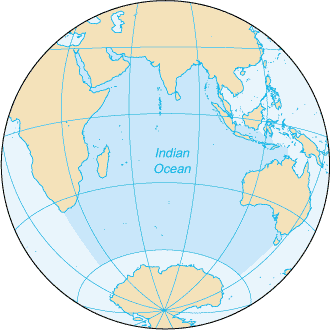
The Indian Ocean is the third-largest ocean on Earth, stretching between Africa, Asia, Australia and the Southern Ocean. It forms a vast maritime corridor for trade, monsoon weather, coastal life and design cultures from East Africa to South Asia, Southeast Asia and western Australia.
- It is named for India, whose coastline forms part of its northern edge.
- Its waters connect major ports, island states and fishing communities across three continents.
- Monsoon winds and seasonal currents have long shaped sailing routes, building practices and material exchange.
- Its coastlines include coral reefs, mangrove systems, tropical deltas and arid shorelines, each supporting distinct forms of architecture and craft.
Where is the Indian Ocean?
The Indian Ocean sits between the Atlantic and Pacific systems, with Africa on the west, Asia on the north and Australia on the east. Its southern boundary is usually given as the Southern Ocean, though older descriptions sometimes extend it to Antarctica. It covers about one-fifth of the Earth’s surface water and includes marginal seas such as the Arabian Sea, Bay of Bengal and Andaman Sea.
That geography matters because the ocean is not only a body of water but also a set of routes, edges and climates. Coastal cities such as Mumbai, Muscat, Colombo, Mombasa, Perth and Jakarta have been shaped by its tides and trade winds, as have smaller harbours, fishing villages and island settlements.
Why does the Indian Ocean matter to design and craft?
The Indian Ocean has carried materials and making knowledge for centuries. Timber, stone, textiles, ceramics, metalwork, spices and later industrial goods moved along its routes, linking makers and markets across widely separated shores. Monsoon navigation made this exchange possible: sailors learned to read seasonal winds, and ports grew around the rhythms of arrival and departure.
Those exchanges left visible traces in buildings and objects. Kerala houses often combine local timber construction, sloped roofs and deep verandas suited to heavy rain. Coastal East African architecture reflects coral stone, lime plaster and Arabic, Indian and local influences. On the islands and peninsulas around the ocean, ventilation, shading, raised floors and weather-resistant finishes are practical responses to heat, salt and humidity.
What does it look like in practice?
In design terms, the Indian Ocean is best understood through material adaptation. Builders use laterite, teak, coral stone, shell lime, bamboo and concrete differently depending on local climate and supply. Interiors often favour cross-ventilation, screened openings, courtyards and shaded thresholds because the air is hot, damp and salt-laden in many coastal zones. Furniture and products made for this region often need to be mobile, modular or resistant to corrosion and mould.
The ocean also appears as an aesthetic reference. In architecture and interiors, its presence is often expressed through light, water, horizon lines and cool, reflective surfaces. In many coastal projects, designers borrow from the colours and textures of the sea without literal nautical decoration. The result can be quiet and restrained: polished stone, limewashed walls, woven fibres, timber grain and openings that frame views of water, rain or sky.
How has the Indian Ocean shaped everyday life?
For centuries, the Indian Ocean has organised work as much as style. Fishing, pearl diving, salt production, boat building, port labour and textile manufacture all depend on its coastal ecologies and exchange networks. Seasonal weather still affects the timing of travel, supply chains and construction. Even now, a storm over the western Indian Ocean or a dust event off western Australia can alter transport, visibility and local life far inland.
Its significance is also cultural. The ocean connects languages, religions and foodways across a broad rim of settlements. That mixture appears in domestic interiors, market architecture, temple and mosque forms, and in the circulation of objects made for travel rather than permanence. In FreeYork terms, the Indian Ocean is a place where climate, materials and movement are inseparable.
Frequently Asked Questions
Is the Indian Ocean bigger than the Atlantic or Pacific?
No. It is the third-largest ocean, after the Pacific and the Atlantic. It still covers a huge area and includes some of the world’s most important sea lanes.
Why is it called the Indian Ocean?
The ocean takes its name from India, which forms part of its northern coastline and sat at the centre of many early maritime routes. European cartographers and navigators helped fix the name in global usage, but the water had long connected communities around the rim of Asia and Africa.
Why do architects and designers mention the Indian Ocean?
They often use it as shorthand for climate, coastal setting and regional exchange. The phrase can point to monsoon conditions, materials that withstand humidity and salt, and design languages shaped by trade across the ocean’s shores. In practice, it signals a context where water is both a resource and a constraint.