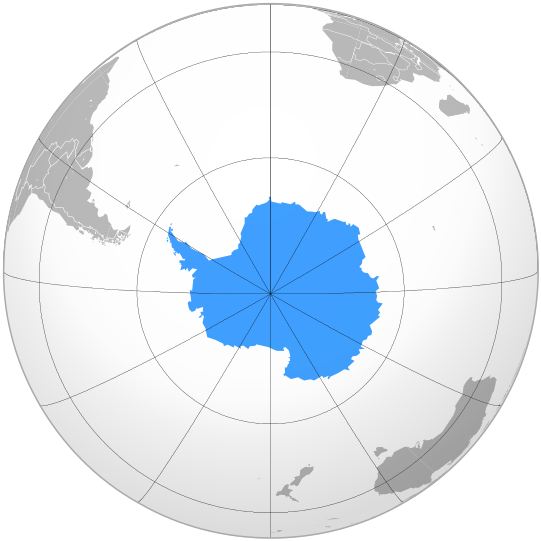
Antarctica is Earth’s southernmost continent, a vast landmass centered on the South Pole and surrounded by the Southern Ocean. It is the fifth-largest continent by area, almost entirely south of the Antarctic Circle, and covered mostly by ice that can reach several kilometres in thickness. That ice shapes the continent’s appearance, climate, ecology, and human use: Antarctica is less a settled land than a frozen field for science, exploration, and image-making.
- Antarctica is a continent, not just an ice sheet, although ice dominates its surface.
- It holds the geographic South Pole and lies mostly within the Antarctic Circle.
- The continent has no permanent civilian population and no sovereign nation.
- Its physical character is defined by extreme cold, wind, seasonal darkness, and a highly reflective ice cover.
- Artists, photographers, and designers often use Antarctica as shorthand for scale, isolation, and climate change.
What makes Antarctica different from other continents?
Antarctica stands apart from other places on the map because its ground is hidden under ice. The continent contains about 90 percent of the world’s ice and most of its fresh water. In many areas the surface is not bare rock but compacted snow, ice shelves that extend over the sea, and blue ice fields where ancient ice is compressed and exposed by wind.
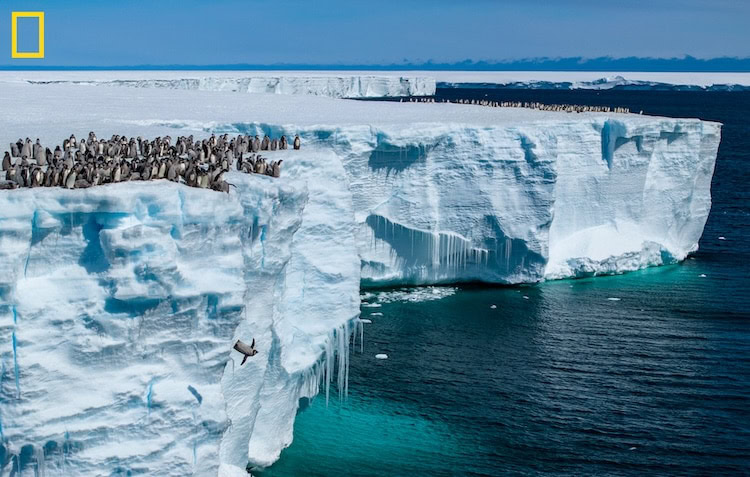
This frozen surface gives Antarctica a visual identity that is instantly recognisable in photographs and film: white plateaus, cracked sea ice, floating bergs, and mountain peaks called nunataks that rise above the ice cap. The continent’s harsh conditions limit vegetation to tiny mosses, lichens, and algae in a few coastal zones. Most of the animal life depends on the surrounding ocean, especially krill, which supports penguins, seals, whales, and seabirds.
How did Antarctica become known?
Antarctica entered European maps slowly, through speculation, sightings of ice-bound waters, and 19th-century exploration. Sailors and scientists had long imagined a southern land to balance the continents of the north. The first confirmed sightings came in the early 1800s, and the interior remained largely unknown until the Heroic Age of Antarctic Exploration in the late 19th and early 20th centuries.
That era produced some of the continent’s most enduring images: sledging parties, canvas tents, frozen shipwrecks, and expeditions led by figures such as Robert Falcon Scott, Ernest Shackleton, and Roald Amundsen. Their journeys helped establish Antarctica as a place of scientific ambition and human endurance. Later, aerial survey, satellite imaging, and field stations turned it into a continent studied from the air, from orbit, and from temporary research camps rather than permanent cities.
Why does Antarctica matter today?
Antarctica matters because it regulates global climate and sea level. The ice sheet stores water that, if lost, would raise oceans dramatically. Its snow and ice reflect sunlight back into space, helping cool the planet. Changes in Antarctic sea ice, glaciers, and ice shelves now serve as visible signs of warming, and the continent has become a critical site for climate research.
It also matters politically. The Antarctic Treaty System, beginning in 1959, set the continent aside for peaceful use and scientific cooperation. No country owns Antarctica outright under that agreement, and military activity, mining, and nuclear testing are barred. In practice, national research stations from many countries mark a presence on the continent, each built for extreme weather, logistics, and self-sufficiency rather than permanent settlement.
What does Antarctica look like in practice?
In visual culture, Antarctica usually appears through its materials: blue ice, wind-scoured snow, black volcanic rock, rusted expedition equipment, metal field stations, and the hard geometry of containers, skis, tracks, and survey gear. The blue color often seen in ice photographs comes from dense ice that absorbs red light and scatters blue. That effect is strongest in crevasses, icebergs, and freshly broken blocks of glacial ice.
Antarctica also shapes making and survival. Buildings must be prefabricated, insulated, and easy to transport. Vehicles need wide tracks or skis to move across snow without sinking. Clothing systems rely on layered synthetic and wool garments, sealed seams, and face protection against windburn and frostbite. In design terms, the continent is a test of minimal material use, thermal efficiency, and reliability under pressure.
Frequently Asked Questions
Is Antarctica a desert?
Yes. Antarctica counts as a desert because it receives very little precipitation, even though it is covered in ice and snow. The interior is among the driest places on Earth. Cold air holds little moisture, so snowfall is sparse and evaporation is low.
Does anyone live in Antarctica?
No one lives there permanently in the way people live in towns or cities. Around a few thousand people stay on the continent at research stations during summer, and fewer remain through winter. These stations support scientists, engineers, cooks, medics, and logistics crews, all on temporary postings.
Why is Antarctica so important in photography and art?
Antarctica offers extreme contrast: white expanses, dark water, saturated blue ice, and sharply defined shadows. That visual clarity makes it useful for photographs about climate, isolation, scale, and survival. It also reads as a place where human technology looks fragile beside the weather and the ice.
At a glance
- Address
- Antarctic Treaty area
- Coordinates
- -90, 0
Articles mentioning Antarctica