
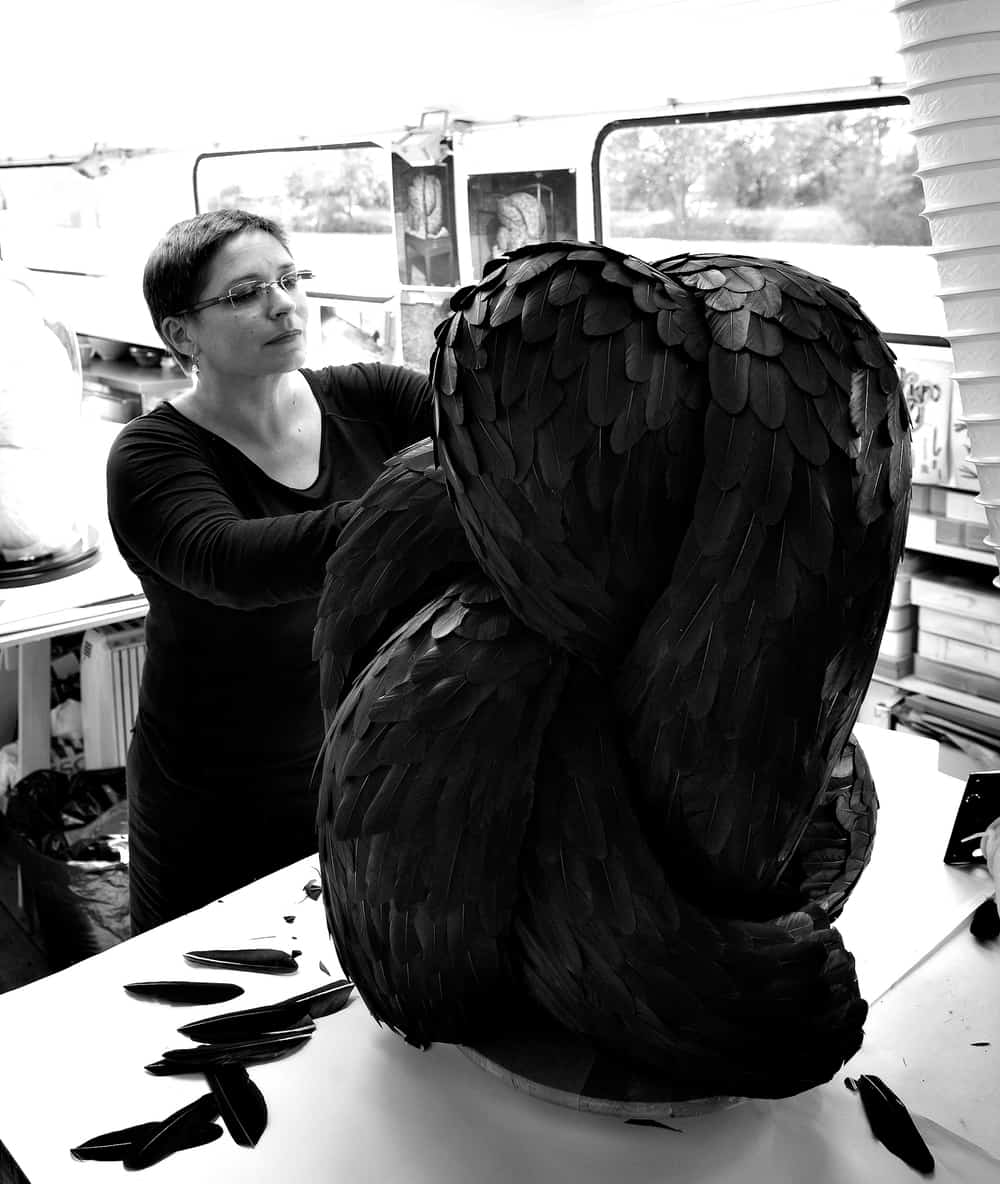
Kate MccGwire is a British sculptor known for large-scale works made from bird feathers and other natural materials, arranged into coils, skins, ripples, and looping forms that feel both seductive and unsettling. Her practice turns close observation of the natural world into sculpture, using repetition, texture, and careful hand assembly to explore attraction and repulsion, softness and violence, order and excess.
- She works mainly with bird feathers, often collected from natural molts, and composes them into dense, patterned surfaces.
- Her sculptures are typically abstract but bodily, suggesting serpents, organs, pelts, or currents rather than literal birds.
- Duality is central to her work: beauty and decay, fragility and strength, nature and artifice.
- Her background in the Norfolk Broads shaped her long interest in birds, wetlands, and animal life.
- She studied at the Royal College of Art and has shown internationally in museums and galleries.
What does Kate MccGwire make?
MccGwire makes sculptural objects and installations built from thousands of natural elements, especially feathers. The material is crucial: feathers carry associations of birds, flight, plumage, and ritual display, but in her hands they become something more ambiguous. She arranges them into tightly controlled surfaces that can resemble flowing membranes, draped fabric, or scales, depending on the form.
The work depends on tension. Up close, the viewer sees minute repetition, color variation, and the labor of assembly. From a distance, those individual parts merge into a smooth or sinuous mass. That shift between fragment and whole is one of the main effects of her sculpture.
Where did her practice come from?
MccGwire grew up in the Norfolk Broads, a landscape of waterways, reed beds, and birdlife in eastern England. That environment gave her an early familiarity with avian forms and with nature as something observed closely rather than romanticized. Birds became a lasting reference point, not as decorative motifs but as a source of material and conceptual direction.
She went on to study at the Royal College of Art, graduating in 2004. Since then, her work has appeared in major venues including the Saatchi Gallery in London, the Museum of Art and Design in New York, and the Musée de la Chasse et de la Nature in Paris. More recently, she has shown at Glasstress, an official collateral event of the Venice Biennale, which placed her work in a setting where material experimentation and sculptural illusion are especially valued.
Why does her work matter?
MccGwire’s sculpture matters because it gives natural material a sharply contemporary role without turning it into simple eco-art. The feathers are not presented as raw nature untouched by culture. They are cut, sorted, pinned, layered, and made to behave like a crafted skin. That process makes the work feel both handmade and strangely alive.
Her sculptures also stand out for how they handle visual pleasure. Feather surfaces can be lush and inviting, but MccGwire uses them to produce unease as well. The forms often feel serpentine, constricting, or anatomical, so the viewer is pulled between admiration for the craftsmanship and a more unsettled bodily response. That friction gives the work its charge.
How are her feather sculptures made?
The making is painstaking. Feathers must be selected for size, color, and curvature, then fixed in dense sequences so the surface reads as continuous rather than pieced together. The process is closer to slow construction than expressive brushwork: the final effect depends on exact placement and patient repetition.
This method gives her sculptures their distinctive finish. Instead of visible joins or rough edges, the material often appears to flow. The hand remains present, but indirectly, through accumulation and discipline. That is part of why the work can resemble both a natural growth and an engineered object.
Frequently Asked Questions
Is Kate MccGwire a figurative sculptor?
Not usually. Her work is mostly abstract, though it often hints at bodies, animals, or anatomical forms. The suggestion of snakes, skins, or internal organs comes from shape and surface rather than from literal depiction.
Why does she use feathers instead of other materials?
Feathers carry a strong visual and symbolic charge. They are light, precise, and closely tied to birds, but they also behave like a modular building material when repeated at scale. That makes them useful for exploring contrast: delicacy and density, softness and menace, natural origin and constructed form.
What should be noticed first when seeing her work?
Scale and surface usually register first, followed by the labor hidden inside the surface. The work often shifts when seen from different distances, revealing that the apparently smooth mass is built from many small parts. That transformation is central to how the sculpture holds attention.
Articles mentioning Kate MccGwire


