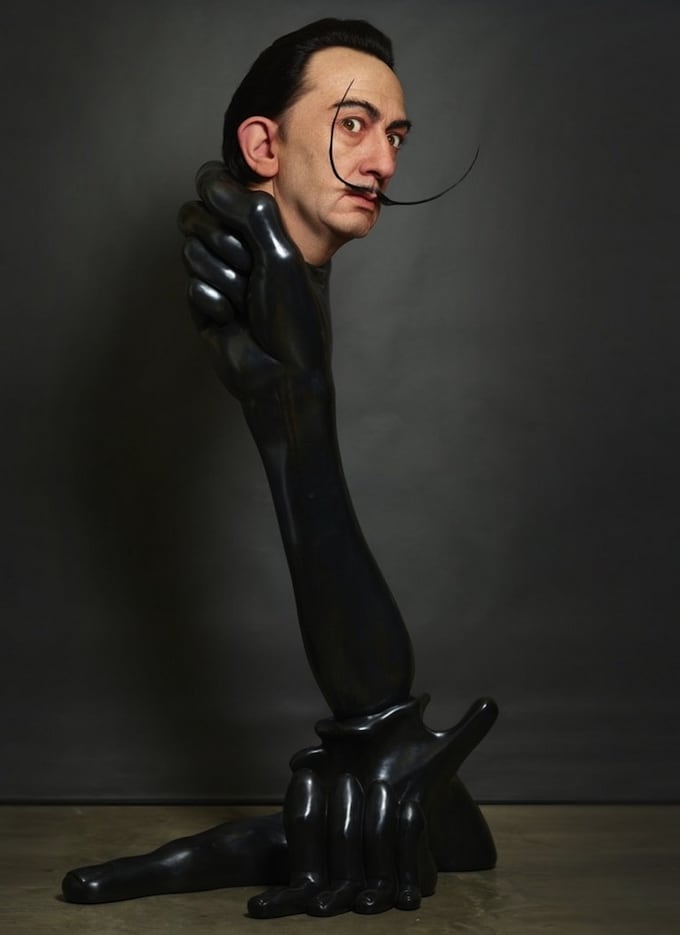
Kazuhiro Tsuji is a Japanese-born American sculptor known for monumental hyperrealist portraits built in resin, platinum silicone, and other detailed casting materials. He spent 25 years in Hollywood as a special effects makeup artist before turning full time to fine art in 2012, where he became known for sculptures that mimic skin, hair, bone structure, and minute facial asymmetry at roughly twice life size.
| Fact | Detail |
|---|---|
| Born | Japan |
| Based in | Los Angeles, California |
| Known for | Hyperrealist portrait sculpture |
| Former work | Special effects makeup artist |
| Main materials | Resin, platinum silicone, pigments, hair, and mixed armature materials |
| Scale | Often about two times life-size |
From film makeup to fine art sculpture
Tsuji’s career began in the practical, collaborative world of film makeup effects, where the goal is to make bodies and faces read convincingly on camera. That background matters because hyperrealist sculpture depends on the same skills: close observation, anatomical accuracy, layering of skin tones, and a sharp sense of how light hits surfaces. The difference is that the finished work is not meant to disappear into a movie scene. It is the scene.
His move into sculpture in 2012 was not a change of technique so much as a change of purpose. Instead of creating prosthetics and creatures that serve a story, he began making autonomous portraits with their own presence. The shift gave him room to slow down, enlarge details, and push illusion farther than film usually allows.
What does his work look like?
Tsuji’s sculptures are portraits that can read from across a room as living people. At close range, they reveal uncanny specifics: pores, wrinkles, veins, eyelashes, beard stubble, and the soft transitions around eyes and mouths that make a face feel inhabited. The works are often scaled larger than life, which intensifies the scrutiny and makes every detail feel exposed.
He typically builds the work through modeling, mold-making, casting, painting, and the insertion of individual materials such as hair and other lifelike finishes. Platinum silicone is especially important because it can imitate the translucency and elasticity of skin better than many rigid sculptural media. Resin and internal support structures give the portraits stability, while paint layers and surface treatment supply the final illusion.
Why does Kazuhiro Tsuji matter?
Tsuji sits at a point where cinema craft, portrait tradition, and contemporary sculpture meet. His work shows that the skills often treated as “effects” can stand as fine art when they are directed toward sustained looking rather than narrative illusion. In that sense, he helped widen the space for materials associated with special effects to be taken seriously in gallery and museum contexts.
He also helped define a current wave of hyperreal portrait sculpture that treats likeness as both technical and psychological. The work is not only about copying a face. It is about making viewers confront scale, aging, identity, and the uneasy gap between a manufactured object and a living body.
How is hyperrealism built in practice?
Hyperrealist sculpture usually begins with a sitter, a reference photograph, or a carefully constructed composite. The artist studies anatomy in detail, then models the head or body in clay or another workable medium before making molds and casting the final surfaces. The process often involves a division of labor between structural engineering, surface detailing, coloration, and hair insertion.
Tsuji’s practice uses this workflow but pushes it toward portrait specificity. The finish is never generic. Skin tones are built up in layers, details are corrected by eye, and the final surface must hold up under close inspection without collapsing into stagecraft. The result is technically exact and emotionally uneasy, which is a large part of its impact.
Frequently Asked Questions
Is Kazuhiro Tsuji still working in special effects?
No, his main focus shifted to fine art sculpture in 2012. His background in special effects remains visible in his methods, but the finished works are intended as independent sculptures rather than film props or makeup appliances. That history is part of what makes his portraits so convincing.
Why does he use platinum silicone?
Platinum silicone has a softness and translucency that resembles human skin more closely than many harder materials. It can hold fine detail while still feeling organic at the surface. For hyperrealism, that combination is crucial because the illusion depends on both precision and a believable physical presence.
Are his sculptures meant to look exactly like real people?
They are meant to appear startlingly real, but exact imitation is not the only goal. Scale, expression, and surface detail are used to heighten the psychological effect of the portrait. The viewer is left balancing recognition with the awareness that the face is manufactured.
Articles mentioning Kazuhiro Tsuji