
Kehinde Wiley is an American portrait painter known for large, highly naturalistic paintings that place contemporary Black and brown subjects in the poses and settings of European court portraiture. Born in 1977 and based in New York, he built a career by combining academic painting techniques with references to hip-hop, fashion, and art history.
Kehinde Wiley on FreeYork
 28 Artists Transform Obama’s $850M Chicago Center with Bold Vision and Community Spaces
 What 7 travel posters would look like if they were designed by famous artists
 Photographer Brad Ogbonna Captures The True Colour and Spirit Of Cuba
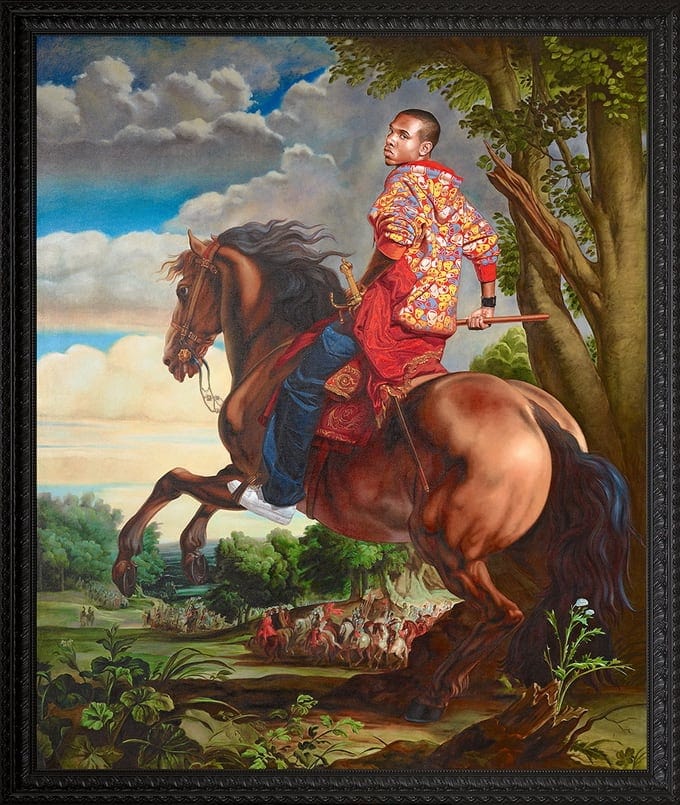 Kehinde Wiley Blends Hip-Hop With Renaissance To Make Beautiful Art
How does Kehinde Wiley work?
Wiley usually begins with photographs of his sitters, then translates them into oil paintings with smooth flesh tones, sharp facial detail, and elaborate patterned backgrounds. The figures are often shown in poses borrowed from Titian, Ingres, Velázquez, or other European painters, but the clothing is streetwear, sportswear, or other contemporary dress. That collision is the point: the old visual language of power stays recognisable, but the subject changes.
His canvases are large and polished, with a sheen that echoes museum portraiture. Flowers, leaves, and ornament can swallow the figure’s edges, turning the background into a dense decorative field. The result feels ceremonial rather than documentary, even when the sitter is drawn from everyday life.
Why is he important?
Wiley became widely known for asking who gets represented as noble, central, and memorable in painting. Traditional Western portraiture gave that status to rulers, patrons, and aristocrats; Wiley puts contemporary Black subjects in those same visual slots. The work is not simply symbolic. It depends on precise drafting, careful colour control, and a command of composition strong enough to make the joke, the critique, and the beauty all land at once.
His work also helped make figurative painting feel newly public again. Museums, fashion brands, and civic commissions have all used his imagery because it reads quickly and carries strong social meaning. That visibility has made him one of the most recognisable painters of the 21st century.
What does his art look like in practice?
A typical Wiley painting shows a lone sitter in a relaxed but stately pose, sometimes seated, sometimes reclining, sometimes astride a horse or surrounded by foliage. The figure may wear a hoodie, tracksuit, or tailored suit, but the body is rendered with the gravity of an emperor or saint. The background often looks like a wallpaper pattern pushed to the edge of abstraction.
He has also worked beyond the easel, including monumental public portraits and large commissions. His portrait of Barack Obama for the Smithsonian’s National Portrait Gallery brought his approach into a mainstream political setting: a realistic likeness, formal innovation, and a pointed revision of how authority is pictured.
What makes his style recognisable?
Three things stand out: the scale, the surface, and the substitution. The scale makes ordinary people look monumental. The surface is smooth and exact, avoiding the roughness often associated with expressive figurative painting. The substitution places present-day Black culture into compositions historically reserved for Europe’s elite.
That approach can look glamorous at first glance, but it also carries pressure. Wiley’s paintings do not hide their sources; they quote them openly. The work asks why certain bodies have been framed as universal subjects of art while others were treated as marginal, exotic, or invisible.
Questions
Is Kehinde Wiley a realist painter?
Yes, but only in a limited sense. His figures are often highly realistic, especially in the face and body, but the overall effect is constructed and art historical rather than observational. The realism serves a larger compositional idea.
Why do Wiley’s paintings use older European poses?
He borrows those poses because they already carry ideas about rank, beauty, and legitimacy. Reusing them lets him place new subjects inside a visual tradition that once excluded them. The borrowings also make his references legible to viewers familiar with Western art history.
What media does he usually use?
Oil paint is central to his practice. He also relies on photography for source material and on decorative patterning that is often built by hand rather than digitally printed. The finished paintings keep the marks of careful studio fabrication even when they look effortless.