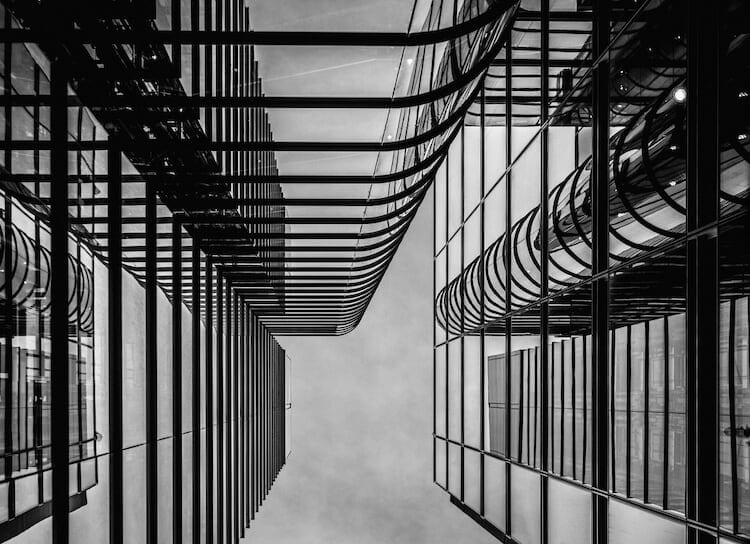
Nicolas Lescot is a photographer whose work focuses on architecture, urban form, and the graphic effects of light and shadow. He is best known here for black-and-white images that treat buildings as surfaces, volumes, and rhythms rather than as neutral records of place.
| Field | Photography |
|---|---|
| Known for | Architectural and urban photography in black and white |
| Medium | Digital or film photography presented as monochrome prints and published images |
| Subject matter | Buildings, facades, streets, and the visual structure of cities |
| Style | High-contrast, detail-conscious, formally composed |
What Nicolas Lescot photographs
Lescot’s name appears in connection with images of London architecture, which places him in the long tradition of photographers who use the city as a study in line, mass, and texture. Architectural photography can serve documentation, but it can also isolate specific visual qualities: a repeated window pattern, a hard edge against the sky, or the way a facade catches low light. Lescot’s work sits closer to the second approach.
Black and white matters here because it strips away the distraction of color and pushes attention toward structure. Brick, stone, glass, concrete, and metal each read differently once hue is removed. A photograph of a building can then become a record of proportion and surface rather than a simple likeness of the structure.
Why black-and-white architecture photography matters
Architectural photography has always depended on technical control. The photographer chooses viewpoint, focal length, time of day, and exposure to manage perspective and shadow. In monochrome, those decisions become even more visible because tonal contrast replaces color as the main organizer of the image. A bright facade can flatten or flare; a deep shadow can carve out a volume or turn a passage into a void.
Lescot’s work matters because it shows how contemporary cities can still be pictured with restraint. Instead of crowding the frame with traffic or people, this kind of photography often gives buildings room to speak through geometry. It can make familiar streets look newly designed, and it can reveal that urban identity is built from repeating materials and carefully managed surfaces as much as from landmark forms.
How his images work in practice
Architectural photographs of this kind usually depend on precise framing. Vertical lines are kept as straight as possible, and compositions often favor symmetry, repetition, or sharp diagonal interruption. That approach suits modern and postwar architecture especially well, since those buildings often emphasize grids, planar facades, and exposed structural logic. It can also make older streets feel abstract, as cornices, windows, and rooflines start to read like pattern.
In practice, the craft involves attention to weather, contrast, and print quality. Soft overcast light can flatten a facade into a clean tonal field, while hard sunlight can throw strong shadows that sharpen the image. In publication, the final black-and-white rendering controls how the viewer reads the building’s material character: polished metal may gleam, rough masonry may absorb light, and glass may disappear or reflect the city around it.
Where Nicolas Lescot fits in photography
Lescot belongs to a wider line of photographers who treat architecture as a subject for formal description. The tradition includes documentary photographers, modernist image-makers, and contemporary artists working between editorial, commercial, and fine-art contexts. What ties them together is a belief that buildings are not just backgrounds for life but designed objects worthy of close visual analysis.
That makes Lescot relevant to readers interested in how cities are seen and edited. His images do not simply show architecture; they interpret it through monochrome, composition, and selective emphasis. In that sense, his work is part of the making of visual culture as much as the recording of it.
Frequently Asked Questions
Is Nicolas Lescot an architectural photographer?
Yes. The available context places him in architectural photography, especially through black-and-white images of London buildings. That means his work is centered on built form rather than portraits, events, or reportage.
Why does black and white suit architecture so well?
Black and white removes the competing information of color and makes shape, surface, and contrast easier to read. Buildings often depend on these elements for their visual character, so monochrome can clarify rather than simplify. It also highlights how light falls across materials such as stone, brick, glass, and concrete.
What should be noticed in photographs like his?
Composition, shadow, and surface detail matter most. Repeated windows, strong verticals, and the balance between bright planes and dark recesses often carry the image. Those features show how photography can turn a building into an orderly visual structure rather than just a location.
Articles mentioning Nicolas Lescot